System bus (CAN) with Servo PLC & Drive PLC
System blocks
6.1 CAN1_IO (9300 Servo PLC)
6-5
L
PLC-Systembus EN 1.1
Process data telegram
The process data telegram consists of an
identifier
and 8 bytes of user data.
11-bit 8-byte user data
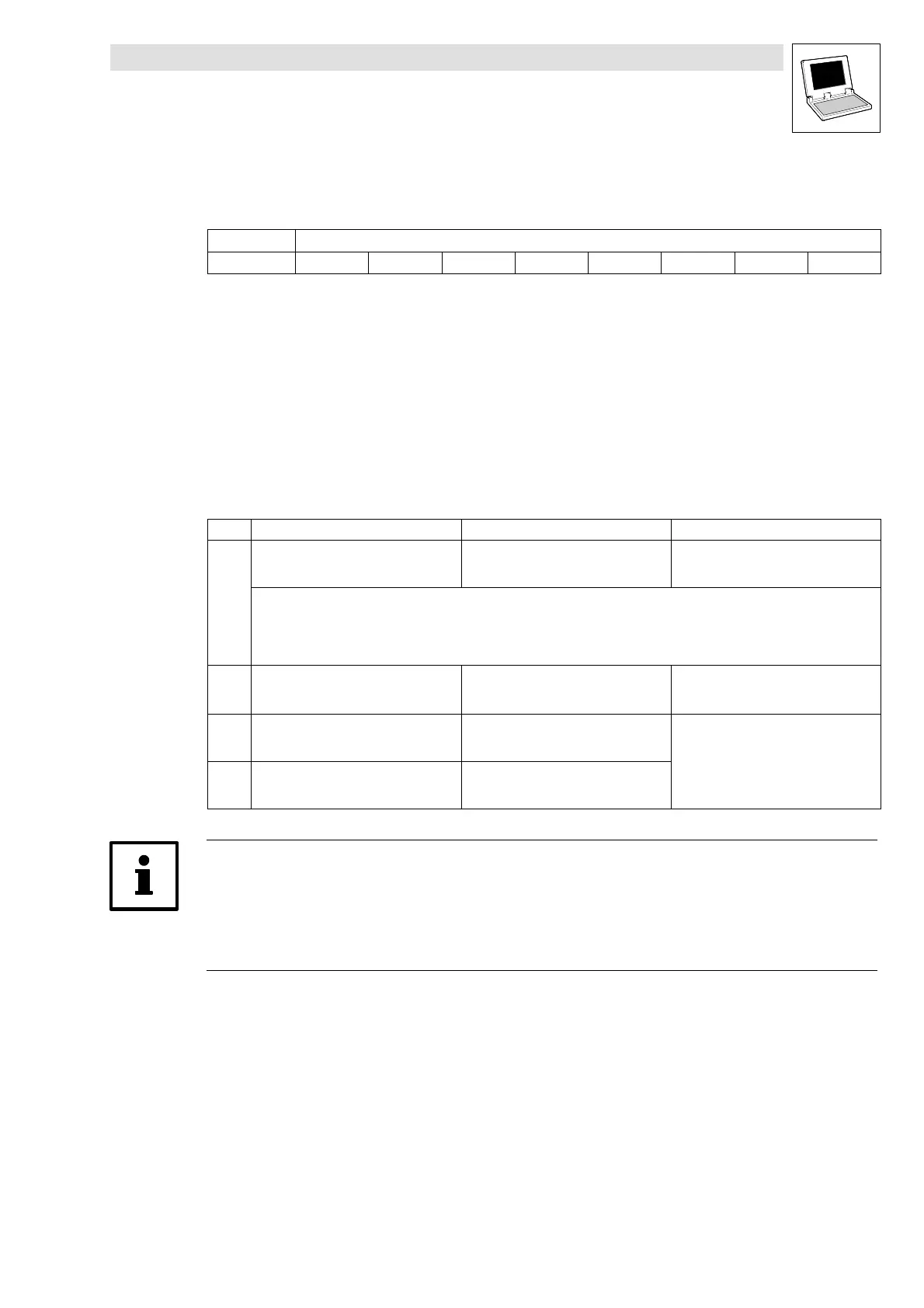
Identifier Byte 1 Byte 2 Byte 3 Byte 4 Byte 5 Byte 6 Byte 7 Byte 8
Identifier
Information about the identifier can be found in chapter 2.3.1.
(^ 2-2)
User data
The 8 bytes of user data to be transmitted can be written by several variables of different data types
at the same time. This allows the PLC to transmit data - as required - as:
• binary information (1-bit)
• status word quasi-analog value (16-bit)
• phase-angle information (32-bit)
Byte Variable (1-bit) Variable (16 -bit) Variable (32 -bit)
1, 2
CAN1_wDctrlStat
Note:
Bytes 1 and 2 can be used to transmit the status word for the DCTRL SB.
• To do this, connect the variable DCTRL_wStat of the DCTRL SB with the variable CAN1_wDctrlStat.
• In addition to signals such as IMP and CINH, the status word of the DCTRL SB contai ns some freely a ssignable signals that can be
written via the variables DCTRL_bStateB.._b of the DCTRL SB.
3, 4
CAN1_nOutW1_a
5, 6 CAN1_bFDO 0 _b
...
CAN1_bFDO 15 _b
CAN1_nOutW2_a
7, 8 CAN1_bFDO 16 _b
...
CAN1_bFDO 31 _b
CAN1_nOutW3_a
C
N1_dnOu
D1
p
Tip!
Make sure that a byte to be transmitted is not at the same time written by different variable types to
ensure data consistency.
• For writing bytes 5 and 6, either use only the variable
CAN1_dnOutD1_p
, only the variable
CAN1_nOutW2_a
or only the variables
CAN1_bFDO0_b
...
CAN1_bFDO15_b
.



 To Next Page