196
4-3. Operating the lights and wipers
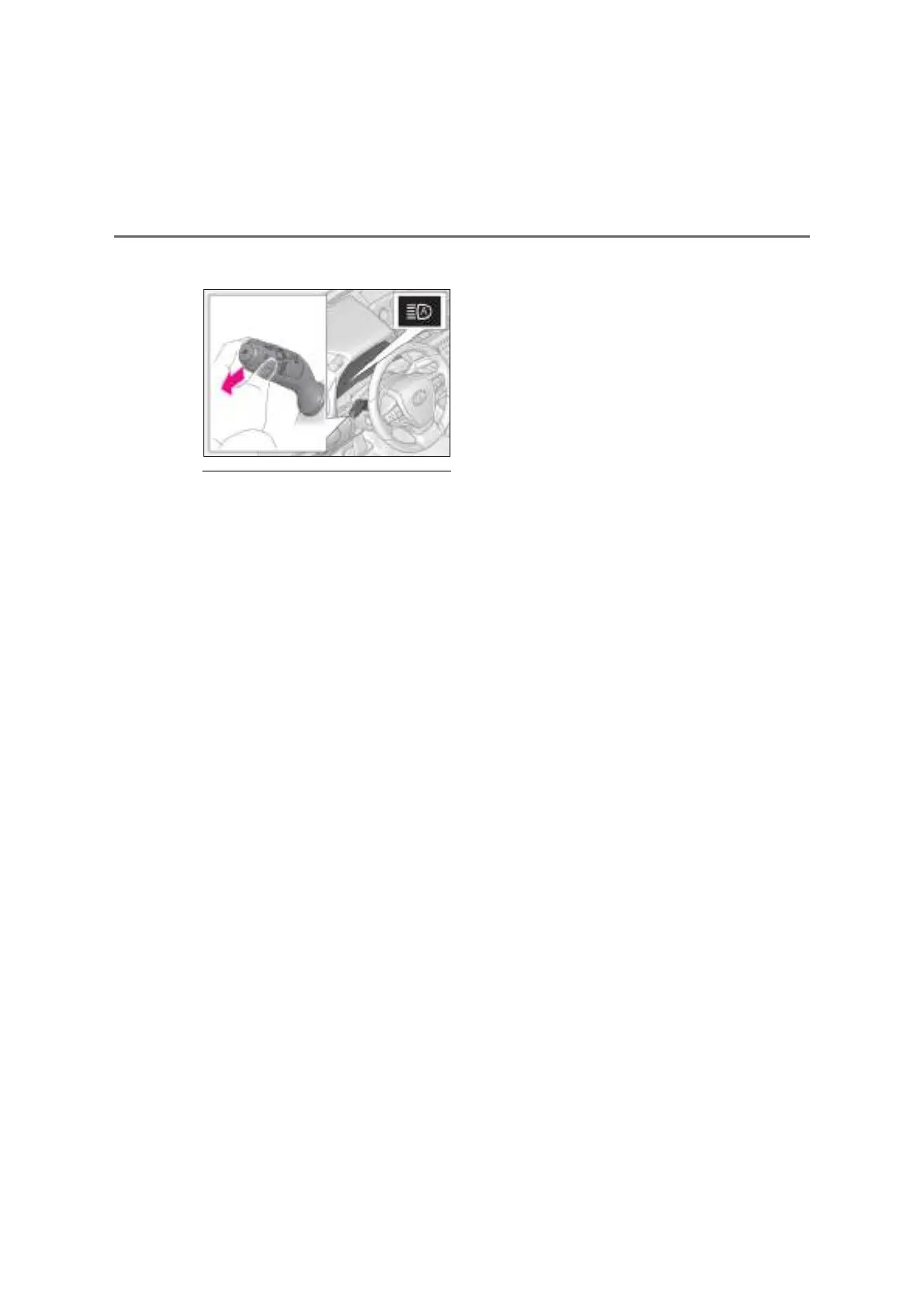
The AHS indicator will come on when the
system is operating.
■ Conditions in which the light distribu-
tion control of the headlights changes
automatically
● When all of the following conditions are
met, the high beams will be turned on
automatically and the system will operate:
• The vehicle speed is approximately 15
km/h (10 mph) or more.
*
• The area ahead of the vehicle is dark.
*
: When the vehicle speed is approximately
30 km/h (19 mph) or more, the area in
the direction that the vehicle is turning
will be illuminated more brightly than
other areas while driving on a curve.
● When all of the following conditions are
met, the shaded high beams will turn on
and the distance that the low beams are
projected will be adjusted automatically,
depending on the location of vehicles
ahead:
• The vehicle speed is approximately 15
km/h (10 mph) or more.
• The area ahead of the vehicle is dark.
• There are vehicles ahead with headlights
or tail lights turned on.
● If any of the following conditions are met,
the high beams or shaded high beams will
be changed to the low beams automati-
cally:
• The vehicle speed is below approxi-
mately 15 km/h (10 mph).
• The area ahead of the vehicle is not dark.
• There are many vehicles ahead.
• Vehicles ahead are moving quickly and
the high beams may blind the drivers of
the other vehicles.
● When the vehicle speed is between
approximately 3 and 15 km/h (1.9 and 9.3
mph), the cornering lights will turn on.
■ Camera sensor detection information
● The high beams may not be automatically
changed to the shaded high beams in the
following situations:
• When vehicles ahead suddenly appear
from a curve
• When the vehicle is cut in front of by
another vehicle
• When vehicles ahead are hidden from
sight due to repeated curves, road divid-
ers or roadside trees
• When vehicles ahead appear from the
faraway lane on wide road
• When vehicles ahead have no lights
● The high beams may be changed to the
shaded high beams if a vehicle ahead that
is using fog lights without its headlights
turned on is detected.
● House lights, street lights, traffic signals,
and illuminated billboards or signs and
other reflective objects may cause the
high beams to change to the shaded high
beams, cause the high beams not to
change to the shaded high beams, or
change the area that is not illuminated.
● The following factors may affect the
amount of time taken to turn the high
beam on or off, or the speed by which the
areas not illuminated change:
• The brightness of headlights, fog lights,
and tail lights of vehicles ahead
• The movement and direction of vehicles
ahead
• When a vehicle ahead only has opera-
tional lights on one side
• When a vehicle ahead is a two-wheeled
vehicle
• The condition of the road (gradient,
curve, condition of the road surface etc.)
• The number of passengers and amount of
luggage
● The light distribution control of the head-
lights may change unexpectedly.
● Bicycles or similar objects may not be
detected.



 To Next Page