303
4
4-5. Using the driving support systems
Driving
● Vehicles which suddenly accelerate or
decelerate near your vehicle
● Guardrails, walls, signs, parked vehicles
and similar stationary objects
*
● Small motorcycles, bicycles, pedestrians,
etc.
*
● Vehicles moving away from your vehicle
● Vehicles approaching from the parking
spaces next to your vehicle
*
● Objects which are extremely close to a
radar sensor
*
● Vehicles are approaching from the right
or left at the rear of the vehicle at a travel-
ing speed of less than approximately 8
km/h (5 mph)
● Vehicles which are approaching from the
right or left at the rear of the vehicle at a
traveling speed of more than approxi-
mately 24 km/h (15 mph)
*
: Depending on the conditions, detection
of a vehicle and/or object may occur.
■ RCTA buzzer
Regardless of whether the RCTA function is
enabled or not (P.282), if the Parking
Support Brake function is enabled
(P.289) and brake control is performed,
a buzzer will sound to notify the driver.
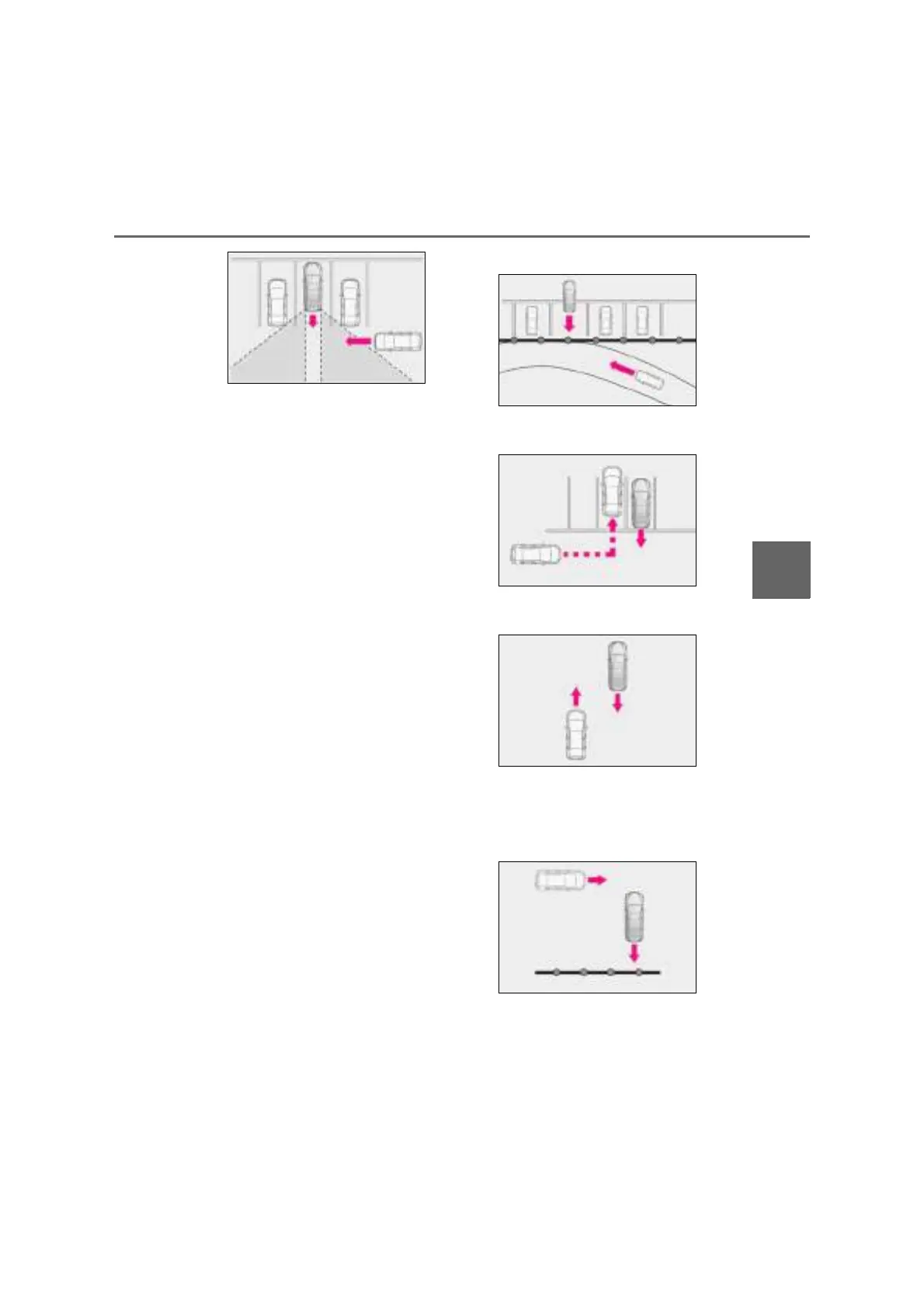
■ Situations in which the system may
operate even though there is no possi-
bility of a collision
In some situations such as the following, the
Parking Support Brake function (rear-
crossing vehicles) may operate even
though there is no possibility of a collision.
● When the parking space faces a street
and vehicles are being driven on the
street
● When a detected vehicle turns while
approaching the vehicle
● When a vehicle passes by the side of your
vehicle
● When the distance between your vehicle
and metal objects, such as a guardrail,
wall, sign, or parked vehicle, which may
reflect electrical waves toward the rear of
the vehicle, is short
● When there are spinning objects near
your vehicle such as the fan of an air con-
ditioning unit
● When water is splashed or sprayed


 To Next Page
 Loading...