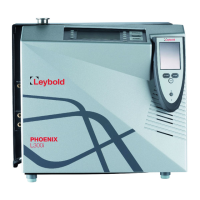
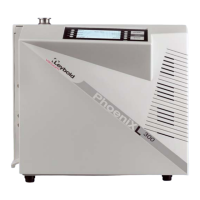
1.1 General Information
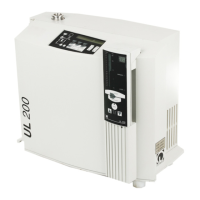
The UL 200 helium leak detector is supplied
ready for operation. Even so, we recommend
that you carefully read the Operating Instruc-
tions and the Technical Handbook so as to
ensure optimum operating conditions right
from the start.
This handbook contains important information on func-
tions, installation, start-up and operation of the UL 200.
Unpack the UL 200 helium leak detector immediately
after it has been received even if it is to be put into ope-
ration at some later date.
Examine the shipping container for any external dama-
ge.
Completely remove all packaging materials.
Note
Retain the shipping container and the packaging materi-
als in the event of possible complaints concerning any
damages.
Check that the UL 200 helium leak detector is complete
(see Section 1.4) and Carefully subject to a visual ins-
pection.
If any damage is discovered please immediately inform
the forwarding agent and the insurers. If it is required to
exchange the damaged part please contact our orders
department.
1.1.1 Purpose
The ULTRATEST UL 200 is a helium leak detector. This
instrument may be used to localise and quantify leaks in
test samples.
- when these have been evacuated first and are sprayed
with helium on the outside. For this it is required that a
vacuum connection is provided between the UL 200
and the test sample.
- In the case of small test samples, these may be eva-
cuated by the UL 200 alone (vacuum method); in the
case of larger volumes, the test samples must be eva-
cuated together with a further pump system (partial
flow vacuum method).
- when there is present in the test samples a helium
overpressure and when the test sample is searched
from the outside with a sniffer probe (sniffer method).
Caution The UL 200 must not be operated while
standing in water or when exposed to
drip water. The same applies to all other
kinds of liquids.
Caution Avoid contact of the UL 200 with bases,
acids and solvents as well as exposure
to extreme climatic conditions.
1.2 Technical Data
1.2.1 Physical Data
Operation of the UL 200 helium leak detector is - as a
rule - based on the counterflow principle.
Lowest detectable helium leak rate
Vacuum mode ≤ 5·10
-11
mbar·l·s
-1
Sniffer mode ≤ 1·10
-7
mbar·l·s
-1
Greatest helium leak rate which can be displayed
0.1 mbar·l·s
-1
Measurement range 9 decades
Detectable masses 2, 3 and 4
Mass spectrometer 180 ° sector field
Ion source 2 cathodes; iridium / yttrium
Max. inlet pressure (in measurement mode) 3 mbar
Equipment-specific processing time
time constant of the leak rate signal
(blanked off, 63 % of the final value) < 1 s
Pumping speed at the inlet S ≥ 1 l·s
-1
FINE
S ≥ 0.6 l·s
-1
GROSS
Temperature coefficient ≤ 1 % / °C (10 to 40 °C)
Test port DN 25 KF
Time until ready for operation < 3 minutes
1.2.2 Electrical Data
Mains voltage (fixed) 100 V ± 10 %; 50 / 60 Hz
110 - 120 V ± 10 %; 60 Hz
220 - 240 / 230 V ± 10 %; 50 / 60 Hz
Power consumption ≤ 350 W
Type of protection IP 30
Mains cord 2.5 m
3
TH 10.211/8.02 - 12/97
1 Description


 To Next Page