3.5 Forevacuum connection
The high vacuum pressure level which can be achieved is a function of the
volume of gas flow Q to be pumped and the forevacuum pressure.
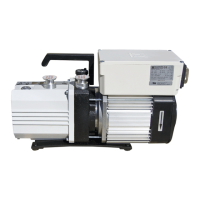
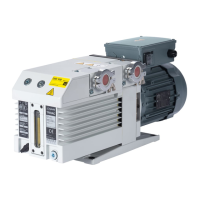
We recommend using TRIVAC rotary vane pumps for this purpose.
Connect the clean forevacuum line. The connecting flanges must be clean
and undamaged. The cross section of this line must be so wide that safe
opera tion of the pump can be ensured.
The forevacuum line must be tight. Hazardous gases can escape at leaks
or the gases being pumped can react with air or humidity.
Observe Safety Information 0.4.5.
Fig. 3.7 is a schematic diagram of a pump system incorporating a turbomo-
lecular pump and a TRIVAC forevacuum pump with an anti-suckback valve.
A separate safety valve must be provided for oil-sealed forevacuum pumps
without an anti-suckback valve. The safety valve prevents oil flowing back
from the forevacuum pump into the turbomolecular pump when the system is
not running.
To ensure that the forevacuum space at the turbomolecular pump is kept
largely free of oil vapors during operation, as well, we recommend installing
an adsorption trap in the forevacuum line. Alternatively purge the forevacuum
line with inert gas. In this case the pressure in the forevacuum line must be
over 10
-2
mbar.
Provide a roughing line to achieve the shortest cycle times.
Ensure that the pump is sufficiently isolated against vibrations generated by
the forevacuum pump.
No forces from the piping system may be allowed to affect the turbomolecu-
lar pump. Support the piping correspondingly or decouple through flexible
joints.
Forevacuum pump
DANGER
Safety valve
Adsorption trap



 To Next Page
 Loading...