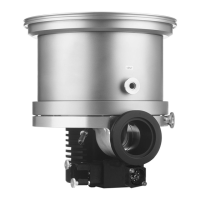
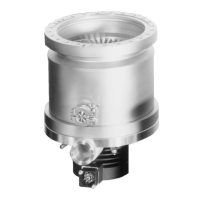
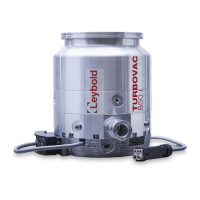
3.4 Attach the pump to the vacuum chamber
Never touch the rotor. Touching the rotor may cause injury and damage the
rotor bearing.
The high vacuum flange must be solidly mounted to the vacuum chamber.
Observe Safety Information 0.1.6.
Remove the transport seal from the intake flange and remove the desiccant.
Pay attention to maximum cleanliness when connecting.
In the case of a sudden rotor vane rupture or rotor-stator contact which may
occur in practice (caused, for example, by solid objects from the process
chamber entering the pump through the high vacuum flange), the decelera-
tion momentum needs to be absorbed by the system.
Deceleration Deceleration
TURBOVAC torque [Nm] TURBOVAC torque [Nm]
600 C 2300
151/151 C 220 1000 C 2900
361/361 C 1500 1100 C 2000
In most applications the pump is flanged to the high-vacuum flange at the
apparatus. The pump can be mounted and operated in any desired attitude.
No support is required.
Use exclusively flange connecting components and fittings which have been
manufactured in accordance with DIN 28403, DIN 28404, ISO 1609 (KF- and
ISO-K flange connections) or ISO 3669 (CF flange connections).
The flange material to which the pump is bolted, must have at operating tem-
perature a minimum strength specification of 150 N/mm
2
.
Operation with vibration absorber
The pump is precision balanced and is generally operated without a reson-
ance damper. To decouple extremely sensitive equipment and to prevent
transfer of external vibrations to the pump a special resonance damper is
available for mounting at the high-vacuum flange.
In this case mount the turbomolecular pump separately. A vibration absorber
cannot reliably sustain the high deceleration torque in case of a rotor seizure.
If additional mounting is not possible, then the pump must be protected by a
suitable shield during operation.
NOTICE
WARNING
Torque when the
rotor seizes



 To Next Page
 Loading...