14: Control Keyboard 1 Select control location /
define locks
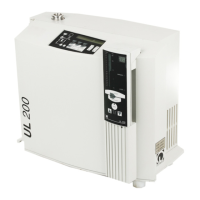
The UL 200 may be controlled from 3 locations. Here it
is possible to define which location is to control the
UL 200.
Keyboard: The UL 200 is controlled by the hand unit
(Fig. 4) and the control panel (Fig. 5).
Access to the keyboard can be restricted
in two levels.
Keyboard 1: The keyboard is fully operational. No
restrictions for the hand unit or the control
panel.
Keyboard 2: The CAL push-button (4/9) is locked. No
changes can be made in the basic menu.
Access to the extended menu as well as
changes to the service menu are only pos-
sible after entering the passwords once
more.
Keyboard 3: The push-button CAL, MANUAL and
ZERO are locked. No changes can be
made in the basic menu. Access to the
extended menu as well as changes to the
service menu can then only be made by
entering the passwords once more. The
UL 200 can only be controlled via the
push-buttons START / STOP / VENT and
volume control.
RS 232: A computer which is connected to SERIAL
(2/10) socket controls the UL 200. All fun-
ction keys on the hand unit and the control
panel are locked. No changes can be
made in the menus.
Ext. Inputs: The UL 200 is controlled via the CON-
TROL connections (3/12) Start, Stop and
Zero. See Chapter 2.6.
The starting process is initiated by a rising
edge at the corresponding input.
When a positive rising edge is applied to
the STOP input, the measurement is stop-
ped or an error is acknowledged.
Venting occurs when a logic level of „1“ is
applied to the STOP input for a period of
time which exceeds the time defined in
menu item 22. In the same way as for the
ZERO push-button (5/1) a constant back-
ground coming from the test sample may
be suppressed via the CONTROL connec-
tion. When applying a logic signal 1 (high),
the current leak rate is reset to Zero (sup-
pression of the external helium backgro-
und). When applying a logic signal 0 (low)
(or when the ZERO input is left unused)
the entire measurement signal will be dis-
played.
15:RS 232 Baud rate 9600
Parameter setting for the
SERIAL connection (3/10)
(refer also to the descripti-
on for the interface
SB 10.211).
16: Relay Mode 1 Definition of the function
output
The function of the relay changeover contacts 11, 12, 13
or 14, 15 and 16 of the plug CONTROL (3/12) can be set
by modifying the relay mode. 3 modes are available:
Mode 1: Contacts 14, 15, 16 generate a ready signal
Mode 2: Contacts 14, 15, 16 generate a fail signal
Mode 3: Contacts 14, 15, 16 generate a ready signal
Contacts 11, 12, 13 generate a fail signal
Note
In mode 3 the treshold value 3 is not available (see
Chapter 2.5.4) the corresponding LED (4/4) is not con-
trolled.
Instrument mode Contact status / linked contacts
Mode 1 and Mode 2: Fail
3: Ready (Mode 3: Fail)
————————————————————————–
UL 200 switched off inactive/Pin 14 and 16 inactive/Pin 14 and 16
closed (11 and 13) closed
UL 200 switched on inactive/ Pin 14 and 16 active / Pin 14 and 15
closed (11 and 12) closed
Standby inactive/ Pin 14 and 16 active / Pin 14 and 15
closed (11 and 12) closed
EVAC inactive/ Pin 14 and 16 active / Pin 14 and 15
closed (11 and 12) closed
Measurement mode active / Pin 14 and 15 active / Pin 14 and 15
closed (11 and 12) closed
Inlet vented, VENT inactive/ Pin 14 and 16 active / Pin 14 and 15
closed (11 and 12) closed
Calibration inactive/ Pin 14 and 16 active / Pin 14 and 15
closed (11 and 12) closed
Fault condition inactive/ Pin 14 and 16 inactive/Pin 14 and 16
closed (11 and 13) closed
SERVICE (default) inactive/ Pin 14 and 16 active / Pin 14 and 15
closed (11 and 12) closed
18: Alarm Trigger off Select acoustic warning
The loudspeaker can output a signal which depends on
the operating mode as described in the following.
off: The frequency of the acoustic output responds in
the same way as the reading on the bargraph dis-
play (5/4). In this mode the presence of a leak can
be localized very well without being able to see the
UL 200 or the hand unit. The sound covers a range
of appr. 300 Hz (underflow (5/5) indicator active) to
appr. 3000 Hz (overflow indicator (5/7) active).When
the reading on the bargraph (5/4) moves from the
lower decade to the upper decade, a signal of
f = 900 Hz is generated.
20
TH 10.211/8.02 - 12/97



 To Next Page