1.4 Technical Description
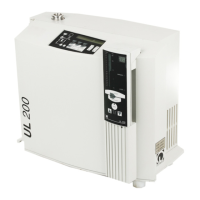
The UL 200 is capable of detecting and quantifying heli-
um test gas flowing into a test sample having a leak by
means of a selective mass spectrometer. Its operation is
based on the counter flow principle, i.e. inflowing helium
diffuses against the gas flow being pumped by the tur-
bomolecular pump into the mass spectrometer whereas
heavier gases, water vapour in particular, are held back.
A cold trap using liquid nitrogen is thus not required.
The ULTRATEST UL 200 is composed of the following
principal subassemblies:
- a 180 ° magnetic sector field mass spectrometer -the
detection system
- a high vacuum pump system
- a valve block for controlling the gas flow
- the corresponding electrical and electronic subassem-
blies for supplying power and for signal conditioning. A
detachable hand unit and a control panel on the instru-
ment itself belong to this category.
1.4.1 Forevacuum Pump
A TRIVAC D 2.5 E rotary vane pump in the UL 200 ser-
ves as the forevacuum pump (2/16). All data and further
information on this pump are given in the Operating
Instructions GA 01.600.
The backing pump generates the forepressure required
for operation of the turbomolecular pump.
In the vacuum mode the test sample is also evacuated,
whereas in the sniffer mode the necessary gas flow is
generated.
1.4.2 Turbomolecular Pump
A TURBOVAC TMP 35 LS is used in the ULTRATEST UL
200. The turbomolecular pump generates the high vacu-
um necessary for operation of the mass spectrometer.
Heavier gases are evacuated owing to the high com-
pression, whereas the helium test gas is able to diffuse
upstream into the mass spectrometer.
This pump offers two special features:
a) Ahead of the turbomolecular stage (high pumping
speed) there is a screw-type stage which provides a
high compression. Thus the UL 200 may switch to
the measurement mode already at high intake pres-
sures.
b) The TMP 35 LS has a side connection. Thus the
high pumping speed may be utilised in the FINE
mode at the inlet of the leak detector. This consider-
ably reduces the response time of the leak detector.
(Response time = volume of the test sample / effec-
tive pumping speed for helium)
The compression capacity of the TMP and the pumping
speed of the forevacuum pump determine the sensitivity
of the entire arrangement.
1.4.3 Mass Spectrometer
The mass spectrometer, MS (2/7) is chiefly composed of
the ion source, the magnetic separator and the ion
collector (1/5).
The ion source ionizes neutral gas particles and genera-
tes from these an ion beam. The positively charged ions
are accelerated out of the ion source and then enter the
magnetic field. Here they are deflected along a circular
path, the radius of which depends and the mass-to-char-
ge ratio of the ions. Only the helium ions are able to meet
the separating conditions and arrive at the ion collector,
where their presence can be measured as a current by
an electrometer amplifier.
1.4.4 Ion Source
Electrons having an energy of 80 eV are used in the ion
source.
The electrons which are emitted by the hot cathode (1/1)
5
TH 10.211/8.02 - 12/97
Key to Fig. 1
1 Cathode 1
2 Anode
3 Cathode 2
4 Amplifier
5 Ion collector
6 Shield for ion collector
7 Suppressor
8 Magnetic field
9 Intermediate orifice
10 Extractor orifice
11 Guard ring
Fig. 1 Schematic diagram of the mass spectrometer



 To Next Page