TH 10.211/8.02 - 12/97
given in Chapter 2.5.2 and then you must enter the pas-
sword which is to be valid in future.
2.6 Equipment Connections
The mechanical and electrical connections are located
separately at the connector strips on the side of the
instrument.
The mechanical connections serve the purpose of app-
lying or removing gases. With the aid of the angled
bracket which is supplied with the instrument, it is possi-
ble to easily connect plastic tubes (6 mm outside diame-
ter and 4 mm inside diameter).
The connections have been assigned as follows (from
top to bottom):
- Venting gas with silencer (3/4)
- Exhaust (3/5)
- Gas ballast connection (3/6)
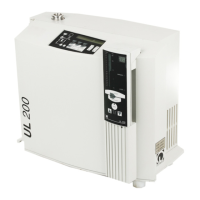
The UL 200 is equipped with four different multi-pin
connection sockets for the purpose of electrical commu-
nication:
- SERIAL (3/10): RS 232 interface (25 pins) to control
the UL 200 via a PC or for connecting a printer.
- RECORD (3/11): Chart recorder output (4 pins), 2
channels, 0 to 10 V.
- CONTROL (3/12): Inputs / outputs (16 pins) for access
to the four relay contacts and to control the UL 200 by
means of digital START / STOP signals.
- OPTION (3/13): Connections for driving of Leybold
accessories (8 pins) (partial flow valve, for example).
The option „Set of connection plugs“ (see Chapter 1.3.2)
is recommended in order to provide the corresponding
links for the connections RECORD, CONTROL and
OPTION. Commercially available connectors may be
used for the SERIAL link.
Note
The optional plugs which have been supplied, are not
numbered since they will only fit into their corresponding
sockets. In each case, the lower contact pin carries
the number „1“.
The exact way in which the pins of these connectors
have been assigned, is given in the following.
2.6.1 RS 232 C Interface (SERIAL)
This RS 232 C interface (3/10) is wired as data commu-
nication equipment (DCE) and permits the connection of
a printer or a PC for monitoring and data logging. The
connection is made through a 25 way sub-D socket.
Refer also to the interface description SB 10.211.
27
2.6.2 Chart Recorder Outputs
(RECORDER)
The RECORDER output (3/11) may be used to log the
leak rate, the inlet pressure and the forevacuum pressu-
re.
The measured values are output by way of an analogue
signal in the range from 0 ... 10 V. Resolution is limited to
10 mV. The instrument which is connected here (X(t)
chart recorder, for example) should have an input resi-
stance of no less than 2.5 k Ω .The measured values are
available through pins 1 and 4. The reference potential
(GND) is available at pins 2 and 3. The contacts are
numbered from bottom to top.
The mode of the RECORDER output may be selected in
menu item 13 (see Chapter 2.4).
Note
The chart recorder outputs are electrically isolated from
the other plugs. If, in spite of this, hum interference is
apparent it is recommended to operate the UL 200 and
the chart recorder from the same mains phase. If this is
not possible, you must make sure that the frame ground
of both instruments is kept at the same potential.
2.6.3 Control Inputs and Outputs
(CONTROL)
Via this connection (3/12) it is possible to control and
monitor the UL 200 from a central system controller. Via
the relay changeover contacts the three triggers (menu
item 1) and the mode (Ready / Fail) of the UL 200 (menu
item 16) may be monitored. The maximum rating for the
relay contacts is 60 V DC / 1A. Moreover, the functions of
the START (5/3), STOP (5/2) and ZERO (5/1) push-but-
tons may alternatively be controlled by applying logic sig-
nals to the CONTROL connection (menu item 14). The
level of the logic signals must not exceed 35 V.
For operation please refer to the description of the indi-
vidual menu items (e.g. menu items 14, 16). All CON-
TROL connections are electrically isolated.
The contacts are numbered from bottom to top.
Pin Assignment
————————————————————————
1 Start, U < 7 V / I = 0 A (logic state 0)
U > 13 V / I = 7 mA (logic state 1)
2 Stop, U < 7 V / I = 0 A (logic state 0)
U > 13 V / I = 7 mA (logic state 1)
3 Zero, U < 7 V / I = 0 A (logic state 0)
U > 13 V / I = 7 mA (logic state 1)
4 GND, reference potential for contacts 1, 2, 3
5,6,7 Relay for Trigger 1;
(compare with menu item 01)
5 center contact; 6 normally open contact,
7 normally closed contact
This relay is activated when the level drops



 To Next Page