EasyManua.ls Logo

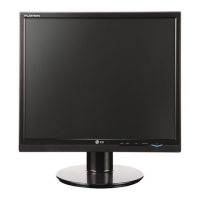
LG L1953T - User Manual

LG L1953T
27 pages
Print Icon
To Next Page IconTo Next Page
Loading...
Make sure to read the Important Precautions before using the product.
Keep the User's Guide(CD) in an accessible place for furture reference.
See the label attached on the product and give the information to your
dealer when you ask for service.
L1753T
L1953T
L1733TR
L1933TR
L1753TR
L1953TR
Users Guide
Question and Answer IconNeed help?

Do you have a question about the LG L1953T and is the answer not in the manual?

Summary

Important Precautions

General Safety Guidelines

Essential safety rules for installation, use, and servicing to prevent electrical shock or fire hazards.

Installation and Environmental Safety

Guidelines for safe installation, avoiding water, heat, and ensuring proper ventilation.

Cleaning, Repacking, and Disposal

Instructions for cleaning the screen, repacking for transport, and responsible product disposal.

Connecting the Display

Connecting and Assembling the Stand

Step-by-step instructions for assembling the display stand.

Removing the Monitor Stand

Detailed steps for detaching the monitor stand from the display.

Removing the Stand Base

Instructions on how to detach the stand base from the stand body.

Positioning and Connecting to Computer

Adjusting display for comfort and connecting it to your computer system.

Control Panel Functions

Front Panel and Side Controls Overview

Explanation of MENU, SOURCE, and navigation buttons on the monitor's side panel.

Power and Auto Image Adjustment Buttons

Using the Power button and AUTO/SET button for display functions.

Power Indicator Status

Explanation of the power indicator light and its color meanings.

On Screen Display (OSD) Operation

OSD Adjustment Overview

How to access and navigate the OSD menus for screen adjustments.

Picture, Color, and Position Settings

Adjusting brightness, contrast, color, and image position via OSD menus.

Tracking, Setup, and F-Engine Settings

Configuring tracking, system setup, and Flatron F-Engine modes through OSD.

Troubleshooting Display Issues

No Image or OSD Locked Problems

Solutions for when the screen is blank or the OSD controls are locked.

Image Quality and Artifact Issues

Fixing problems like distorted images, lines, noise, or abnormal colors.

Driver and Recognition Troubleshooting

Guidance on installing drivers and resolving monitor recognition or signal cable problems.

Technical Specifications

17-inch Model Specifications

Detailed technical specifications for the 17-inch display model.

19-inch Model Specifications

Detailed technical specifications for the 19-inch display model.

Display Modes and Connectors

Information on preset resolutions, recommended modes, and signal connector pin assignments.

Installing the Wall Mount Plate

Wall Mount Plate Installation Guide

Instructions for removing the stand and installing a wall mount plate and security slot.

Overview

This document is a user's guide for several LG monitor models, including L1753T, L1953T, L1733TR, L1933TR, L1753TR, and L1953TR. It provides essential information for the safe installation, operation, and maintenance of these displays.

The guide begins with "Important Precautions" to ensure user safety and proper device function. It emphasizes that the unit is engineered for personal safety, but improper use can lead to electrical shock or fire hazards. Users are advised to observe basic rules for installation, use, and servicing. It is crucial to read these precautions before using the product and to keep the User's Guide (CD) in an accessible place for future reference. The document also instructs users to refer to the label on the product for information to provide to a dealer when requesting service.

Regarding "On Safety," the manual specifies using only the power cord supplied with the unit. If an alternative power cord is used, it must be certified by applicable national standards. In case of a faulty power cable, users should contact the manufacturer or an authorized repair service provider for a replacement. The power supply cord serves as the main disconnection device, so the socket-outlet must be easily accessible after installation. The display should only be operated from a power source indicated in the manual's specifications or listed on the display itself. If unsure about the home's power supply type, users should consult their dealer. Overloaded AC outlets, extension cords, frayed power cords, and broken plugs are dangerous and can cause shock or fire hazards, necessitating replacement by a service technician. Users are explicitly warned not to open the display, as there are no user-serviceable components inside, and dangerous high voltages are present even when the power is off. If the display is not operating properly, the dealer should be contacted. To avoid personal injury, the display should not be placed on a sloping shelf unless properly secured, and only a manufacturer-recommended stand should be used. To prevent fire or hazards, the display should always be turned off when leaving the room for a short period and never left on when leaving the house. Children should be prevented from dropping or pushing objects into the display's cabinet openings, as some internal parts carry hazardous voltages. No accessories not designed for the display should be added. During a lightning storm or when the display will be unattended for an extended period, it should be unplugged from the wall outlet.

"On Installation" provides further guidelines. Users must not allow anything to rest upon or roll over the power cord, nor place the display where the power cord is subject to damage. The display should not be used near water sources like bathtubs, washbowls, kitchen sinks, laundry tubs, wet basements, or swimming pools. Displays are equipped with ventilation openings to release heat generated during operation. Blocking these openings can lead to heat build-up, causing failures and potential fire hazards. Therefore, users must NEVER block bottom ventilation slots by placing the display on a bed, sofa, or rug; place the display in a built-in enclosure without proper ventilation; cover openings with cloth or other material; or place the display near or over a radiator or heat source. Users are also cautioned not to rub or strike the Active Matrix LCD with hard objects, as this can permanently scratch, mar, or damage it. Pressing the LCD screen with a finger for an extended period may cause afterimages. Some dot defects (red, green, or blue spots) may appear on the screen, but these do not impact display performance. If possible, the recommended resolution should be used for optimal image quality. Using any mode other than the recommended resolution may result in scaled or processed images, which is characteristic of fixed-resolution LCD panels.

For "On Cleaning," the display should be unplugged before cleaning the screen. A slightly damp (not wet) cloth should be used, and aerosol sprays should not be applied directly to the display screen, as over-spraying can cause electrical shock.

"On Repacking," advises users not to discard the carton and packing materials, as they are ideal for transporting the unit. When shipping the unit to another location, it should be repacked in its original materials.

"On Disposal," states that the fluorescent lamp in the product contains a small amount of mercury. The product should not be disposed of with general household waste but in accordance with local authority regulations.

The "Important Precautions" section also includes "NOTE"s regarding FCC compliance. It clarifies that the manufacturer is not responsible for radio or TV interference caused by unauthorized modifications to the equipment, which could void the user's authority to operate it. The equipment has been tested and found to comply with Class B digital device limits under FCC Rules Part 15, designed to provide reasonable protection against harmful interference in residential installations. If interference occurs, users are encouraged to try correcting it by reorienting or relocating the receiving antenna, increasing separation between equipment and receiver, connecting the equipment to an outlet on a different circuit, or consulting a dealer or experienced radio/TV technician.

"Connecting the Display" provides instructions for setting up the monitor. Before starting, ensure power to the monitor, computer system, and other attached devices is off. To connect the stand:

  1. Place the monitor face down on a soft cloth.
  2. Assemble the Stand Body into the product in the correct direction until a "click" is heard.
  3. Assemble the Stand Base (Front, Rear) into the Stand Body in the correct direction.
  4. Carefully lift the monitor and face the front side. Important notes: The illustrations are general models, and the monitor may differ. Do not carry the product upside down holding only the stand base, as it may fall and cause damage or injury.

To remove the Stand:

  1. Place a cushion or soft cloth on a flat surface.
  2. Place the monitor face down on the cushion or soft cloth.
  3. Hold the product as shown and lift the Stand slightly.
  4. Change your hold on the product as shown and turn the Stand Base in the arrow direction until a "click" is heard.
  5. Pull out the Stand to remove it.

To remove the Stand Base:

  1. Hold the body of the Stand as shown.
  2. Press the two latches at the same time as shown.
  3. Put the Stand Base on a flat surface and pull up the body of the Stand while holding the Stand Base with the other hand to remove it.
  4. The body of the Stand and the Stand Base are then successfully separated.

"Positioning your display" explains how to adjust the monitor for maximum comfort.

  1. Adjust the panel's position in various ways. The Tilt Range is -5° to 20°. Warning: When adjusting the screen angle, do not place fingers between the monitor head and the stand body to avoid injury. Ergonomic recommendation: To maintain an ergonomic and comfortable viewing position, the forward tilt angle of the monitor should not exceed 5 degrees.

"Using the Computer" details connecting the display to a computer.

  1. Place the monitor in a convenient, well-ventilated location near the computer.
  2. Connect the signal cable (①). Tighten thumbscrews to secure the connection.
  3. Connect the power cord into a proper, easily accessible power outlet close to the display (②). The guide shows connections for Analog signal (D-sub) and Digital signal (DVI), noting that connections vary by model. It also mentions a Mac adapter for Apple Macintosh use, requiring a separate plug adapter for the 15-pin high-density D-sub VGA connector to a 15-pin 2-row connector.
  4. Press the power button on the side switch panel to turn the power on. When the monitor powers on, the 'Self Image Setting Function' is automatically executed (for Analog Mode only). NOTE: 'Self Image Setting Function' provides optimal display settings. It automatically adjusts the display to optimal settings for individual input signals when the monitor is first connected. To adjust while in use or to run it again, push the 'AUTO/SET' button. The 'Factory reset' option in the OSD menu can also be used, but this initializes all menu items except 'Language'.

"Control Panel Functions" describes the buttons on the front and side panels. Side Panel Controls:

  1. MENU Button: Used to enter or exit the On Screen Display (OSD).
    • OSD LOCKED/UNLOCKED: This function locks current control settings. Press and hold the MENU button for several seconds to lock ("OSD LOCKED" message appears) or unlock ("OSD UNLOCKED" message appears) the OSD controls.
  2. ▲∇ Buttons: Used to select or adjust functions in the OSD. Refer to page A15 for more information.
  3. fEngine∇: For more information, refer to page A15.
  4. AUTO/SET Button: Used to enter a selection in the OSD.
    • AUTO IMAGE ADJUSTMENT: When adjusting display settings, always press AUTO/SET before entering the OSD. This automatically adjusts the display image to ideal settings for the current screen resolution. Best display mode for 17-inch monitors is 1280 x 1024, and for 19-inch monitors is 1280 x 1024.
  5. Power Button: Used to turn the display on or off.
  6. Power Indicator: Lights up blue when the display is in On Mode. Changes to amber in Sleep Mode (Energy Saving). SOURCE Hot key: Used to activate D-Sub or DVI connector. This feature is for when two computers are connected. The default setting is D-Sub.

"On Screen Display (OSD) Control Adjustment" explains how to adjust image size, position, and operating parameters using the OSD system. NOTE: Allow the display to stabilize for at least 30 minutes before making image adjustments. Steps to make adjustments in the OSD:

  1. Press the MENU Button to open the main OSD menu.
  2. Use the ▲ or ∇ Buttons to highlight the desired icon, then press the AUTO/SET Button to access the control.
  3. Use the ▲ / ∇ Buttons to adjust the image to the desired level. Use the AUTO/SET Button to select other sub-menu items.
  4. Push the MENU Button once to return to the main menu, or twice to exit the OSD.

The guide provides a table of OSD Selection and Adjustment menus:

  • Main menu: PICTURE, COLOR, POSITION, TRACKING, SETUP, FLATRON F-ENGINE.
  • Sub-menus and their functions:
    • PICTURE: BRIGHTNESS (adjust screen brightness), CONTRAST (adjust screen contrast), GAMMA (set gamma value: -50/0/50; high values show whitish images, low values show high contrast images).
    • COLOR: PRESET (sRGB, 6500K, 9300K to customize screen color), RED (set red color levels), GREEN (set green color levels), BLUE (set blue color levels).
    • POSITION: HORIZONTAL (move image left/right), VERTICAL (move image up/down).
    • TRACKING: CLOCK (minimize vertical bars/stripes, horizontal screen size changes), PHASE (adjust focus, remove horizontal noise, sharpen characters), SHARPNESS (adjust clearness of screen).
    • SETUP: LANGUAGE (choose OSD language), OSD POSITION (adjust OSD window position), WHITE BALANCE (adjust signal level to fit video card output for optimal image, enabled when white and black colors are present), POWER INDICATOR (set power indicator ON/OFF), FACTORY RESET (restore default settings except language; press ∇ button to reset immediately). If screen image doesn't improve, restore defaults and perform white balance again (for analog input only).
    • FLATRON F-ENGINE: MOVIE/TEXT (select desired image condition optimized for environment/image types), USER (manually adjust brightness, ACE, RCM; save/restore values), NORMAL (normal operating conditions).

Details on FLATRON F-ENGINE: When executed, two tones appear on the screen. The left side shows the applied screen, and the right side shows the non-applied screen. Press the SET button to use the adjusted screen.

  • MOVIE/TEXT: Easily select optimal image conditions. MOVIE for animation/videos, TEXT for text/word processing.
  • USER: Manually adjust BRIGHTNESS, ACE (Adaptive Clarity Enhancer for clarity mode), RCM (Real Color Management for color mode: Not applied, Green enhance, Flesh tone, Color Enhance). Select SAVE and YES to store values.
  • NORMAL: Under normal operating conditions.

"Troubleshooting" section helps users diagnose and resolve common issues before calling for service.

  • No image appears:
    • Check power cord connection.
    • Press Power button.
    • Adjust brightness and contrast.
    • If power indicator is amber (sleep mode), move mouse or press any key, or turn on PC.
    • "OUT OF RANGE" message: PC video card output is outside display's horizontal/vertical frequency range. Configure display again using 'Specifications' section.
    • "CHECK SIGNAL CABLE" message: Signal cable between PC and display is not connected. Check and try again.
  • "OSD LOCKED" message:
    • "OSD LOCKED" when pressing MENU button: Current control settings are locked. Press MENU button for several seconds to unlock ("OSD UNLOCKED" message appears).
  • Display image is incorrect:
    • Display Position is incorrect: Press AUTO/SET. If unsatisfactory, adjust H position and V position in OSD. Check Control Panel -> Display -> Settings for frequency/resolution changes; readjust video card to recommended resolution.
    • Vertical bars/stripes on screen background: Press AUTO/SET. If unsatisfactory, decrease vertical bars/stripes using CLOCK icon in OSD.
    • Horizontal noise/unclear image/characters: Press AUTO/SET. If unsatisfactory, decrease horizontal bars using PHASE icon in OSD. Check Control Panel -> Display -> Settings; adjust to recommended resolution or ideal setting. Set color setting higher than 24 bits (true color).
    • Screen color is mono or abnormal: Check signal cable connection and fasten with screwdriver. Ensure video card is properly inserted. Set color setting higher than 24 bits (true color) at Control Panel - Settings.
    • Screen blinks: Check if screen is set to interlace mode; change to recommended resolution. Ensure power voltage is high enough (AC100-240V 50/60Hz).
  • Have you installed the display driver?
    • If not: Install driver from CD/diskette or download from http://www.lge.com.
    • "Unrecognized monitor, Plug&Play (VESA DDC) monitor found" message: Check if video card supports Plug&Play function.

"Installing the Wall mount plate" provides instructions for mounting the monitor. This monitor supports wall mount plates or interchange devices.

  1. Put a cushion or soft cloth on a flat surface.
  2. Place the monitor face down on the cushion or soft cloth.
  3. Hold the product as shown and lift the Stand slightly.
  4. Change your hold on the product as shown and turn the Stand Base in the arrow direction until a "click" is heard.
  5. Pull out the Stand to remove it.
  6. Install the wall mount plate.
    • Wall mount plate (Separate purchase): This is stand-type or wall mount type and is connectable with a wall mount plate. Refer to the installation guide provided with the wall mount plate.
    • Kensington Security Slot: Connected to a locking cable (purchased separately) for security.

LG L1953T Specifications

General IconGeneral
Screen Size19 inches
Resolution1280 x 1024
Panel TypeTN
Brightness250 cd/m²
Response Time5 ms
Viewing Angles160° horizontal, 160° vertical
Aspect Ratio5:4
Weight4.5 kg
Input ConnectorsD-Sub, DVI-D

Related product manuals