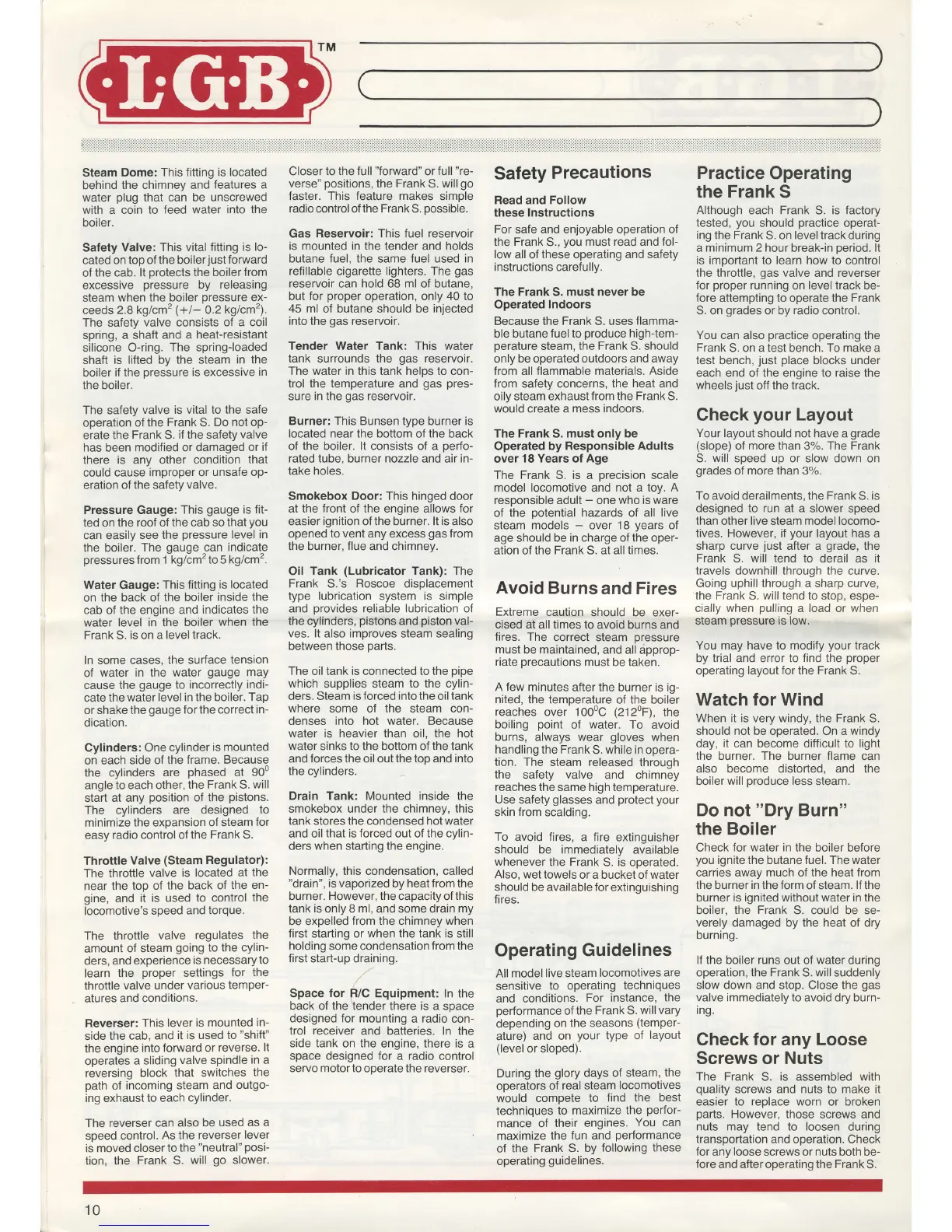
Steam
Dome:
This fitting
is located
behind
the chimney and
features a
water
plug
that can be unscrewed
with a coin to
feed water into the
boiler.
Safety
Valve: This vital fitting
is lo-
cated on
top
of
the boiler
justforward
of
the cab. lt
protects
the boiler from
excessive
pressure
by
releasing
steam
when the boiler
pressure
ex-
ceeds 2.8
kg/cm2
(+/-'0,2kg/cm2).
The
safety
valve consists
of a coil
spring, a shaft
and a
heat-resistant
silicone
O-ring.
The
spring-loaded
shaft
is lifted by the steam
in the
boiler
if the
pressure
is
excessive
in
the boiler.
The safety
valve is vital to the safe
operation of
the Frank S.
Do not op-
erate
the Frank S.
if the safety valve
has
been
modified or damaged
or
if
there is any other
condition
that
could cause
improper or
unsafe op-
eration
of the safety
valve.
Pressure Gauge:
This
gauge
is fit-
ted on the
roof
of
the cab so that
you
can easily
see the
pressure
level in
the boiler.
The
gauge
can
indicate
pressures
f rom 1-kg/cm2
to
5
kg/cm2.
Water
Gauge:
This
fitting is located
on
the back of
the boiler inside
the
cab of
the engine and
indicates the
water level in
the boiler when
the
Frank S.
is
on a
level track.
ln some cases,
the surface
tension
of
water in the
water
gauge
may
cause
the
gauge
to incorrectly
indi-
cate
the water level
in the boiler.
Tap
or shake the
gauge
for the correct
in-
dication.
Cylinders: One
cylinder
is mounted
on each
side ofthe
frame. Because
the cylinders
are
phased
at 900
angle
to each other,
the Frank S.
will
start
at any
position
of the
pistons.
The cylinders
are designed
to
minimize
the
expansion
of steam
for
easy
radio control of
the Frank S.
Throttle
Valve
(Steam
Regulator):
The throttle
valve
is located at
the
near the
top of the
back of
the en-
gine,
and
it is used to control
the
locomotive's
speed
and torque.
The
throttle
valve regulates
the
amount
of steam
going
to the cylin-
ders, and
experience
is
necessaryto
learn the
proper
settings
for
the
throttle
valve under
various
temper-
atures
and conditions.
Reverser:
This
lever is
mounted in-
side
the cab,
and
it is used to
"shift"
the engine
into
forward or
reverse.
lt
operates
a sliding
valve spindle
in a
reversing block
that switches
the
path
of
incoming steam
and outgo-
ing exhaust
to
each
cylinder.
The reverser can
also be
used as a
speed
control.
As the
reverser
lever
is moved
closer
to the
"neutral" posi-
tion, the
Frank S.
will
go
slower.
Closer to the
full "forward"
or
full "re-
verse"
positions,
the Frank
S.
will
go
faster. This feature makes
simole
radio control of the Frank S.
possible.
Gas Reservoir: This fuel reservoir
is mounted in
the tender and
holds
butane fuel, the
same
fuel used in
refillable cigarette lighters. The
gas
reservoir
can
hold
68
ml
of butane,
but for
proper
operation, only 40 to
45 ml
of butane should be
iniected
into the
gas
reservoir.
Tender Water Tank: This water
tank
surrounds
the
gas
reservoir.
The water in this tank helos to con-
trol
the
temperature and
gas
pres-
sure
in the
gas
reservoir.
Burner: This Bunsen type burner is
located near the bottom of the back
of the boiler. lt consists of a
perfo-
rated tube,
burner
nozzle
and air
in-
take holes.
Smokebox
Door: This hinged door
at the front of the engine allows for
easier
ignition
of the burner.
lt
is also
opened to vent any excess
gas
from
the burner,
flue
and chimney.
Oil
Tank
(Lubricator
Tank): The
Frank S.'s Roscoe disolacement
type lubrication
system
is
simple
and orovides reliable lubrication of
the cylinders,
pistons
and
piston
val-
ves. lt
also
improves
steam
sealing
between those oarts.
The oil tank is connected to the
pipe
which
supplies steam
to the cylin-
ders. Steam is
forced into
the oil tank
where
some of
the steam con-
denses
into hot water. Because
water is heavier than
oil,
the hot
water sinks to the bottom of the tank
and forces the oil out the top and
into
the
cylinders.
Drain Tank: Mounted inside the
smokebox under the chimney, this
tank stores the condensed hot water
and oil
that is forced
out of
the
cylin-
ders when stading the engine.
Normally, this condensation, called
"drain",
is vaporized by heat
from
the
burner.
However, the
capacity of
this
tank is only 8 ml, and some drain my
be expelled
from the
chimney
when
first starting or when the tank is still
holding
some condensation
from the
first start-up draining.
/
Space for
[/C
Equipment: In
the
back of the'tender there is a
soace
designed for mounting
a radio con-
trol receiver
and batteries. In the
side tank
on
the
engine, there is a
space designed for a radio control
servo motor to
ooerate
the reverser.
Safety
Precautions
Read and Follow
these lnstructions
For
safe
and enjoyable operation of
the
Frank
S.,
you
must read
and
fol-
low
all of
these
operating
and safety
instructions carefully.
The Frank S. must never be
Operated
Indoors
Because the Frank S. uses
flamma-
ble butane
fuel to
produce
hightem-
perature
steam, the
Frank
S. should
only be operated outdoors
and away
from all flammable materials.
Aside
from safety concerns,
the heat
and
oily steam
exhaustfrom the Frank S.
would create a
mess indoors.
The Frank S. must only be
Operated
by Responsible Adults
over
18 Years
of
Age
The Frank S. is a orecision scale
model locomotive
and
not
a
toy. A
responsible adult
-
one who is ware
of the ootential hazards of all
live
steam
models
-
over
18
years
of
age should be in charge of the oper-
ation of the
Frank
S. at all
times.
Avoid Burns
and
Fires
Extreme caution
should be exer-
cised at all times to avoid burns
and
fires. The
correct steam
pressure
must
be maintained, and
all approp-
riate
orecautions
must
be taken.
A few minutes
after the burner is ig-
nited,
the temperature of the
boiler
reaches
over
1000C
(2120D,
the
boiling
point
of water. To
avoid
burns,
always wear
gloves
when
handling
the Frank
S.
while
in opera-
tion. The
steam released through
the safety valve
and chimney
reaches
the same high temperature.
Use
safety
glasses
and
protect
your
skin from scalding.
To
avoid
fires,
a fire extinguisher
should be immediately
available
whenever
the Frank
S.
is
ooerated.
Also, wet towels
or a bucket of water
should be available for
extinguishing
fires.
Operating
Guidelines
All
model live steam
locomotives
are
sensitive
to operating
techniques
and conditions.
For instance,
the
performance
of
the Frank S.
will vary
depending
on the seasons
(temper-
ature)
and on
your
type of
layout
(level
or sloped).
Practice
Operating
the
Frank
S
Although each Frank S. is factory
tested,
you
should
practice
operat-
ing the Frank S. on level track during
a
minimum 2 hour
break-in oeriod. lt
is important to learn how to
control
the throttle,
gas
valve and reverser
for
proper
running
on
level
track be-
fore attempting to operate the Frank
S. on
grades
or by
radio
control.
You can
also
practice
operating the
Frank
S. on a test bench. To make a
test
bench,
just
place
blocks under
each end of the engine to raise the
wheels,ust
off the track.
Check
your
Layout
Your layout should not have a
grade
(slope)
of
more than
3%.
The Frank
S.
will
speed up or slow down on
grades
of
more than
37o.
To
avoid derailments, the
Frank
S.
is
designed to run
at
a
slower speed
than other live steam model locomo-
tives. However, if
your
layout has
a
sharp curve
just
after a
grade,
the
Frank
S.
will tend to
derail as
it
travels downhill through the curve.
Going uphill through a sharp curve,
the Frank
S.
will tend to
stop, espe-
cially when
pulling
a load or when
steam oressure
is low.
You may have to modify
your
track
by trial and error to find the
proper
operating
layout for the Frank
S.
Watch for Wind
When it is very windy, the Frank
S.
should not be operated. On a windy
day,
it
can become difficult to
light
the
burner.
The
burner
flame
can
also become distorted, and the
boiler will
oroduce
less
steam.
Do not "Dry Burn"
the Boiler
Check
for water in
the boiler before
you
ignite the butane fuel. The water
carries away much of the heat from
the
burner
in
theform of steam.
lf
the
burner is ignited without water in the
boiler,
the Frank
S. could be se-
verely damaged by the heat
of
dry
burning.
lf the
boiler
runs
out of
water
during
operation, the Frank S. will suddenly
slow down and stop. Close the
gas
valve immediately to avoid dry burn-
Ing.
Check
for
any Loose
Screws or Nuts
Duringtheglorydaysof
steam,.the
The Frank S. is assembled with
operators
of
real steam
locomotives
oualitv screws and
nuts
to
make it
would
compete
to find
.
the
best
easiei to replace worn
or
broken
techniques
to maximize
the.
perfor-
parts.
Howeirer,
those screws and
mance of
their engines.
Yoy
91!
huts may tend to loosen
during
maximize
the
fun and
performance
transportition and operation. Chec;
of
the
Frank S. by
following these
for
any
loose
screws or
nuts
both be-
operating
guidelines.
fore
and after ooeratino the Frank S.
10


 To Next Page
 Loading...