4
the Frank
S before attempting
to ig-
nite the burner.
Notes:
1 . lf more 45 mlof butane
is injected
into
the
gas
reservoir, the boiler
could run out of
water
before all of
the butane
is
used.
Dry burning
would result and severe damage
to the Frank S.
is
possible.
2. Injecting more than
45 ml
of
butane
into the
gas
reservoir will
make igniting the burner
more
difficult
because liquid butane,
in-
stead of butane
gas,
will come
out of
the
burner
nozzle when the
gas
valve is opened.
In
this case,
open the
gas
valve
until
the
ex-
cess butane
is expelled through
the burner
nozzle.
lf the butane will not transfer
f rom
the container
to the reservoir,
warm up the
gas
container
with
your palms
and shake the con-
tainer. Both actions
will helo in-
crease
the
pressure
in the con-
tainer to a higher
level tahn in the
reservoir.
lf the reservoir is
warm from
sun-
shine,
it may
also
be diff icult to in-
ject
butane into the
reservoir.
However,
you
can cool the
reser-
voir
by
injecting butane into the
gas
inlet
while
slightly
opening
the
gas
valve. When the butane
vaporizes
into
gas,
it absorbs
heat.
and
the temperature of
the
reservoir
will
quickly
cool down.
Do not add water
into the tender
water tank
to cool down the
re-
servoir
while
injecting butane.
Water
should
be added after
qas
iniection.
Step 6:
Add Water to the
Tender Water Tank
Add water into the tender water tank
until
the water
coves slightly
more
than half of the
gas
reservoir.
Because
temperature and
pressure
are directly related, warmer or
cooler
water
can be added
to the
tender water tank to help control the
pressure
in the
gas
reservoir.
See
the
chart comparing
"Pressure
in the
Gas Reservoir" and
"Temoerature
in
the Water Tank."
On a level track,
the burner requires
gas pressure
of about 1.5 kg/cm2,
which means that
the temoerature
of
the water
should be at least 15oC
(590F).
On large layouts
with steep
grades
(maximum
3%), the
burner
will require-
gas pressure
of about
2.5
kmlcm', which means
that the
temperature
of the water
should be
about 250C
(770F).
During
operation,
both the tempera-
ture
and
pressure
in the
gas
reser-
voir will
decrease, and
on cold days,
water at
about
25oC
should
be
added to the water tank
to offset the
drop in
pressure
and temperature.
Caution!
Never
add water
over
40oC
(1040D
to the
tender
water
tank.
Water
over 40uC
will
raise
the
gas pressure
beyond
the
design
limits
of the
burner
(about
3 kgicm2)
and will
make it
difficult
to
ooerate
the
burner. Very
hot water
could also
raise
the
gas pressure
beyond
the
safety
limit
of the
gas
reservoir.
Step
7:
Check
Controls
Review Steps
'1
through
6 to make
sure
that they
have been
followed
propefly.
Make sure that
the regulator
valve
(green) is closed and
that
the re-
verser is in the
neutral
position.
Be-
fore trying
to rgnite
the burner,
blow
any
excess
butane away
from
the
burner.
flue and
chimnev.
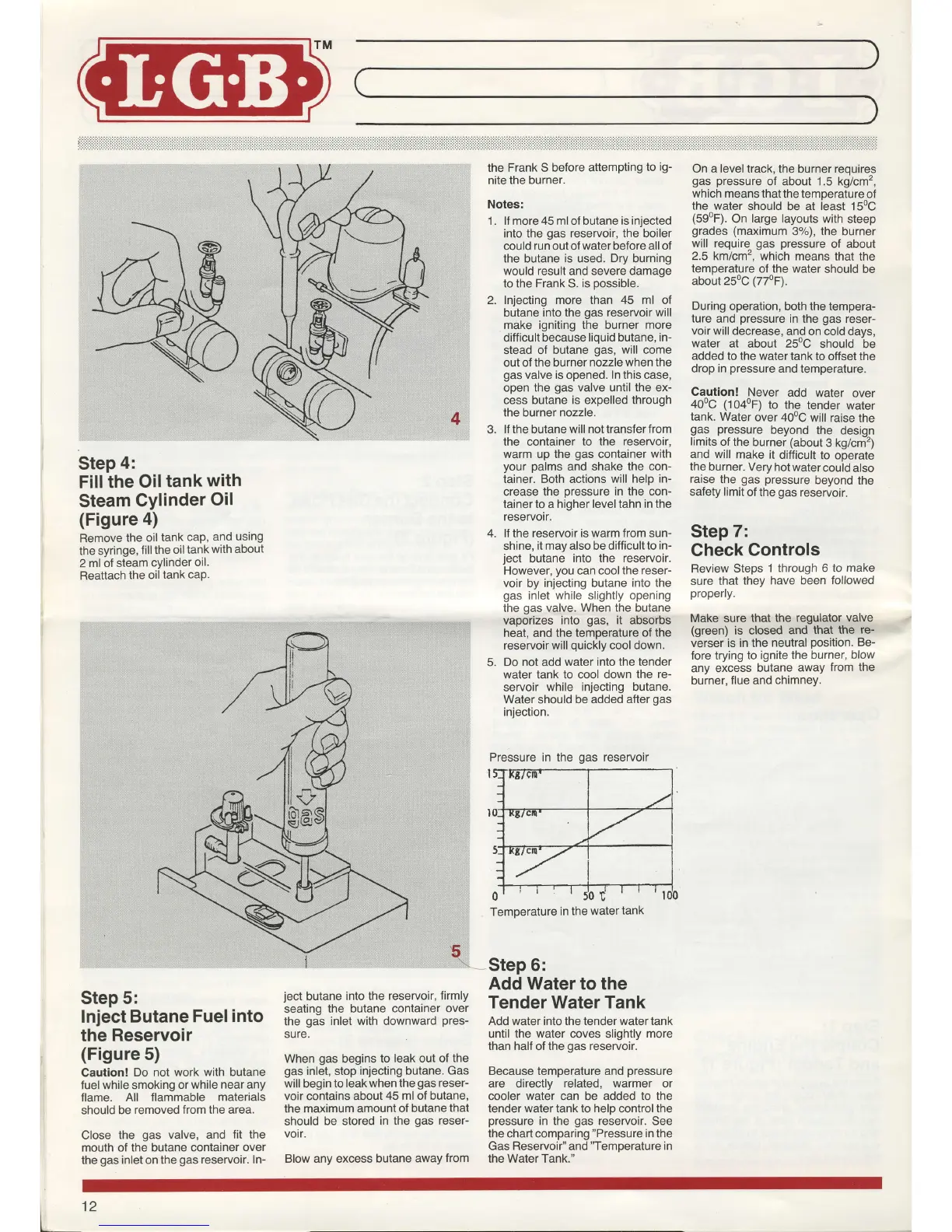
Step
4:
Fill
the Oil
tank
with
Steam
Cylinder
Oil
(Figure 4)
Remove
the
oil tank
cap,
and
using
the syringe,
fillthe
oiltank
with about
2 ml of steam
cYlinder
oil.
Reattach
the oil
tank
cap.
Step 5:
Inject
Butane
Fuelinto
the Reservoir
(Figure
5)
Caution!
Do
not work with butane
fuel
while
smoking
or
while near any
flame. All
flammable materials
should be
removed from
the area.
Close
the
gas
valve, and
fit the
mouth of
the butane container
over
the
gas
inlet on
the
gas
reservoir.
In-
ject
butane
into the reservoir,
{irmly
seating
the butane container
over
the
gas
inlet
with
downward
pres-
sure.
When
gas
begins to
leak
out
of the
gas
inlet, stop
injecting butane. Gas
will
begin
to leak
when the
gas
reser-
voir contains about
45 ml of butane,
the
maximum amount o{
butane that
should
be stored
in the
gas
reser-
volr"
Blow any excess
butane away
from
4.
5
Temoerature
in the
water
tanK


 To Next Page
 Loading...