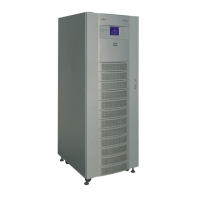
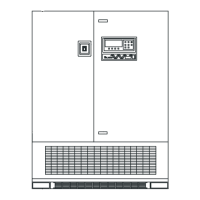
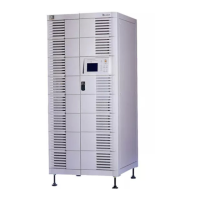
The document describes the Liebert Series 300™ UPS (Uninterruptible Power System), a three-phase power protection system available in ratings from 10 kVA to 125 kVA, operating at 60 Hz. This manual provides comprehensive information on its installation, operation, and maintenance.
The core function of the Liebert Series 300 UPS is to supply critical loads with continuous, computer-grade power, maximizing isolation from disturbances and interruptions, minimizing maintenance and repair time, and providing monitoring of significant system operating characteristics.
Technical Specifications:
The UPS is available in ten power ratings: 10, 15, 20, 30, 40, 50, 65, 75, 100, and 125 kVA. Corresponding kW ratings range from 8 kW to 100 kW.
- Voltage Configuration: Three-Phase, 3-wire-plus-ground with standard input isolation transformer. Some models can be configured for 3-phase, 4-wire-plus-ground with an input auto transformer.
- Voltage Range: +10%, -15% of nominal.
- Frequency: Nominal frequency ± 5%.
- Power Factor: 0.80 lagging minimum at nominal input voltage and full rated UPS output load; 0.90 lagging with optional input filter.
- Inrush Current: 800% of full load current maximum.
- Current Limit: 125% of nominal AC input current maximum.
- Input Current Walk-In: 20 seconds to full rated input current maximum. Field selectable 5 or 20 seconds.
- Current Distortion: 30% THD at full load, 10% THD with optional input filter.
- Surge Protection: Sustains input surges without damage per criteria listed in ANSI C62.41-1980.
AC Output, UPS Inverter:
- Voltage Configuration: Three-Phase, 4-wire-plus-ground.
- Voltage Regulation: ±1% for balanced load.
- Voltage Unbalance: Balanced load ±1%; 20% unbalanced load ±1%; 50% unbalanced load ±2%; 100% unbalanced load ±5%.
- Voltage Adjustment Range: ±5% manual adjustment.
- Frequency: Nominal frequency ±0.1%.
- Frequency Slew Rate: 1.0 Hertz per second maximum. Field selectable from 0.1 to 1.0 Hz per second.
- Bypass Line Sync Range: ±0.5, ±1.0, ±3.0 Hertz. Field selectable.
- Load Power Factor Range: 0.9 leading to 0.5 lagging.
- Output Power Rating: Rated kVA at 0.8 lagging power factor.
- Voltage Distortion: 5% total harmonic distortion (THD); 3% maximum for any single harmonic, for linear loads.
- Phase Displacement: ±1° for balanced load; ±3° for 50% unbalanced load.
- Voltage Transient Response: 20% load step ±4%; 50% load step ±5%; 100% load step ±8%; Loss or return of AC input power ±1%; Manual transfer of 100% load ±4%.
- Transient Recovery Time: To within 1% of output voltage within 50 milliseconds.
- Overload Capability: 125% for 10 minutes (without bypass source); 150% for 30 seconds (without bypass source).
- Fault Clearing: Sub cycle current of at least 300%.
Battery:
- Type: Sealed, lead-acid, in matching cabinet.
- DC Voltage Range: 163V - 240V for 10-15 kVA models (102 cells); 288V - 423V for 20-125 kVA models (180 cells).
Environmental Specifications:
- Operating Temperature Range: UPS: 0°C to 40°C; Battery: 25°C ±5°C.
- Storage Temperature Range: UPS: -20°C to +70°C; Battery: -40°C to +40°C.
- Relative Humidity: 0 to 95% non-condensing.
- Audible Noise: 65 dBA at 1 meter.
- Altitude: 0 to 6560 feet (2000 meters). Derated for higher elevations.
Usage Features:
The UPS offers three power paths:
- Through the UPS Module: Normal operation where input AC power is converted to DC by the rectifier/charger, which charges the battery and powers the inverter. The inverter then converts DC to conditioned AC power for the critical load, eliminating voltage transients. If input power is interrupted, the battery immediately supplies DC power to the inverter.
- Static Bypass Line: Provides an alternate power path during overload or UPS fault conditions. The control system automatically transfers the load to this line without interruption if the inverter cannot supply enough power or if a fault is detected in the UPS Module.
- Maintenance Bypass Line: A hardwired line that supplies unconditioned power to the critical load during startup or when the UPS Module is de-energized for maintenance. This path is manually selected using the Rotary Switch (Positions 1, 2, or 3).
Operator Controls and Display:
Located on a recessed panel on the UPS Module Cabinet door, these include:
- Digital Display Screen: A four-line, 16-character LCD that shows messages for startup, operation, shutdown, and status information. It also displays system status, meter functions (load, DC bus, input/output phase voltages and currents, frequency), system configuration, alarm history, and lamp test results.
- Selection Pads: Three touch-sensitive pads (Up, Down, Alarm Silence) to navigate menus and acknowledge alarms.
- Power Status Diagram: LEDs indicate power flow from input to output, distinguishing between the Maintenance Bypass Line (yellow) and UPS Module path (green).
- Rotary Switch: A single-point control with five positions (0: Off, 1: On Bypass, 2: UPS Start, 3: UPS Check, 4: On UPS) for managing power paths and initiating tests.
- Advisory Display: Guides operators through startup and shutdown with LEDs (Pause, clockwise/advance arrow, counter-clockwise/return arrow).
Default Screen Messages:
The display shows six default messages: "Normal Operation," "Warning: Load on Maintenance Bypass," "Warning: Load on UPS," "Warning: Load on Static Bypass," "Fault: System Shutdown," and "UPS on Battery." These messages provide immediate status updates and prompt operator actions.
System Options:
The UPS supports various optional features:
- External Maintenance Bypass Cabinet: A matching cabinet extension for total isolation of the UPS module from the electrical system during maintenance. It includes its own rotary switch and optional circuit breakers/bypass transformer.
- Slim-Line Distribution: A cabinet extension housing panelboards and a main circuit breaker for output distribution.
- Remote Status Panel: A wall-mountable panel with LEDs for load status, battery discharge, low battery reserve, bypass load, UPS alarm, new alarm, audible alarm, and pushbuttons for lamp test/reset and audio reset.
- Remote Contact Board: Provides individual isolated Form C contacts for various alarm conditions (battery discharging, low battery reserve, load on bypass, summary alarm, new alarm).
- RS-232 Interface Port: Allows remote monitoring and control via a terminal or PC, transmitting status, instrumentation, alarms, and diagnostics.
- Internal SNMP Support: Enables direct connection to an I.P. based network for monitoring system measurements, alarm status, and load control via an SNMP adapter.
- Internal Modem: Allows the UPS to dial out and notify remote computers/pagers of important events, or to be called by a remote terminal/PC for monitoring and control.
- SiteScan®/Sitemaster Interface: Provides communication capability with Liebert site monitoring products.
- IBM® AS/400 Signal Interface: Provides a signal cable to activate status messages in the IBM system (UPS supplying power, bypass supplying power, battery discharging, low battery).
- System/38 Power Warning Signal: Provides an isolated normally open contact for System/38 computer power warning circuitry.
- Battery Circuit Breaker: An external breaker for manual disconnect and overcurrent protection for external battery plants.
- Contact Isolator Board: Provides an interface for external battery circuit breaker release, auxiliary contacts, and reduced AC input current limit.
- DC Ground Fault Alarm: Annunciates alarm if positive or negative DC bus is grounded.
- Computer Interface System: Performs automatic unattended orderly shutdown of the customer's operating system during power failures or low battery alarms.
- Multi-Computer Interface System: Designed for configurations where a single UPS powers multiple computer file servers, performing automatic unattended orderly shutdown.
- IBM® AS/400 Multi-Interface System: Designed for configurations where a single UPS powers multiple AS/400 units, providing UPS status information for automatic unattended orderly shutdown.
Maintenance Features:
- Operator’s Log: Recommended for recording air filter replacements, battery maintenance, input/output/battery status readings, and any abnormal messages.
- Air Filter Replacement: Filters should be checked periodically (at least every six months) and replaced as needed.
- Periodic Restart: Advisable once or twice a year to power down the UPS to Maintenance Bypass Line and perform a startup, which includes self-diagnostic testing.
- Battery Maintenance: Regular inspection and electrical checks are recommended annually. This includes checking for corrosion, connection integrity, and retorquing terminals. Voltage records (float and nominal) should be maintained.
- Battery Safety Precautions: Emphasizes extreme care when handling batteries due to hazardous materials (lead-acid), risk of electrical shock, and fire (hydrogen gas). Strict adherence to safety procedures is required, including wearing protective gear, using insulated tools, and avoiding sparks.
- Professional Start-up: Liebert Customer Engineers perform thorough non-powered inspections, electrical checkouts, calibration, and battery installation inspections.
- Maintenance Agreements: Liebert offers various service agreements, including Full Service, Preventive Maintenance, Basic Service, and Extended Full Service, which may include infrared scanning visits.
- Training: Customer training courses cover proper operation, emergency procedures, and preventive/corrective maintenance.

 Need help?
 General

 To Next Page