Installation
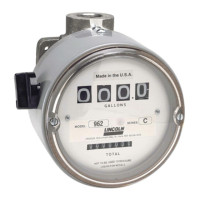
The 900 series meter consists of a chamber
housing, measuring chamber, gear train,
counter assembly, and cover.
The design of the meter is such that it can
be completely disassembled without dis-
turbing the piping.
1 Determine direction for fluid to flow.
2 Install meter observing directional arrow
on nutating disk assembly housing (1)
(† fig. IPB, pg.6).
Operating instructions
For accurate measurement and to prevent
meter damage, meter and piping must
always be filled with liquid and free of air.
Meter should be calibrated per instruc-
tions in this manual prior to its use.
1 Stop flow of liquid.
2 Reset register to “0” using reset knob (4)
(† fig. IPB, pg.6).
Meter is ready for use.
Maintenance
Meter should operate maintenance free.
However, certain liquids can dry out while in
meter housing, causing the meter to stop.
If this happens, meter should be thoroughly
cleaned († Cleaning instructions).
Cleaning instructions
Run a flushing fluid through meter. For a
more thorough cleaning, disassemble meter
per Assembly and disassembly section,
Meter chamber assembly subsection.
Rinse all meter components.
Recalibrate meter following calibration
instructions.
Storage
If meter is to be stored for a period of time,
clean thoroughly. This will help protect
meter from damage.
Repair
Meters needing repair should be taken to an
authorized repair shop or returned to factory
for service. Meters must be thoroughly
triple-rinsed before being taken in for repair.
Prior to service, adhere to the following
instructions:
• If meter was used for a fluid other than a
petroleum product, it must be triple-
rinsed and accompanied by a note indicat-
ing the chemicals that have been pumped
through the unit.
• Meters not adhering to these specifica-
tions may be refused service at either the
repair shop or at the factory.
When ordering repair parts, be sure to
give replacement part number, date of
manufacture and meter series number.
This will ensure that the correct replace-
ment part is supplied.
Calibration
The Lincoln series 900 meters can be
calibrated for either U.S. gallons or litres.
Calibration is required upon installation,
after disassembly, after significant wear or
when metering a different viscosity fluid.
Depending on the model, series 900 meters
are calibrated at the factory metering gaso-
line in either U.S. gallons or litres.
Calibration must be done between 6 and
40 gal./min. (23 and 151 l/min.).
A proving container or a container of
known volume will be needed for the cali-
bration procedure. It is recommended that
the container’s volume be at least five times
larger than the unit of calibration. For exam-
ple, a five-gallon container should be used
when calibrating for gallons.
The meter is factory calibrated for a SAE
30 weight oil at room temperature and
tested for accuracy at 3 gal./min. (11,4 l/min.)
and 30 gal./min. (113,6 l/min.).
5


 To Next Page