Stompboxes & Effects • About the Stompboxes
6 • 3
Comp/Gate Effects
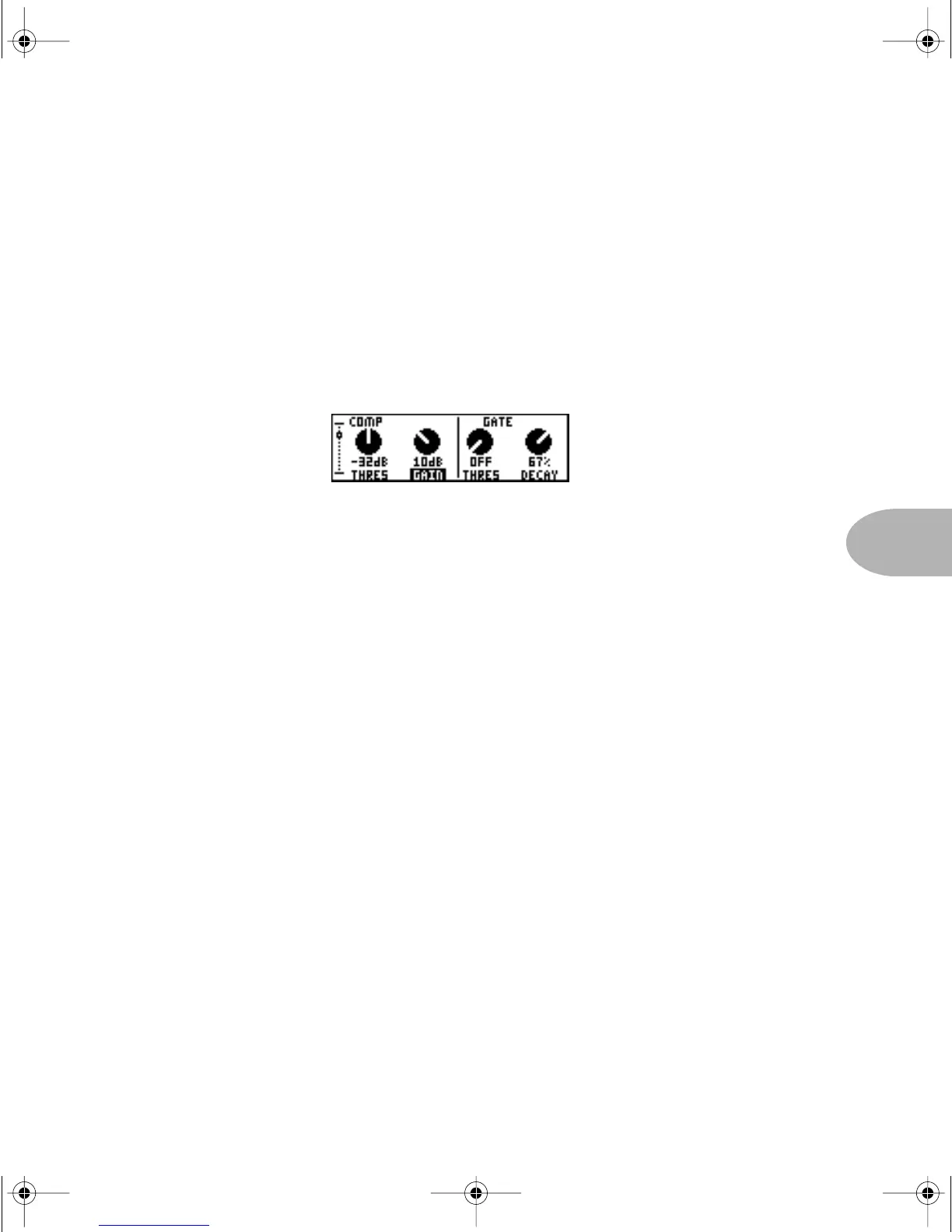
The Compressor effect available from the COMP (GATE) button is just the thing
when you want to smooth out your levels the way that you would typically do in a
recording studio. The
THRES (Threshold) knob determines how aggressive you want
the Compressor to be in smoothing things out. More negative numbers make the
Compressor more active in taming your levels, so -32dB is a more aggressive setting
that -16dB, say. The
GAIN knob lets you add back level to compensate for the overall
level reduction that the Compressor may cause.
The Gate effect helps eliminate unwanted noise when you’re not playing, and can be
especially valuable when using high gain sounds. Like a security gate, it’s supposed to
quickly open to pass the things that you want, and then swing closed to keep out the
things that you don’t want. Turn the
THRESH all the way down to minimum to disable
the Gate (
THRESH’s value will then be OFF, as shown above). The THRESH knob
determines how loud your playing has to be to open the gate. More negative numbers
(where the knob is near its fully-counterclockwise setting) mean that the gate will
open and allow sound through even when you are playing quietly, and less negative
numbers (where the knob is near its fully-clockwise setting) mean that the gate will
only allow sound to pass when you are playing pretty hard. The
DECAY knob
determines how fast the gate will swing closed. Like a gate in the real world, a fast
decay means the gate might catch your trailing foot as you pass through—in this case,
that means the gate will chop off the decay of your notes. And a slow decay means
that as the gate swings slowly closed behind you, someone might have time to slip
through behind you—in this case, that would be the unwanted noise that you hear as
your notes decay. You’ll have to experiment with the
DECAY to get just the right
happy medium for your particular guitar, playing style, and sound settings.
Modulation Effects
Modulation effects are things that swoosh, pulse and warble—from phase shifters to
flangers to choruses. Why are they called modulation effects? Well, if we consult a
dictionary, we discover that ‘modulate,’ in the electronic world means to “alter the
PODxt Manual Book RevC.book Page 3 Friday, August 29, 2003 5:43 PM


 To Next Page