Need help?
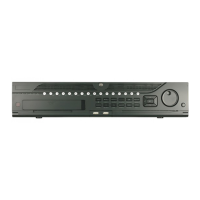
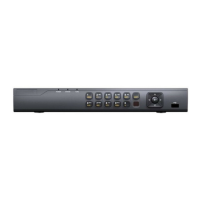
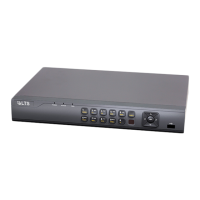
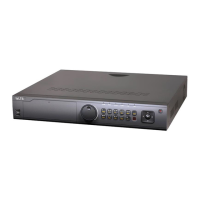
Do you have a question about the LTS LTN86 Series and is the answer not in the manual?
Provides instructions for using and managing the Product, including pictures, charts, and images.
Details the terms, conditions, and limitations of liability for the product and its use.
Covers FCC compliance, test results, and measures to correct interference.
States product compliance with EU standards like EMC, LVD, and RoHS directives.
Defines symbols used in the document, such as Danger, Caution, and Note.
Guides through device activation via local menu, PLATINUM IP PORTAL, client software, or web browser.
Explains how to configure TCP/IP settings for network operation, supporting IPv4 and IPv6.
Ensures video recorder storage media is functional by installing and initializing HDDs or creating RAID.
Details how to add network cameras for live video and recording.
Covers connection to platforms using ISUP, LTS Connect, and OTAP protocols.
Allows configuration of On-screen Display for cameras, including date/time and camera name.
Customizes image parameters like day/night switch, backlight, contrast, and saturation.
Protects privacy by concealing parts of the image from live view or recording with a masked area.
Enables automatic time synchronization for connected IP cameras.
Displays real-time video images from each camera, with options for capture and playback.
Zooms into live images in different magnifications (1x to 16x) using the toolbar.
Supports fisheye camera expansion in Live View or playback mode for panoramic views.
Covers PTZ parameter configuration, setting/calling presets, patrols, and patterns.
Details configuration of recording parameters like stream type, resolution, and H.265+.
Allows playing recorded video files, including instant playback, normal video, and smart search.
Covers editing video clips, configuring transcoded playback, and using thumbnails view.
Sets picture capture parameters like resolution, quality, interval, and delay time.
Automatically captures pictures according to a schedule, ensuring HDDs or network disks are available.
Configures alarms for motion detection, video loss, tampering, sensors, exceptions, and audio/light outputs.
Supports VCA detections like temperature screening, line crossing, intrusion detection, etc.
Enables smart, facial, vehicle, and human body detection in live view mode.
Sets actions triggered by alarms, including auto-switch monitoring, buzzer, email, and alarm output.
Allows adding access control, alarm, and network audio devices to the recorder.
Configures linkage actions and arming schedules for access control or alarm devices.
Displays alarm information from IoT devices on live view images, with privacy settings.
Searches alarms by time, event type, or channel for access control and alarm devices.
Calculates people count and generates daily/weekly/monthly/annual reports for analysis.
Analyzes visitor patterns in specific areas using graphical representation of data.
Adds false alarm examples from target detection to reduce future false alarms.
Specifies detailed conditions to search videos and pictures, with export options.
Exports files for backup purposes to a USB device or eSATA HDD.
Enables searching face, human, and vehicle pictures based on various criteria.
Manages local HDDs, including grouping, property settings, and quotas.
Combines multiple HDDs into a single logical unit (RAID) for data redundancy.
Configures devices to work in normal mode for the hot spare system.
Sets a device to operate in hot spare mode, taking over tasks when a working device fails.
Adds working and hot spare devices to the system and views their status.
Sets up Dynamic DNS service for network access using modes like DynDNS, PeanutHull, NO-IP.
Configures user name and password for Internet connection via PPPoE.
Configures SNMP settings for device status and parameter information retrieval.
Configures email notifications for events like alarms, motion detection, or password changes.
Enables remote access via UPnP or manual mapping for cross-segment network connections.
Allows connection with third-party cameras via ONVIF protocol with user account permissions.
Connects to POS machines to overlay transaction messages on images and trigger event alarms.
Selects linked channels to overlay POS characters with configurable font, size, and display time.
Triggers channels for recording or full-screen monitoring when a POS event occurs.
Manages user accounts, including adding, editing, and setting user levels and permissions.
Assigns permissions for local/remote configuration and camera operations to users.
Covers exporting GUID files, configuring security questions, and setting reserved email.
Provides methods to reset admin passwords via GUID, security questions, or reserved email.
Configures device settings like language, output standard, resolution, and auto logout.
Manages time settings through manual synchronization, NTP, and DST.
Manages audio files used for alarm linkage, allowing import and management.
Monitors network traffic, tests delay and packet loss, and exports network packets.
Performs HDD maintenance like bad sector detection, S.M.A.R.T. detection, and health detection.
Upgrades device firmware via local backup, FTP server, or LTS Connect.
Exports device configuration for backup or imports to multiple devices.
Customizes log storage, searches, exports logs, and uploads logs to a server.
Restores factory defaults for parameters, user accounts, or the entire system.
Configures the device to automatically restart according to a schedule.
Manages security features like ONVIF, IP/MAC filtering, RTSP authentication, and HTTP authentication.
Provides definitions for technical terms used in the manual, such as Dual-Stream, DVR, HDD, DHCP, HTTP, PPPoE, DDNS, NVR, PAL, PTZ, USB.
Answers common questions regarding 'No Resource' display, unsupported stream types, risky passwords, and playback quality.
 General
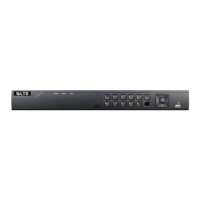
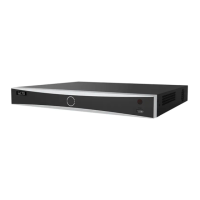
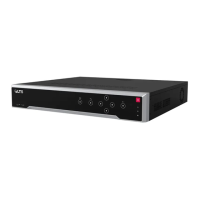
| Model | LTN86 Series |
|---|---|
| Hard Drive Support | SATA |
| Audio Output | RCA |
| Type | NVR (Network Video Recorder) |
| Channels | 8/16/32/64 |
| Video Output | HDMI, VGA |
| Recording Resolution | Up to 8MP (3840x2160) |
| Resolution Support | 8MP/5MP/4MP/3MP/1080p |
| HDD Capacity | Up to 10TB per HDD |
| Maximum Hard Drive Capacity | Up to 10TB per HDD bay (Varies by model) |
| Incoming Bandwidth | 160Mbps |
| Outgoing Bandwidth | 160Mbps |
| Decoding Format | H.265/H.264 |
| Compression | H.265+/H.265/H.264+/H.264 |
| Audio Input | RCA |
| Network Interface | RJ45 10/100/1000Mbps |
| USB Interface | USB 2.0 |
| Power Supply | 100-240V AC, 50/60Hz |
| Operating Temperature | -10 °C to +55 °C (14 °F to +131 °F) |
| Operating Humidity | 10% to 90% |

 To Next Page