Brakes
Braking Systems
WARNING: It is critical to occupant
safety that your braking systems are
always functioning properly. If you
experience any braking issues or
receive any fault messages regarding
the braking system, contact a Lucid
Service Center immediately.
WARNING: Driving through heavy rain
or water can have a temporary adverse
effect on braking efficiency.
CAUTION: Do not rest your foot on
the brake pedal while the vehicle is
in motion unless you are applying the
brakes. Resting your foot on the brake
pedal can cause premature brake
wear.
The foot pedal hydraulically-operated brakes
are electrically boosted, but only when the
vehicle is On. If the vehicle loses power when
driving, you will need to apply more force on
the brake pedal and you will experience longer
stopping distances.
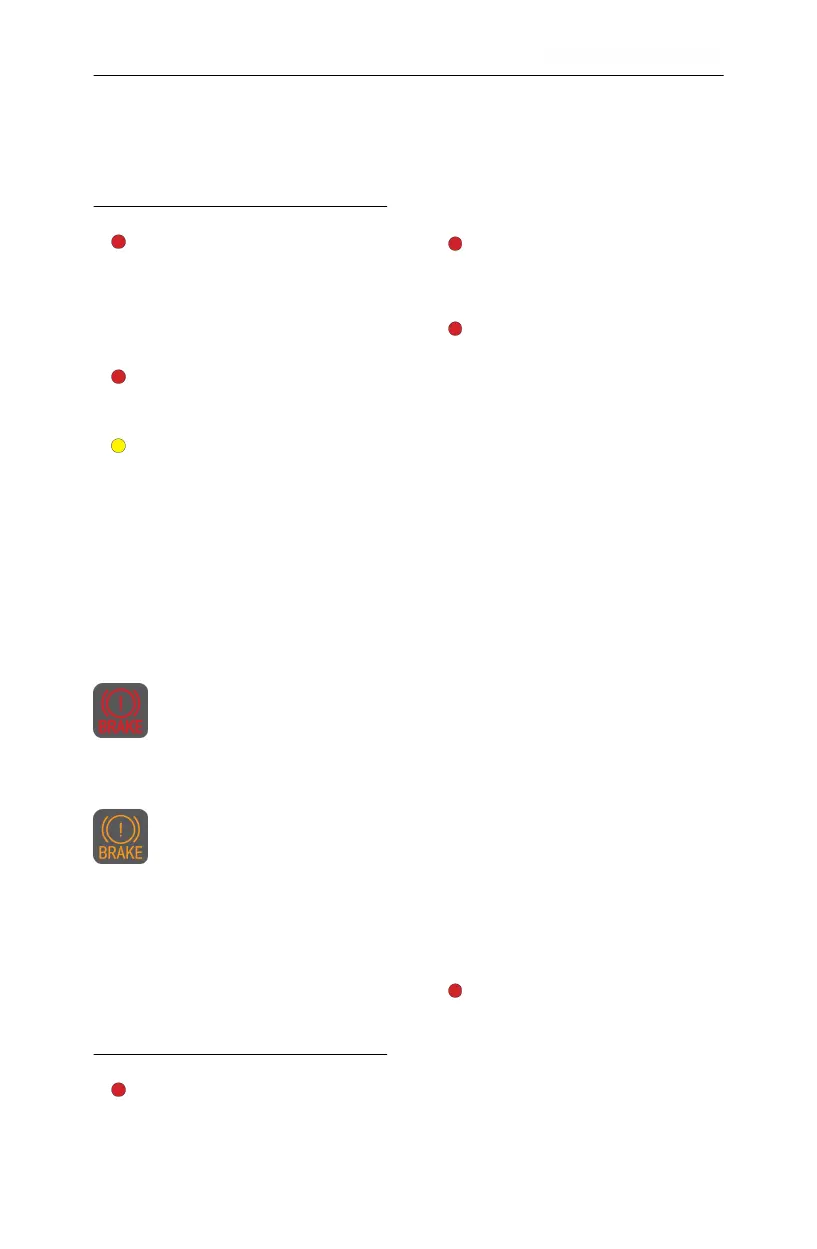
If the brake fluid level in the
reservoir is low, a red brake indicator
and a notification message will be
displayed on the Cockpit Panel.
See Checking Brake Fluid on page 157.
If the yellow brake indicator displays
on the Cockpit Panel, a brake
system fault has been detected.
Contact a Lucid Service Center as
soon as possible.
Note: It's normal for new brakes to produce
minor noises during a break-in period, during
which time the brake pad and rotor optimize
their surfac contact area and friction force. A
typical break-in period is approximately 20-25
stops from 35mph (56 kph) or higher.
Anti-Lock Braking System (ABS)
WARNING: Always maintain an
appropriate distance from the vehicle
in front. ABS cannot overcome the
physical limitations of trying to stop
the vehicle in too short a distance.
WARNING: The braking distance on
road surfaces that are wet, slippery
or loose is always increased; even for
vehicles equipped with ABS.
WARNING: Always drive with due care
and attention to your surroundings
and road conditions. ABS will not
correct driver errors.
Your vehicle is equipped with an Anti-lock
Braking System (ABS) that helps prevent the
wheels from locking during hard braking or
when braking on roads with reduced grip.
During braking, the ABS monitors the speed
of each wheel and varies the brake fluid
pressure at each wheel to prevent the
wheels from locking. This system helps
maintain steering ability during maximum
brake application.
When ABS activates, you may experience the
following conditions:
- Pulsations in the brake pedal
- A slight drop of the brake pedal
- Clicking or grinding noises
- ABS warning indicator flickering on and
off as the system activates
These conditions demonstrate that ABS is
operating and are not a cause for concern.
Maintain a firm and steady pressure on the
brake pedal while experiencing the pulsation.
Emergency braking
WARNING: Do not pump the brake
pedal. This interrupts the operation of
the ABS system and increases your
stopping distance, which could lead to
a collision.
In an emergency, fully press the brake pedal
even when the road surface is slippery.
Driving & Operating
78



 To Next Page