3
N31U User manual
1 APPLICATION
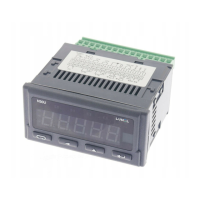
The N31U meter is a digital panel meter adapted to be xed to the panel de-
signed to measure standard analog signals used in automation. N31U meters
enable the measurement of standardized voltage and current signals, the sig-
nals from RTD and thermocouple sensors. The measuring value can be freely
converted into the required value using the mathematical functions or an indi-
vidual characteristic.
Additionally, the meter supports the programmable alarm with the delay acti-
vation and deactivation function as well as a memory of the alarm event. The
functionality of the meter is complemented by RS-485 interface.
The user interface consists four buttons and the high contrast LCD display
with back-light. Thanks to the two-line display, it is possible to set the selected
unit, display simultaneously the measuring value and the value not converted
by individual characteristics, as well as a clear and user friendly menu with
simultaneously visible the parameter name and its value.
Features of the N31 meter:
• Universal measuring input including the standard signals used in automation.
• Measuring sensor failure indication.
• High contrast LCD display with built-in backlight.
• Two-line display.
• Programmable unit of measuring value.
• Possibility to simultaneously display a measuring value and not conver-
ted quantity.
• Programmable displayed precision with automatic setting of a deci-
mal point.
• Possibility to program the measuring range (narrowing).
• Additional measurement of minimum and maximum values during the mo-
ving window, with the possibility of programming one of these values to be
displayed as the basic one.
• Programmable alarm with the functions of programmable delays of alarm
activation and deactivation, triggered by a specic controlling value.
• Possibility to control the alarm output (relay) via the RS-485 interface.
• Built-in by default RS-485 interface with MODBUS RTU protocol support.
• Possibility to password protect the settings against unauthori-
zed modication.
• Monitoring of set parameters.
• Measuring quantity conversion using the mathematical functions.
• Measuring quantity conversion using the 32 points individual characteristic.
• Programmed averaging time - averaging algorithm in a specified time
using standard averaging (determining the number of measurements to



 To Next Page
 Loading...