
 Need help?
Do you have a question about the MacDon FlexDraper FD2 Series and is the answer not in the manual?
Details recommended lubricants, specifications, uses, and capacities for machine operation.
Outlines essential maintenance checks for the first 50 hours of operation to ensure component longevity.
Advises logging hours and following the maintenance schedule for machine longevity.
Details initial setup steps for header float and wing balance, including leveling and basic adjustments.
Explains how to check the header float setting using a multi-tool and indicators.
Describes how to adjust header weight by turning adjustment bolts and securing them.
Details the process of checking wing balance using a flex checker cable and indicators.
Guides on how to adjust wing balance for too light or too heavy conditions and locking.
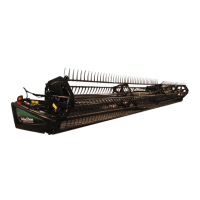
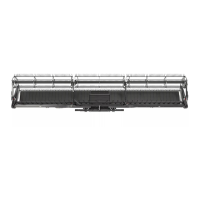
The MacDon FD2 Series FlexDraper Header and FM200 Float Module are designed to optimize harvesting efficiency through precise control over header float and wing balance. This manual outlines the procedures for setting these critical parameters and provides essential maintenance guidelines to ensure the machine's longevity and performance.
The FlexDraper Header and Float Module work in conjunction to allow the header to follow ground contours effectively, minimizing crop loss and maximizing cutting efficiency. The "float" mechanism enables the header to move vertically, adapting to uneven terrain, while the "wing balance" system ensures that the header's wings maintain consistent ground pressure across their span. This combination is crucial for harvesting various crops in diverse field conditions, ensuring a clean cut and efficient feeding into the combine.
The header float system is controlled by a float setting lever and indicators, which allow the operator to adjust the header's weight distribution. This adjustment is critical to prevent the header from being either too heavy (digging into the ground) or too light (skipping over crop). The float height indicators provide visual feedback on the header's position relative to the ground during operation.
The wing balance system, on the other hand, focuses on the lateral stability and ground pressure of the header's wings. It uses spring handles and adjustment bolts to fine-tune the weight distribution across the wings. A flex checker cable and plate are used to measure and interpret the wing balance, guiding the operator to make precise adjustments. Proper wing balance ensures that both wings maintain consistent contact with the ground, preventing uneven cutting and reducing wear on components.
Setting the header float and wing balance involves a series of pre-adjustments and calibration steps. The process begins by parking the combine on a level surface and ensuring the feeder house is level, using a bubble level on the float module. The cutterbar height is set to a specific measurement off the ground, and the header angle hydraulic cylinder and reel fore-aft position are adjusted according to indicators. The reel is then fully lowered, and the combine is shut down for safety.
To set the header float, the operator first removes the linkage cover and places both left and right wing lock spring handles in the locked position. The header float locks are then placed in the unlocked (lowered) position, and stabilizer/transport wheels are set to their uppermost position. The float setting lever is manually lifted to remove slack, and a multi-tool is used to fully engage the lever, locking it in place. The header is moved up and down several times to reduce friction. After removing the multi-tool, the smaller float setting indicator (FSI) is inspected. If the FSI points to a value higher than 2, the header is too heavy; if lower than 2, it's too light. Adjustments are made by loosening bolts and rotating spring locks and adjustment bolts to either decrease or increase header weight, ensuring the FSI values are equal on both sides. Once adjusted, the bolts are tightened, and the header is fully lowered.
For checking and adjusting wing balance, the header float must be properly set. A flex checker cable is attached to the flex checker cable lock. The spring handle on the side being adjusted is moved to the lower (UNLOCK) position, while the opposite wing remains locked. Header float locks are placed in the locked position on both sides. On the flex checker plate, indicators are pinched together, and a multi-tool is used to rotate the plate up and down to obtain two readings. These readings are interpreted using a reference chart to determine if the wing is too light, too heavy, or balanced. Adjustments are made by turning an adjuster bolt to move a clevis in the appropriate direction. After rechecking the balance, the spring handle is moved to the upper (LOCK) position. The flex checker cable is detached, and the process is repeated on the other side. Finally, the multi-tool is returned to storage, and the linkage cover is reinstalled.
Regular maintenance is crucial for the optimal performance and longevity of the FD2 Series FlexDraper Header and FM200 Float Module. The manual emphasizes the use of clean fluids and lubricants, stored in dust-free and moisture-free containers.
Break-in inspections are recommended for the first 50 hours of operation to prevent major component service or replacement. These include:
Ongoing maintenance intervals are outlined in the operator's manual, which includes a comprehensive schedule and record-keeping system. Logging hours of operation and maintaining records are essential for following the maintenance schedule, which in turn increases the machine's life. Specific lubricants and fluids are recommended, including SAE multi-purpose grease for driveline slip-joints, knife drive box, main gearbox, and completion gearbox; SAE 85W-140 gear lubricant for the knife drive box, main gearbox, and completion gearbox; and single-grade trans-hydraulic oil (e.g., Petro-Canada Duratran, John Deere Hy-Gard J20C, Case Hy-Tran Ultraction, AGCO Power Fluid 821 XL) for the header drive systems reservoir. Chain oil with a viscosity of 100-150 sCt at 40°C or mineral oil SAE 20W is specified for the reel drive chain. These detailed maintenance guidelines ensure that all critical components are properly lubricated and functioning, minimizing wear and maximizing operational efficiency.
 General
| Drive System | Hydraulic |
|---|---|
| Working Width | 30 ft, 35 ft, 40 ft |
| Crop Compatibility | Soybeans, Canola |
| Flexibility | Up to 12 in |
| Cutting Width | 30 ft, 35 ft, 40 ft |
| Weight | Varies by model |
| Reel Speed | Adjustable |
| Float Range | Up to 12 in |
| Compatible Combines | John Deere, Case IH, New Holland, Gleaner |


 To Next Page

