5-15
2.4 INSPECTION AND MAINTENANCE
k DANGER
Mandatory
• The equipment must be inspected every day.
If the equipment is not inspected and maintained, error and malfunctions may not be discovered which
could lead to accidents.
•Before inspection, perform the following steps.
(1) Shut off all input power to the inverter.
(2) Wait at least ten minutes and check to make sure that the change lamp is no longer lit.
(3) Use a tester that can measure DC voltages (800V DC or more), and check that the voltage to the DC
main circuits (across PA-PC) does not exceed 45V.
Performing an inspection without carrying out these steps first could lead to electric shook.
Be sure to inspect the inverter regularly and periodically to prevent it from breaking down because of the environment of use, such
as temperature, humidity, dust and vibration, or deterioration of its components with again.
2.4.1 REGULAR INSPECTION
Since electric parts are susceptible to heat, install the inverter in a cool, well-ventilated and dust-free place.
This is essential for increasing the service life.
The purpose of regular inspections is to maintain the correct environment of use and to find any sign of failure or malfunction by
comparing current operation data with past operation records.
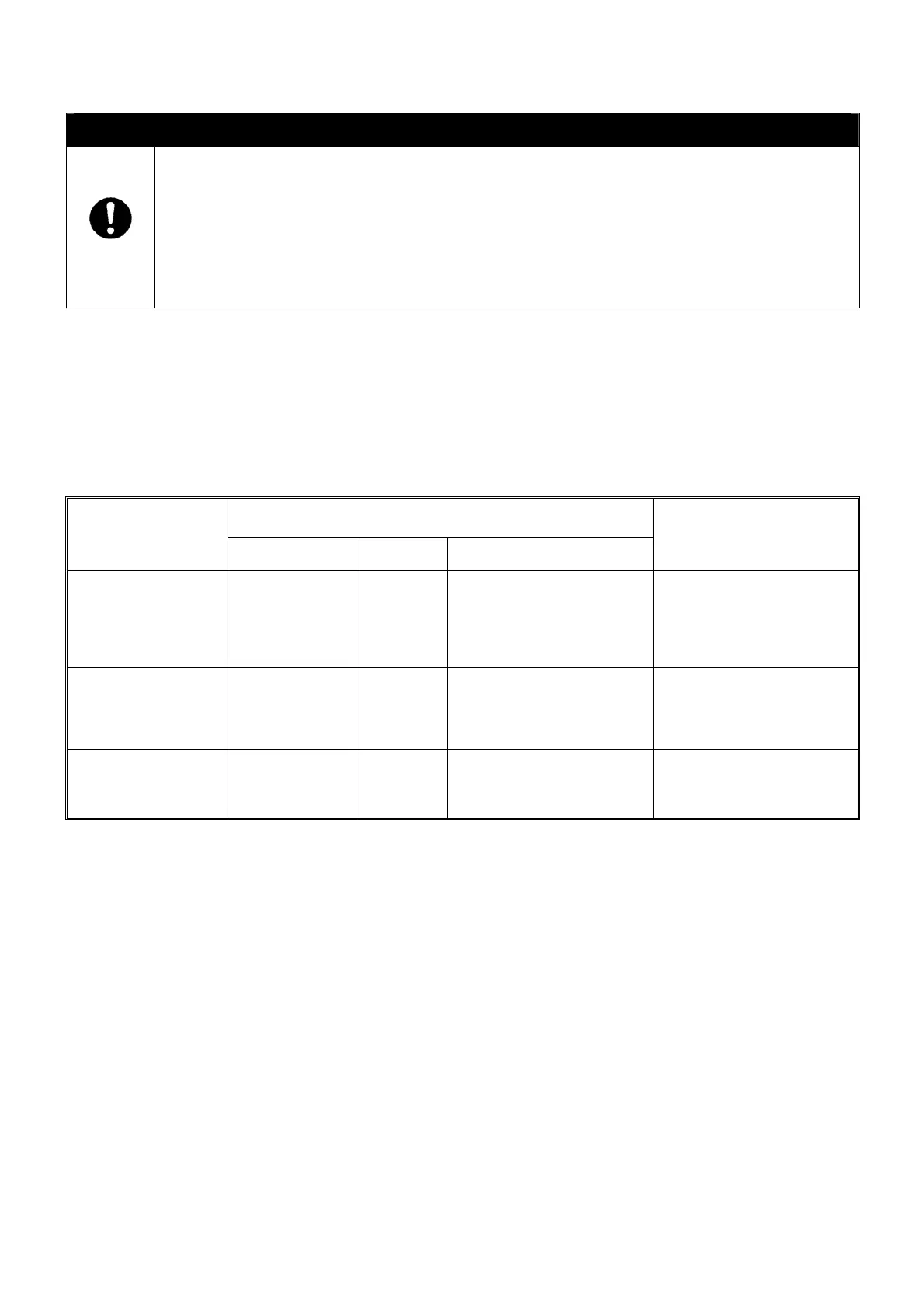
Inspection procedure
Subject of inspection
Inspection item
Inspection
cycle
Inspection method
Criteria for judgment
1. Indoor environment
1) Dust, temperature
and gas
2) Drop of water or
other liquid
3) Room temperature
Occasionally
Occasionally
Occasionally
1) Visual check, check by means of
a thermometer, smell check
2) Visual check
3) Check by means of a
thermometer
1) Improve the environment if it is
found to be unfavorable.
2) Check for any trace of water
condensation.
3) Max. temperature: 60
°C
2. Units and components 1) Vibration and noise Occasionally Tactile check of the cabinet
Is something unusual is found,
open the door and check the
transformer, reactors, contactors,
relays, cooling fan, etc., inside. If
necessary, stop the operation.
3. Operation data
(output side)
1) Load current
2) Voltage (*)
3) Temperature
Occasionally
Occasionally
Occasionally
Moving-iron type AC ammeter
Rectifier type AC voltmeter
Thermometer
To be within the rated current,
voltage and temperature.
No significant difference from data
collected in a normal state.
(*): The voltage measured may slightly vary from voltmeter to voltmeter. When measuring the voltage, always take readings from the same
circuit tester or voltmeter.
■ Check points
1. Something unusual in the installation environment
2. Something unusual in the cooling system
3. Unusual vibration or noise
4. Overheating or discoloration
5. Unusual odor
6. Unusual motor vibration, noise or overheating
7. Adhesion or accumulation of foreign substances (conductive substances)
201



 To Next Page