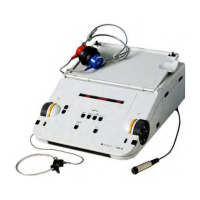
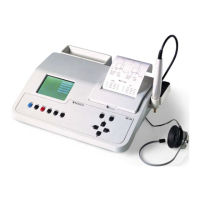
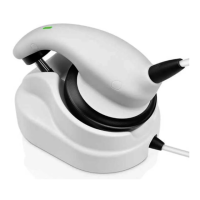
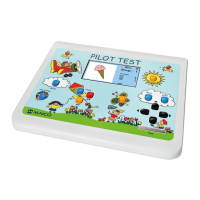
To operate the device, establishing a PC-connection via USB is
required.
This equipment is intended to be connected to other equipment
thus forming a Medical Electrical System. External equipment
intended for connection to signal input, signal output or other
connectors shall comply with the relevant product standard e.g.
IEC 60950-1 for IT equipment and the IEC 60601-series for
medical electrical equipment. In addition, all such combinations
– Medical Electrical Systems – shall comply with the safety
requirements stated the general standard IEC 60601-1, edition
3.1, clause 16.
Any person who connects external equipment to signal input,
signal output or other connectors has formed a Medical
Electrical System and is therefore responsible for the system
to comply with the requirements. If in doubt, contact qualified
medical technician or your local representative. If the device is
connected to a PC (IT equipment forming a system) ensure not
to touch t
he patient while operating the PC or PC equipment.
The device is not intended for operation in areas with an
explosion hazard. Do NOT use the device in a highly oxygen-
enriched environment, such as a hyperbaric chamber, oxygen
tent, etc. If the device is not used switch it off and disconnect it
from the power supply.
Never short-circuit the terminals.
In order to maintain a high level of safety and to ensure the
device works properly, it is necessary to have the device
checked according to the medical electrical safety standard
IEC 60601-1 by a qualified service technician at least every
twelve months. For more information see Section 3.2.
The use of non-calibrated devices can lead to incorrect test
results and is not advisable.
Prevent cable breakage: cables must not be bend or buckled.
2.8 Electromagnetic Compatibility (EMC)
This device is suitable in hospital environments except for
near active HF surgical equipment and RF shielded rooms of
systems for magnetic resonance imaging, where the intensity
of electromagnetic disturbance is high.



 To Next Page