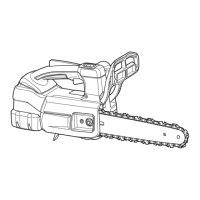
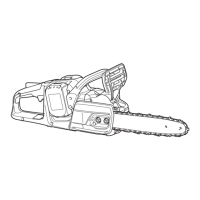
This document is an instruction manual for the Makita Cordless Chain Saw models DUC303, DUC353, and DUC400. It provides comprehensive information on the safe and effective operation, maintenance, and troubleshooting of these tools.
The chain saw is designed for sawing wood. It is a cordless power tool, emphasizing the importance of battery safety and proper handling. The manual begins with a list of symbols used throughout the document, indicating crucial safety information such as "Read instruction manual," "Wear safety glasses," "Wear ear protection," "Wear a helmet, goggles and ear protection," "Use appropriate protection for foot-leg and hand-arm," "Do not expose to moisture," and "Direction of chain travel." It also includes symbols for saw chain oil adjustment and battery types (Cd, Ni-MH, Li-ion), and a note for EU countries regarding the disposal of electric equipment and battery packs.
Safety warnings are a prominent feature of the manual, covering general power tool safety, electrical safety, and personal safety. Users are advised to keep the work area clean and well lit, avoid operating in explosive atmospheres, and keep children and bystanders away. Electrical safety emphasizes matching power tool plugs to outlets, avoiding body contact with earthed surfaces, and not exposing power tools to rain or wet conditions. Personal safety instructions include staying alert, using common sense, wearing personal protective equipment (eye protection, dust mask, non-skid safety shoes, hard hat, hearing protection), and preventing unintentional starting.
Specific cordless chain saw safety warnings are also provided. These include keeping all body parts away from the saw chain when operating, holding the chain saw with both hands (right hand on the rear handle, left hand on the front handle), and using insulated gripping surfaces to avoid electric shock from hidden wiring. Additional warnings cover wearing safety glasses and hearing protection, not operating the chain saw in a tree, maintaining proper footing, being alert for spring back when cutting limbs under tension, using extreme caution with brush and saplings, and carrying the chain saw safely with the guide bar cover fitted. The manual also stresses the importance of proper lubrication, chain tensioning, and accessory changes, as well as keeping handles dry, clean, and free from oil and grease.
The manual includes important safety instructions for the battery cartridge. Users are instructed to read all instructions and cautionary markings on the charger, battery, and product before use. Key points include not disassembling the battery cartridge, stopping operation if the battery time becomes excessively shorter, rinsing eyes with clear water and seeking medical attention if electrolyte gets into them, and preventing short circuits by not touching terminals with conductive material or storing with other metal objects. It also warns against exposing the battery cartridge to water or rain, storing in high temperatures, incinerating, dropping, or using damaged batteries. For commercial transport, specific regulations for lithium-ion batteries must be observed.
Regarding battery maintenance, the manual advises charging the battery cartridge before it is completely discharged and stopping tool operation when power decreases. It also recommends not overcharging, charging at room temperature, and charging if not used for long periods.
The functional description section details how to install and remove the battery cartridge, emphasizing the importance of switching off the tool and holding the tool and cartridge firmly. It also explains the tool/battery protection system, which includes overload protection (tool stops and main power lamp blinks if current is too high) and overheat protection (tool stops and capacity indicator lamp blinks if overheated). Overdischarge protection is also mentioned, where the tool stops automatically when battery capacity is low. The manual describes how to indicate the remaining battery capacity using the check button and capacity indicator lamps.
The main power switch operation is explained, noting that pressing it turns the chain saw to standby mode (main power lamp lights up) and pressing again turns it off. It also describes the auto power-off function to prevent unintentional startup. The switch action section highlights the lock-off lever, a safety feature to prevent unintended starting, and warns against defeating its purpose.
Checking the chain brake involves holding the chain saw with both hands, depressing the lock-off lever, pulling the switch trigger, and then pushing the front hand guard forward to ensure the chain saw stops immediately. The run-down brake check involves running the chain saw and releasing the switch trigger to ensure the chain stops within one second.
Adjusting chain lubrication is done via an adjusting screw to control the oil pump feed rate.
The assembly section provides instructions for removing and installing the saw chain. It advises ensuring the tool is switched off and the battery cartridge is removed, wearing gloves, and allowing the saw chain and guide bar to cool if recently used. Steps include pulling the lever, removing the sprocket cover, and then removing the saw chain and guide bar. For installation, the direction of the chain, fitting it onto the guide bar and sprocket, resting the guide bar, and positioning the adjusting pin are detailed.
Adjusting saw chain tension is a critical maintenance step. The manual warns against overtightening or having a loose chain, which can lead to breakage or injury. The process involves loosening the sprocket cover, lifting the guide bar tip, adjusting the tension with the dial, and then securing the sprocket cover.
The operation section covers lubrication, explaining that the saw chain is automatically lubricated during operation. Users should periodically check and refill the oil tank with Makita saw chain oil or equivalent, avoiding oils with dust, particles, or volatile components. For pruning trees, botanical oil is recommended.
Working with the chain saw includes safety precautions for first-time users, such as practicing on a saw-horse or cradle, securing round pieces, keeping body parts away from the chain, holding the chain saw firmly with both hands, and avoiding overreaching. It also describes the proper technique for bucking (cutting logs), limbing (removing branches), burrowing, and parallel-to-grain cuts, emphasizing the risks of kickback and the need for trained persons for certain operations. Felling trees requires specific procedures, including cutting a scarf and a back cut, and using plastic or aluminum wedges. Carrying the tool safely involves applying the chain brake, removing battery cartridges, and fitting the guide bar cover.
Maintenance features include sharpening the saw chain when it produces mealy sawdust, penetrates wood with difficulty, has a damaged cutting edge, or pulls to one side. It provides criteria for sharpening, including ensuring all cutter lengths are equal and replacing the chain if the cutter length reaches 3 mm or shorter. The manual specifies the correct sharpening angle (30°) and depth gauge distance (0.65 mm for both 90PX and 91PX chain blades), and recommends using a special round file with specific diameters (4.5 mm for 90PX, 4.0 mm for 91PX).
Other maintenance tasks include cleaning the guide bar groove to prevent clogging and ensure proper oil flow, cleaning the sprocket cover to remove chips and sawdust, and cleaning the oil discharge hole to prevent impaired oil delivery. The manual also provides instructions for replacing the sprocket, advising replacement if worn to prevent damage to a new saw chain.
For storing the tool, users are instructed to clean it, lubricate the saw chain and guide bar by running it under no load, cover the guide bar with its cover, and empty the oil tank.
A periodic maintenance schedule is provided in a table, detailing inspection and cleaning tasks for the chain saw, saw chain, guide bar, chain brake, chain lubrication, switch trigger, lock-off lever, oil tank cap, chain catcher, and screws/nuts, with recommended frequencies (before operation, everyday, every week, every 3 months, annually, before storage). It emphasizes that repairs and adjustments should be performed by Makita Authorized or Factory Service Centers using genuine Makita replacement parts.
The troubleshooting section lists common malfunction statuses, their possible causes, and corresponding actions to resolve them, such as installing charged battery cartridges, recharging batteries, turning on the main power switch, releasing the chain brake, filling the oil tank, cleaning the oil guide groove, adjusting oil delivery, installing battery cartridges properly, and consulting an authorized service center for worn brake bands or tool malfunctions.
Finally, the manual lists optional accessories like saw chain, guide bar, guide bar cover, file, tool bag, and Makita genuine battery and charger, with a warning to use only recommended accessories to avoid injury. It also notes that some items may be included as standard accessories and may vary by country.



 To Next Page
 General