Aggressive condensate possible.
Chemical burns due to aggressive media possible!
Wear protective glasses and protective clothes when dismounting,
repairing or cleaning the sensor!
14.3 ADJUSTMENT OF SENSITIVITY
A standard adjustment of the electronic controllers LA1.1 and LA1.4 for a conductivity of 100 µS/cm is
carried out at the factory. In this case, the length of the sensor connection cable is irrelevant.
If a continuous alarm is present after commissioning and the red LED lights up continuously, although
the sensor is dry or if there is no alarm message despite a wet sensor, sensitivity adjustment of the
sensor is necessary.
Adjustment range at the electronic controllers: 50 µS/cm to 1 mS/cm.
The following steps must be carried out for the sensitivity adjustment:
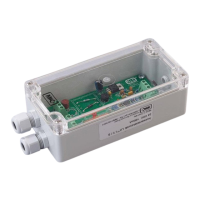
• Remove the 4 cover screws of the electronic controller LA1.1 and then remove the cover.
• Disassemble the sensor and clean and dry the electrodes.
• In case of permanent alarm with a dry and clean sensor:
o Turn the potentiometer “P1” on the LA1.1 or the “Sensitivity adj.” screw on the LA1.4
anticlockwise (to lower sensitivity) until the alarm is out.
o Then short-circuit the sensor electrodes with a damp finger. The electronic controller
LA1... must then immediately display the alarm, i.e. the red LED lights up.
• In case the alarm does not respond, when the sensor electrodes are short-circuited with
a damp finger:
o Turn the potentiometer “P1” (LA1.1) or the “Sensitivity adj.” screw (LA1.4) clockwise (to
higher sensitivity) until the alarm lights up, i.e. the red LED lights up.
• For the LA1.1 electronic controller, screw on the 4 cover screws again.
• Wipe the electrodes dry with a cloth and reassemble the sensor.
For condensate with low conductivity, do not short-circuit the sensor with a
damp finger. Instead, clean the sensor with distilled water first and then
moisten the sensor with the appropriate condensate.


 To Next Page