COMPRESSOR SECTION
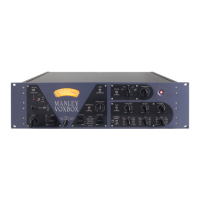
J. COMPRESSOR BYPASS: With this switch up the compressor is engaged. This switch is unique-
ly designed to be used during music. No clicks, no pops and the change of level occurs smoothly.
The compressor is uniquely before the preamp so that transients are “tamed” before the signal enters
the tube circuit. This makes it possible to have exceptionally clean, smooth tracks. It also allows the
normal “mic preamp into outboard compressor into tape” to be essentially “purist mic pre direct to
tape” with compression invisibly taking place. We use a passive opto-isolator for the gain control
element which adds no measurable distortion or noise and only 0.1 dB of insertion loss.
K. COMPRESSOR THRESHOLD: Turning this control clockwise increases compression. This
control is after the INPUT control. There is no “make-up gain” control so some degree of balancing
between INPUT and THRESHOLD is expected. Adding the make-up gain or output level would
have compromised the sonic integrity for the sake of conventionality. The compressor “ratio” is
program dependent and non-linear but is generally similar to 3:1 ratios on VCA based compressors.
L. ATTACK: This controls how the compressor reacts to transients such as explosive consonants or
drums. Slower settings tend to “ignore” transients and let them through untouched. Faster settings
tend to reduce transients which has an audible effect of reducing, for example, the strike of a drum
or the “P”s as in “puppy”. Vocals will usually be best with medium settings. Engineers most famil-
iar with compressors will notice the unusual way the “attack” rides above the reduction set by the
release. Attack changes are most noticable on slower releases on this unit.
M. RELEASE: This controls how fast or slow the compressor returns to full volume. Because vari-
ous RC networks are switched in this control also has some effect on attack rates. The nal release
as reduction approaches 0 dB is a “bonus” function of the Opto. Each setting is actually a separate
complex set of “tuned” time constants. The FAST setting mimics the Manley Electro-Optical Limit-
er and works best in the range of 3 to 8 dB of compression. The MED FAST setting is much like old
LA-2A’s but is also tuned for drums and bass and works well with dynamic broadcast audio. This
setting is designed to pump a bit with the Attack at Slow. MED and MED SLOW are the usual choic-
es for vocals. SLOW is a very slow release and is for the most inaudible compression. RELEASE
SLOW + ATTACK SLOW uniquely mimics a good engineer “riding” a fader. Good for great sing-
ers, questionable for dynamic material. LA-2A = FAST ATTACK & MEDIUM FAST RELEASE or FAST
RELEASE (or LIMITER) LA-3A = SLOW or MEDIUM ATTACK & MEDIUM SLOW RELEASE
N. LINK: Switching up connects or links a second VOXBOX for stereo applications. It ensures that
when either compressor channel reduces gain that both units will reduce the same number of dBs.
This is so that a center image does not drift when a peak is on one side. Both sets of controls should
normally be set to the same positions. It links both the compressor and the de-esser to the second
VOXBOX if RCA LINK interconnects are between both units. The RCA male to male interconnect
can be any typical stereo hi- type.
7


 To Next Page
 Loading...