EasyManua.ls Logo

Marantz 2110 - Test Equipment Required; AM Tuning Display Adjustment; Am Alignment Procedures; AM Frequency Range and Tracking Alignment

Marantz 2110
32 pages
Print Icon
To Next Page IconTo Next Page
To Previous Page IconTo Previous Page
Loading...
2.
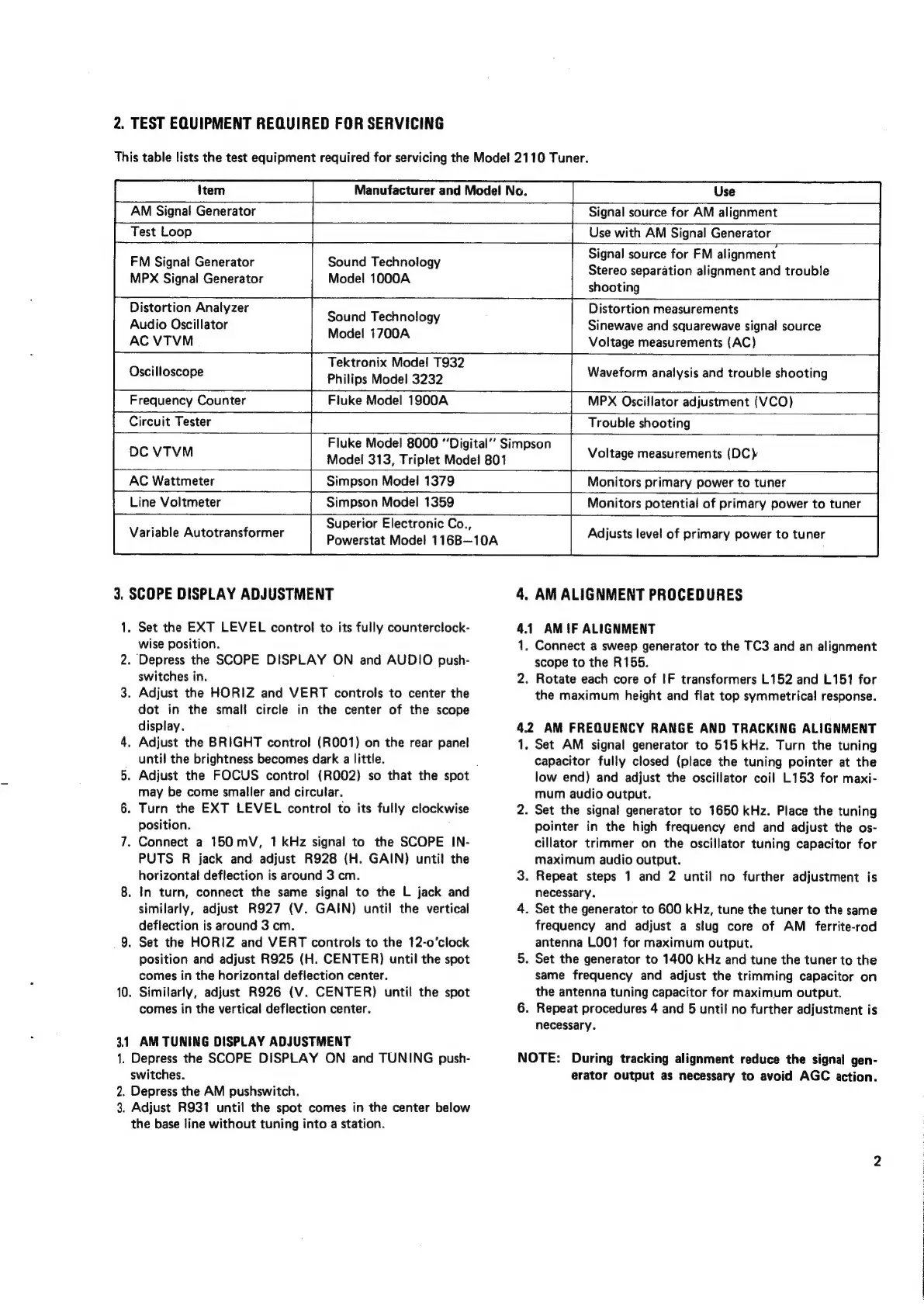
TEST
EQUIPMENT
REQUIRED
FOR
SERVICING
This
table
lists
the
test
equipment
required
for
servicing
the
Model
2110
Tuner.
item
AM
Signal
Generator
Test
Loop
Sound
Technology
Model
1000A
FM
Signal
Generator
MPX
Signal
Generator
Manufacturer
and
Model
No.
Use
Signal
source
for
AM
alignment
Use
with
AM
Signal
Generator
Signal
source
for
FM
alignment
Stereo
separation
alignment
and
trouble
shooting
Distortion
Analyzer
Audio
Oscillator
AC
VTVM
Sound
Technology
Model
1700A
Distortion
measurements
Sinewave
and
squarewave
signal
source
Voltage
measurements
(AC)
Tektronix
Mode!
T932
Philips
Model
3232
Oscilloscope
Waveform
analysis
and
trouble
shooting
Frequency
Counter
Fluke
Model
1900A
MPX
Oscillator
adjustment
(VCO)
Circuit
Tester
Trouble
shooting
DC
VTVM
|
Fluke
Model
8000
‘‘Digital’’
Simpson
Model
313,
Triplet
Mode!
801
Voltage
measurements
(DC}
AC
Wattmeter
Simpson
Model
1379
Monitors
primary
power
to
tuner
Line
Voltmeter
Simpson
Model
1359
Monitors
potential
of
primary
power
to
tuner
Superior
Electronic
Co.,
Variable
Autotransformer
3.
SCOPE
DISPLAY
ADJUSTMENT
1.
Set
the
EXT
LEVEL
control
to
its
fully
counterclock-
wise
position.
2.
Depress
the
SCOPE
DISPLAY
ON
and
AUDIO
push-
switches
in.
3.
Adjust
the
HORIZ
and
VERT
controls
to
center
the
dot
in
the
small
circle
in
the
center
of
the
scope
display.
4,
Adjust
the
BRIGHT
control
(R001)
on
the
rear
panel
until
the
brightness
becomes
dark
a
little.
5.
Adjust
the
FOCUS
control
(R002)
so
that
the
spot
may
be
come
smaller
and
circular.
6.
Turn
the
EXT
LEVEL
control
to
its
fully
clockwise
position.
7.
Connect
a
150
mV,
1
kHz
signal
to
the
SCOPE
IN-
PUTS
R
jack
and.
adjust
R928
(H.
GAIN)
until
the
horizontal
deflection
is
around
3
cm.
8.
In
turn,
connect
the
same
signal
to
the
L
jack
and
similarly,
adjust
R927
(V.
GAIN)
until
the
vertical
deflection
is
around
3
cm.
9.
Set
the
HORIZ
and
VERT
controls
to
the
12-o’clock
position
and
adjust
R925
(H.
CENTER)
until
the
spot
comes
in
the
horizontal
deflection
center.
10.
Similarly,
adjust
R926
(V.
CENTER)
until
the
spot
comes
in
the
vertical
deflection
center.
3.1
AM
TUNING
DISPLAY
ADJUSTMENT
1.
Depress
the
SCOPE
DISPLAY
ON
and
TUNING
push-
switches.
2.
Depress
the
AM
pushswitch.
3.
Adjust
R931
until
the
spot
comes
in
the
center
below
the
base
line
without
tuning
into
a
station.
Powerstat
Model
116B—10A
Adjusts
level
of
primary
power
to
tuner
4.
AM
ALIGNMENT
PROCEDURES
4.1
AM
IF
ALIGNMENT
1,
Connect
a
sweep
generator
to
the
TC3
and
an
alignment
scope
to
the
R155.
2.
Rotate
each
core
of
IF
transformers
L152
and
L151
for
the
maximum
height
and
flat
top
symmetrical
response.
4.2
AM
FREQUENCY
RANGE
AND
TRACKING
ALIGNMENT
1.
Set
AM
signal
generator
to
515
kHz.
Turn
the
tuning
capacitor
fully
closed
(place
the
tuning
pointer
at
the
low
end)
and
adjust
the
oscillator
coil
L153
for
maxi-
mum
audio
output.
.
Set
the
signal
generator
to
1650
kHz.
Place
the
tuning
pointer
in
the
high
frequency
end and
adjust
the
os-
cillator
trimmer
on
the
oscillator
tuning
capacitor
for
maximum
audio
output.
.
Repeat
steps
1
and
2
until
no
further
adjustment
is
necessary.
.
Set
the
generator
to
600
kHz,
tune
the
tuner
to
the
same
frequency
and
adjust
a
slug
core
of
AM
ferrite-rod
antenna
LOO1
for
maximum
output.
.
Set
the
generator
to
1400
kHz
and
tune
the
tuner
to
the
same
frequency
and
adjust
the
trimming
capacitor
on
the
antenna
tuning
capacitor
for
maximum
output.
.
Repeat
procedures
4
and
5
until
no
further
adjustment
is
necessary.
NOTE:
During
tracking
alignment
reduce
the
signal
gen-
erator
output
as
necessary
to
avoid
AGC
action.

Related product manuals