Need help?
Do you have a question about the Mase IS 2.7 B and is the answer not in the manual?
Defines intended use, operating limits, and identifies potential dangers and necessary precautions.
Explains various danger, warning, caution symbols and safety labels on the generator and in the manual.
Lists reference documents, regulations, legislative provisions, and generator identification data.
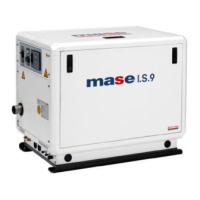
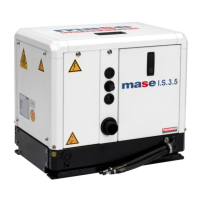
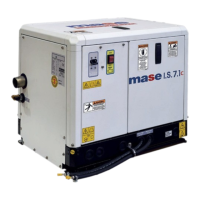
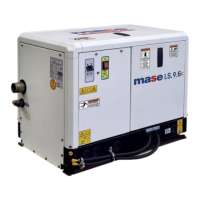
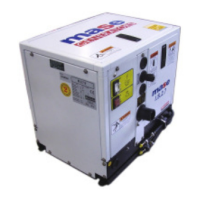
Details the main components that make up the generator unit, including frame, cowling, and connections.
Describes the instrument panel for commands and controls, listing its display and buttons.
Provides a detailed table of the generator's technical specifications, dimensions, and engine/alternator data.
Specifies requirements for installation location, ventilation, air intake, and temperature/humidity limits.
Provides instructions for safely lifting, handling, and securely anchoring the generator.
Covers the open-circuit seawater cooling system, feed systems, and necessary components.
Discusses direct and baffled intake systems, recommending the direct type for seawater cooling.
Lists and illustrates cooling circuit components like filters, valves, and check valves.
Illustrates typical installation configurations for the generator above and below the waterline.
Illustrates installation setups with an exhaust gas separator, above and below the waterline.
Details exhaust system requirements, components, and safety warnings like carbon monoxide risks.
Covers the diesel fuel system, including connections, filters, and the electric fuel pump operation.
Covers the procedures for connecting the generator's electrical systems.
Details correct battery connection procedures and how to connect the essential control panel.
Explains connecting an external battery pack to the CBU and the main AC connection.
Covers switching between generator and utility power, and the procedure for using the emergency stop.
Lists essential pre-start checks and provides safety precautions for refueling the generator.
Details the step-by-step procedure for starting the generator, including preheating and troubleshooting.
Explains the correct procedure for stopping the generator, including the importance of a cool-down period.
Describes protection against short-circuits, overloads, and low-voltage system faults.
Details the CBU unit, its displayed information, signals, and the five protection module fuses.
Emphasizes following manufacturer instructions and performing routine engine maintenance as scheduled.
Provides detailed procedures for checking engine oil level, changing oil, and replacing the oil filter.
Covers replacing fuel filters, bleeding the system, and cleaning the air filter.
Details draining the cooling system and replacing the sacrificial zinc anode to prevent corrosion.
Explains maintenance procedures for the seawater pump impeller and checking/adjusting the V-belt tension.
Covers minimal alternator maintenance and detailed instructions for battery activation and charging.
Lists essential spare parts and outlines operations for storing the generator during periods of inactivity.
Presents a comprehensive schedule for periodic checks and maintenance tasks at various intervals.
Provides a guide for identifying and resolving common anomalies, and instructions for ordering spare parts.
Provides guidelines for safe transport and storage, emphasizing environmental protection and proper positioning.
Details procedures for safely lifting and handling the generator using appropriate equipment and checking capacity.
Outlines the generator's guarantee terms, coverage, and exclusions for defects and improper use.
Defines MASE's responsibilities regarding generator safety, reliability, and performance under specific conditions.
Specifies responsible disposal methods for waste materials like batteries, oils, and filters generated during maintenance.
 General
| Brand | Mase |
|---|---|
| Model | IS 2.7 B |
| Category | Portable Generator |
| Language | English |

 To Next Page