EasyManua.ls Logo

MCi MC8 Crusader - Page 7

Default Icon
429 pages
Print Icon
To Next Page IconTo Next Page
To Previous Page IconTo Previous Page
Loading...
MAINTENANCE
Crusader
MC-8
[
,.
0
,------'--l
-~5
___
DATE
~J:..,,:,_.:_u
IJ_Ly,......c...19.:....:....73-=-----_]MANUAL
,
!----suitable
length
I
2 •
soo•
7
"
-,
8.00
Min.
I
l
t
1.779
11
----
1,911"
-
,.
~77"
I
,909"
i
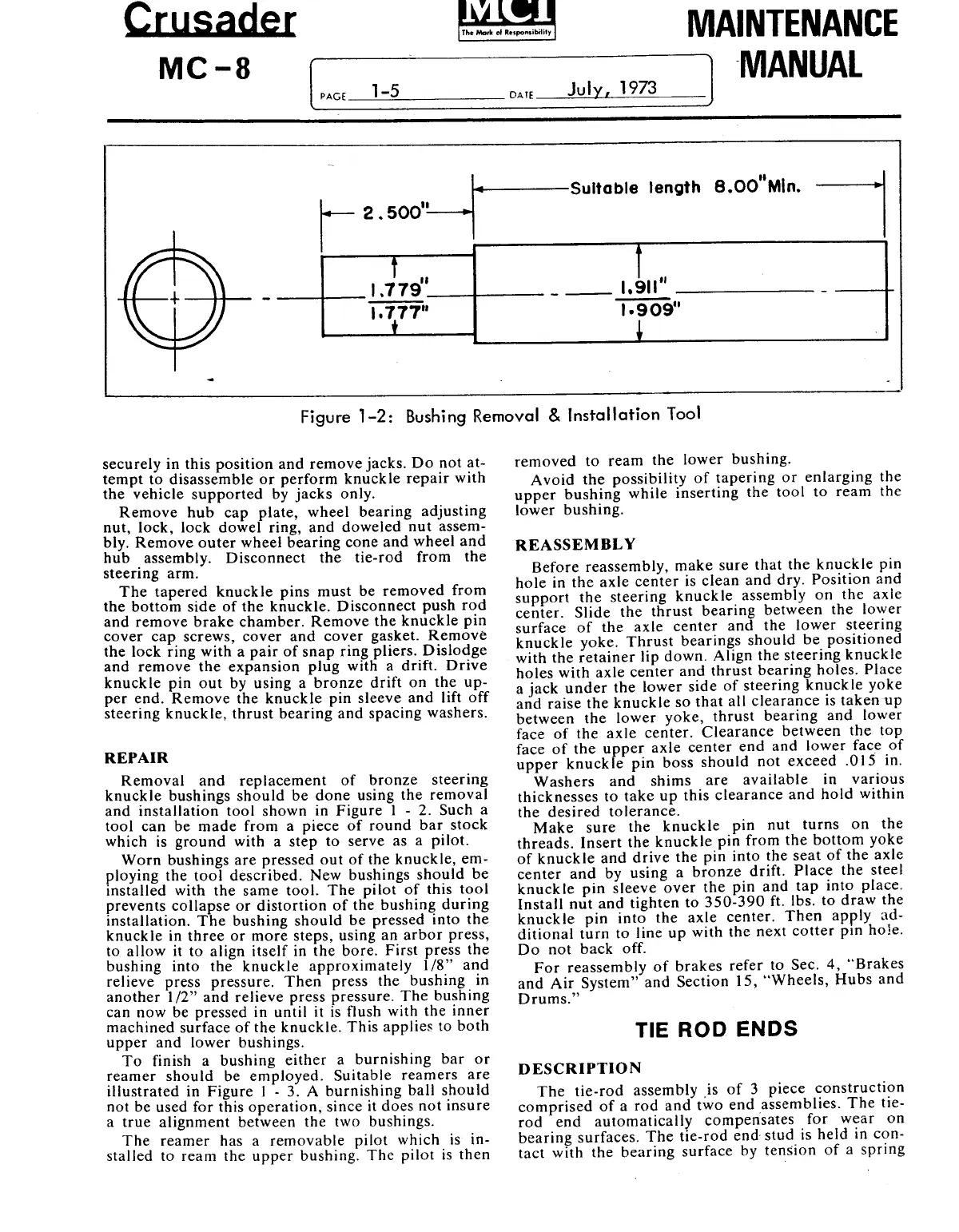
Figure
1-2:
Bushing Removal
&
Installation
Tool
securely
in this
position
and
remove
jacks.
Do
not at-
tempt
to
disassemble
or
perform
knuckle
repair
with
the
vehicle
supported
by
jacks
only.
Remove
hub
cap
plate,
wheel
bearing
adjusting
nut,
lock,
lock
dowel
ring,
and
doweled
nut
assem-
bly.
Remove
outer
wheel
bearing
cone
and
wheel
and
hub
assembly.
Disconnect
the
tie-rod
from
the
steering
arm.
The
tapered
knuckle
pins
must be
removed
from
the
bottom
side
of
the
knuckle.
Disconnect
push
rod
and
remove
brake
chamber.
Remove
the
knuckle
pin
cover
cap
screws,
cover
and
cover
gasket.
Remove
the
lock ring
with
a
pair
of
snap
ring
pliers.
Dislodge
and
remove
the
expansion
plug
with a drift.
Drive
knuckle
pin
out
by using a
bronze
drift
on
the
up-
per
end.
Remove
the
knuckle
pin sleeve
and
lift
off
steering
knuckle,
thrust
bearing
and
spacing washers.
REPAIR
Removal
and
replacement
of
bronze
steering
knuckle
bushings
should
be
done
using
the
removal
and
installation
tool shown in
Figure
I - 2. Such a
tool
can
be
made
from
a piece
of
round
bar
stock
which is
ground
with a
step
to
serve as a pilot.
Worn
bushings
are
pressed
out
of
the
knuckle,
em-
ploying
the
tool
described.
New bushings
should
be
installed
with
the
same
tool.
The
pilot
of
this
tool
prevents
collapse
or
distortion
of
the
bushing
during
installation.
The
bushing
should
be
pressed
into
the
knuckle
in
three
or
more
steps, using an
arbor
press,
to
allow
it
to
align
itself
in
the
bore.
First
press
the
bushing
into
the
knuckle
approximately
I
/8"
and
relieve press pressure.
Then
press
the
bushing in
another
I
/2"
and
relieve
press
pressure.
The
bushing
can now be pressed in until it
is
flush with
the
inner
machined
surface
of
the
knuckle.
This
applies to
both
upper
and
lower
bushings.
To
finish a bushing
either
a
burnishing
bar
or
reamer
should
be
employed.
Suitable
reamers
are
illustrated
in Figure I - 3. A
burnishing
ball
should
not be used for this
operation,
since it does
not
insure
a
true
alignment
between the two bushings.
The
reamer
has a
removable
pilot
which
is
in-
stalled to
ream
the
upper
bushing.
The
pilot
is
then
removed
to
ream
the
lower
bushing.
Avoid
the
possibility
of
tapering
or
enlarging
the
upper
bushing
while
inserting
the
tool
to
ream
the
lower bushing.
REASSEMBLY
Before reassembly,
make
sure
that
the
knuckle
pin
hole
in
the
axle
center
is
clean
and
dry.
Position
and
support
the
steering
knuckle
assembly
on
the
axle
center.
Slide
the
thrust
bearing
between
the
lower
surface
of
the
axle
center
and
the
lower
steering
knuckle
yoke.
Thrust
bearings
should
be
positioned
with
the
retainer
lip
down.
Align the
steering
knuckle
holes
with
axle
center
and
thrust
bearing
holes.
Place
a
jack
under
the
lower
side
of
steering
kn~ckle
yoke
and
raise
the
knuckle
so
that
all
clearance
1s
taken
up
between
the
lower
yoke,
thrust
bearing
and
lower
face
of
the
axle
center.
Clearance
between
the
top
face
of
the
upper
axle
center
end
and
lower
face
_of
upper
knuckle
pin
boss
should
not
exceed
.015
m.
Washers
and
shims
are
available
in
various
thicknesses
to
take
up
this
clearance
and
hold
within
the
desired
tolerance.
Make
sure
the
knuckle
pin
nut
turns
on
the
threads.
Insert
the
knuckle
pin
from
the
bottom
yoke
of
knuckle
and
drive
the
pin
into
the
seat
of
the
axle
center
and
by using a
bronze
drift.
Place
the
steel
knuckle
pin
sleeve
over
the
pin
and
tap
into
place.
Install
nut
and
tighten
to
350-390
ft. lbs.
to
draw
the
knuckle
pin
into
the
axle
center.
Then
apply
ad-
ditional
turn
to
line
up
with
the
next
cotter
pm
hole.
Do
not
back
off.
For
reassembly
of
brakes
refer to Sec. 4,
"Brakes
and
Air
System"
and
Section 15,
"Wheels,
Hubs
and
Drums."
TIE ROD
ENDS
DESCRIPTION
The
tie-rod
assembly
_is
of
3
piece
~onstructi?n
comprised
of
a
rod
and
two
end
assemblies.
The
tie-
rod
end
automatically
compensates
for
wear
on
bearing
surfaces.
The
tie-rod
end
stud_
is
held
in
c~rn-
tact
with
the
bearing
surface
by
tension
of
a
sprmg