Need help?
Do you have a question about the Mebay DC20D MK2 and is the answer not in the manual?
Detailed explanation of each terminal connection point on the genset controller.
Schematic illustration of the genset controller's wiring connections for typical setup.
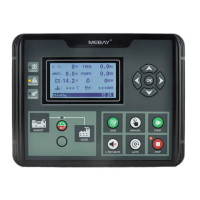
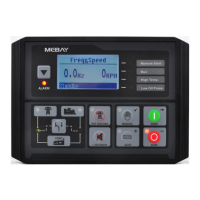
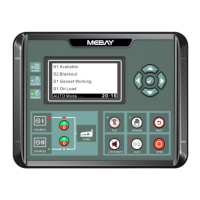
Explanation of the functions associated with each button and indicator on the controller's panel.
Step-by-step guide for starting the generator manually and its operation sequence.
Procedure for starting the generator using an automatic or remote start signal.
Important notes and considerations during the generator's starting sequence.
Details specific warning conditions like low fuel, low battery voltage, and starting faults.
Covers critical shutdown conditions such as emergency stop, over speed, and low oil pressure.
Lists specific shutdown events appearing on this page, including emergency stop and over speed.
Details shutdown alarms from this page, including temperature, frequency, and speed related issues.
Details remaining shutdown alarms from this page, such as voltage, current, and stop failure conditions.
Instructions on how to access the parameter setting menu for configuration.
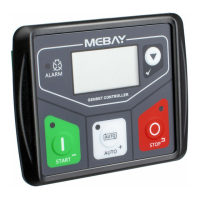
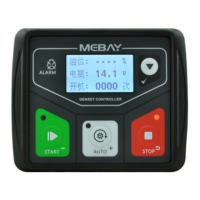
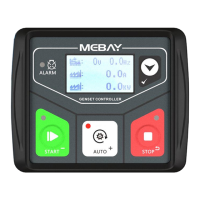
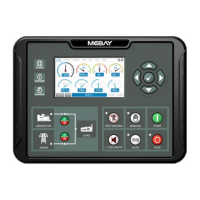
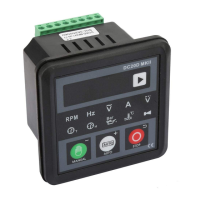
The DC20D MK2 is a sophisticated genset controller designed for both diesel and gasoline generators. It serves as an upgraded version of the DC20D, offering enhanced functionality for automatic start/stop operations, comprehensive protection, and clear alarm indications. The front panel of the controller provides real-time feedback on DC power and the generator's running status, allowing for convenient monitoring.
The primary function of the DC20D MK2 is to manage and protect generator sets. It facilitates automatic starting and stopping of the genset, ensuring reliable operation. The controller continuously monitors various engine and generator parameters to detect potential issues and trigger appropriate alarms or shutdowns. Key parameters monitored include engine RPM, generator frequency (Hz), generator phase voltage (L-N), generator current (A), engine battery voltage, running time, accumulation time, engine water temperature, and engine oil pressure.
The controller incorporates a robust protection system to safeguard the genset from damage. This includes protection against emergency stops, over-frequency, under-frequency, over-voltage, under-voltage, over-current, low oil pressure, high water temperature, open oil pressure sensor, open water temperature sensor, start failure, stop failure, low water level, high oil temperature, RPM signal loss, over-speed, under-speed, low fuel level, and low battery voltage. When a fault is detected, the controller provides clear indications and, in the case of shutdown alarms, locks the system to prevent further operation until the issue is resolved and the alarm is manually cleared.
The DC20D MK2 also features RS485 communication, enabling "Three Remote" functions (remote monitoring, remote control, and remote adjustment) via the MODBUS protocol. This allows for integration into broader control systems and remote management of the genset. The controller supports various crank conditions, including RPM, frequency, and oil pressure, offering flexibility in how the engine's successful start is determined.
The DC20D MK2 is designed for ease of use, with parameters settable directly via the front panel buttons. This eliminates the need for external programming tools for basic configuration. The controller's front panel features a 5-unit LED tube display and LED indicators for fault alarms, providing clear visual feedback to the operator.
The control panel includes dedicated buttons for "MANUAL," "AUTO," and "STOP" modes, simplifying operation. In manual mode, the operator can initiate a start sequence and monitor the engine's progress. The controller performs a series of checks, including sensor connections, before executing the start process. If all conditions are normal, the unit will automatically switch to generator power once running. The "STOP" button allows for immediate shutdown or cancellation of ongoing processes.
In automatic mode, the controller waits for a remote start signal. Once detected, it initiates the start sequence, performs necessary checks, and brings the genset to rated operation. The controller continuously monitors the remote start signal and will initiate a shutdown sequence if the signal becomes invalid.
The controller offers programmable inputs and outputs, enhancing its adaptability to different genset configurations. It has four relay outputs, with two being self-configurable, each capable of being set for up to six different functions. Additionally, it features two sensor inputs and three switch inputs, with input channels 2 and 3 configurable as either sensors or switch inputs. This flexibility allows the controller to interface with a wide range of external devices and sensors.
The ability to self-define sensors using PC software further extends the controller's versatility, allowing it to work with non-standard sensor types. The control protection features ensure that the genset operates within safe parameters, with perfect failure display and protection mechanisms in place.
The DC20D MK2 is designed with maintenance in mind. Its module design incorporates European connectors for all connections, which simplifies installation, connection, repair, and replacement of components. This modularity reduces downtime and makes servicing more efficient.
The controller is built with a standard waterproof rubber gasket, providing an IP54 protection level when properly installed between the controller and its panel. This protection helps to ensure the longevity and reliability of the device in various environmental conditions.
The user manual provides detailed instructions for installation, operation, and fault finding, aiding technicians in troubleshooting and maintenance tasks. The alarm code system (e.g., ALA.01 for Emergency stop alarm, ALA.02 for Over speed alarm) allows for quick identification of specific faults, streamlining the diagnostic process. The fault-finding section in the manual offers possible solutions for common symptoms, such as the controller not responding with power or the genset shutting down unexpectedly. This comprehensive guidance helps in quickly resolving issues and maintaining the genset's operational status.
The controller's ability to save parameters under value checking pages and its clear parameter setting interface contribute to easier configuration and re-configuration during maintenance or system adjustments. The warning system, which differentiates between non-serious failures (warnings) and critical shutdowns (shutdown alarms), helps operators prioritize maintenance actions, ensuring continuous system operation for less critical issues while immediately addressing severe faults.
 General
| Frequency | 50/60 Hz |
|---|---|
| DC Power Supply | 8 to 35 VDC |
| Alternator Input | 15 to 360 V AC (Ph-N) |
| Alternator Frequency | 50/60 Hz |
| Relay Output Capacity | 5A AC at 250VAC |

 To Next Page