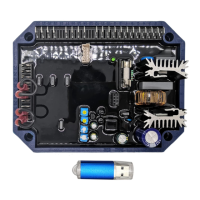
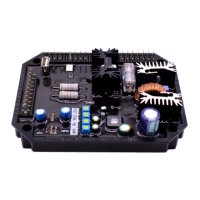
Instruction Manual DSR digital regulator - rev. 05 - pag. 3
The information contained in this manual may be modified without advance notice.
This revision supersedes and replaces all previous editions.
Even partial reproduction of this manual is prohibited, with any means whatsoever, without prior written au-
thorisation by Mecc Alte S.p.A.
INTRODUCTION
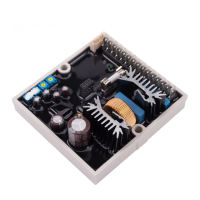
This manual contains information on the operation and use of the DSR digital regulator.
MAIN CHARACTERISTICS
1. Architecture of the system
The DSR is a voltage regulator for synchronous alternators, designed for stand alone working and calibra-
tion; to maximize performance, the regulator should be understood as part of a system made up of at least
three components: the DSR (control unit), a communications module (DI1, for example) and a supervision
unit, as illustrated in figure 4 or 12.
The connectors for connection to and from the power generator and communications module are located
on the DSR regulator.
The supervision unit can be made up of a personal computer, another “synoptic” device or both; it does
not have the function of controlling the system in real time, but allows programming and visualisation of all
operational parameters of the DSR.
If it is equipped with an RS485 or RS232 serial interface, the DI1 communications module is necessary for
its connection.
1.1 Regulator
Since the regulator is designed to control many different types of generators, it must be appropriately con-
figured to obtain the best performance; most of the settings are stored in a non-volatile integrated memory
(EEPROM). The first time the regulator is turned on, a default configuration will be present, which satisfies
the most widely requested characteristics and is suitable to facilitate installation: the trimmers are active
and the inputs for the external potentiometer and the 60 Hz jumper are enabled, therefore the basic cali-
brations can be performed without the use of additional equipment.
The regulator is available in two versions called DSR and DSR/A, the first is the standard one, optimized
for Mecc Alte alternators from series 3 to 38, the second is optimized for Mecc Alte alternators series 40-
46; the two versions differ mainly in some default parameters.
NOTE: the parameter that defines the output voltage (with the VOLT trimmer disabled) is set on 0 (so that
the adjustment takes place on the minimum voltage)
1.2 Communications module
The DI1 communications module (which is provided for connection to the COM connector of the DSR) is
equipped with a RS232 port and a RS485 port, through which it is possible to set the parameters (for both
configuration and operation) and “monitor” operation of the generator.
2. Technical Characteristics
•
Full digital controlled regulator, based on DSP
•
On-board machine installation
•
Suitable for all self-regulated alternators
•
Voltage supply: 40Vac÷270Vac (from auxiliary winding, output voltage or PMG)
•
Frequency range: 12Hz ÷ 72Hz
•
“Sensing” of voltage with true rms or average measurement (70÷280 Vac)
•
Maximum continuous output current: 4Adc;
•
Precision of voltage regulation: ± 1% from no-load to nominal load in static condition, with any power
factor and for frequency variations ranging from -5% to +20% of the nominal value.
In order to avoid damage to persons and/or property, only qualified personnel, having full
knowledge and understanding of the information contained in this manual, should perform the
procedures described herein; when power to the unit is on, the voltage present may be lethal for
the operator.
All connections must be made with the power off.
The plastic protections on connectors J1 and J2 must not be removed for any reason whatsoever.


 To Next Page