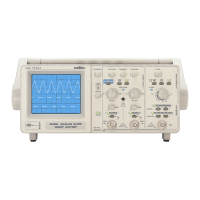
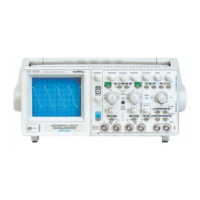
30 MHz-differential oscilloscope
17
4. APPLICATIONS
4.1. Visualisation of the calibration signal
- Connect the PROBE output (33) to CH1 input (34) by using a 1/1 or 1/10 measurement
probe.
- Select the following functions:
• CH1 sensitivity (4) or CH2 (10): 0.1 V/div. (1/1); 10 mV/div. (1/10)
• Sweep speed (20): 0.2 ms/div.
• Trigger source (21) or (22): CH1 or CH2
• Trigger mode (19) : AUTO
- If necessary, adjust vertically using the POSITION (6) or (11) control and stabilise the
trace using the potentiometer LEVEL (15).
- Adjust the low-frequency compensation of the probe so that the impulse plateau is horizontal.
See figures 5 and 6.
To compensate, please refer to the instructions enclosed with the probe.
4.2. Measurement of amplitude and frequency
Amplitude and frequency might be measured from the PROBE output (33) whose
specifications are the following :
• Shape : rectangular
• Amplitude : 0 to + 2.5 V ± 1 %
• Frequency : 1 kHz ± 1 %
• Duty cycle : ½
- Connect the PROBE output (33) to the CH1+ (35) or CH2+ (29) input by using a 1/1 or
1/10 measurement probe.
- Adjust CH1 or CH2 sensitivity to 20 mV/div. (if a 1/10 probe) and the timebase to 1 ms/div.
- Check that the amplitude of the visualised signal is equal to 2.5 divisions and that its
period is equal to 1 division.


 To Next Page