MFJ-209 SWR Analyzer Instruction Manual
14
Large RF chokes usually have frequencies where the distributed capacitance and inductance
form a low impedance series resonance. The troublesome series resonance can be detected by
slowly sweeping the frequency of the MFJ-209 over the operating range of the choke. Peaks
in the voltage measured by the RF voltmeter will identify the low impedance series-resonant
frequencies.
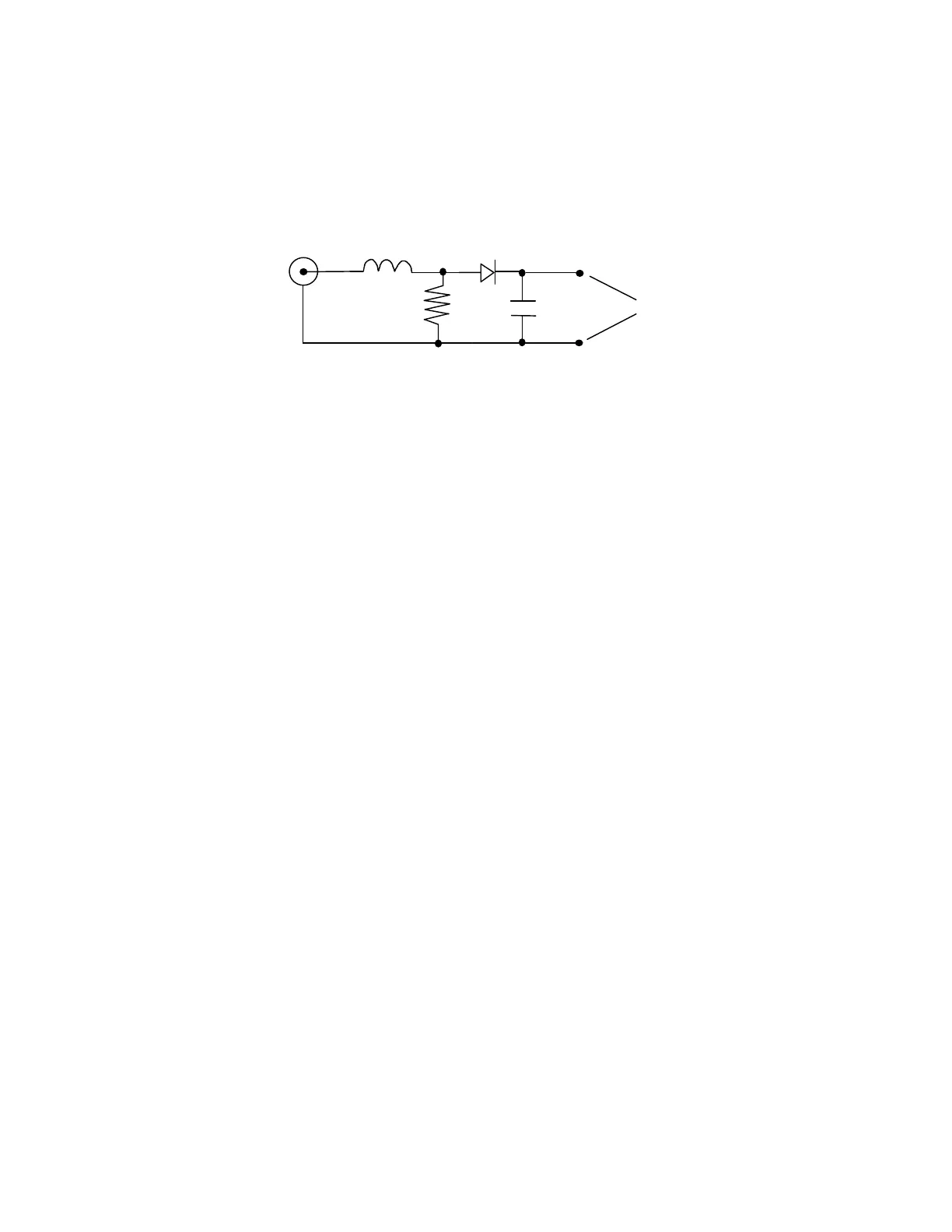
"ANTENNA"
To the MFJ-249's
connector
1N34
.01
10K
Measure the voltage
between these points
with a Hi-Z meter
All leads should be short
Refer to the section on measuring the inductance of RF chokes on page 12.
"ZERO BEATING" THE MFJ-209
The FREQ. OUT jack of the MFJ-209 supplies enough signal to drive a frequency counter or a
receiver. The signal from this jack is strong enough to drive all but the poorest receivers
without direct coupling.
To measure the frequency with a receiver you should first connect a short wire to the input of
the receiver or to the center conductor of coax feeding the receiver. This wire can normally
just be placed near the MFJ-209 to provide ample signal strength for the receiver. In rare
cases a second wire can be inserted into the FREQ OUT jack and placed near the receiver lead.
To determine the operating frequency of the MFJ-209 the receiver should be set to the widest
bandwidth SSB position and tuned to the frequency setting of the MFJ-209 dial. The receiver
dial can then be tuned up and down until a signal is heard swooping past.
Zero in on the signal until the pitch becomes very low. The receiver will be approximately on
the same frequency as the receiver.
If you use the MFJ-209 primarily on one frequency range you can calibrate the knob. Find a
frequency and loosen the set screw on the knob. Carefully pull the knob off and reinsert it at
the correct setting. Be sure that the receiver and the MFJ-209 are on the same frequency
throughout the procedure.
A second method would be to set the frequency of interest on the dial with a grease pen or
other temporary marking device.



 To Next Page