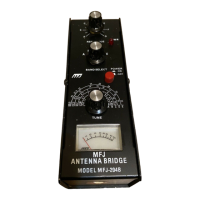
MFJ-209 SWR Analyzer Instruction Manual
7
Measuring the Feedpoint Resistance of Antennas
The feedpoint resistance of a low impedance (10-100 ohm) resonant HF antenna or load can be
measured with the MFJ-209. A low value non-inductive potentiometer (250 ohms) and a
conventional ohm meter can be used to make these measurements.
1 Connect the MFJ-209 directly across the terminals of the unknown impedance. If the load
is unbalanced be sure that the ground is connected to the SO-239 "ANTENNA"
connector's ground.
2 Adjust the MFJ-209 until the SWR reads the lowest value.
3 If the SWR is not unity (1:1), place the potentiometer in parallel with the load. Adjust the
potentiometer until the SWR is as good as possible.
4 If the SWR only becomes worse go to step 7.
5 If the SWR reached unity, remove the potentiometer and measure its resistance.
6 The resistance of the load is found by using the formula below.
R =
R -50
R = Antenna resistance
R = Potentiometer resistance
A
P
P
A
7 If the earlier steps did not work put the potentiometer in series with the center pin
(ungrounded terminal) of the SO-239 "ANTENNA" connector.
8 Adjust the value of the potentiometer until the SWR is unity (1:1).
9 Remove the potentiometer and measure the resistance of the setting used in step 8.
Subtract this value from 50 to determine the load resistance.
TESTING AND TUNING STUBS AND TRANSMISSION LINES
The proper length of quarter and half wave stubs or transmission lines can be found with this
unit and a 50Ω carbon resistor. Accurate measurements can be made with any type of coaxial
or two wire line. The line does not have to be 50 ohms.
The stub to be tested should be attached with a 50Ω noninductive resistor in series to the
center conductor of the "ANTENNA" connector with a coaxial line. The shield should be
grounded to the connector shell. For two wire lines the 50Ω resistor connects in series
between the ground shell of the PL-259 and one conductor. The other conductor of the
balanced line connects directly to the center pin of the connector.
Coaxial lines can lie in a pile or coil on the floor, two wire lines must be suspended in a straight
line a few feet away from metallic objects or ground. The lines must be open circuited at the
far end for odd multiples of 1/4 wave stubs (i.e., 1/4, 3/4, 1-1/4, etc.) and short circuited for
half wave stub multiples ( like 1, 1-1/2, etc.)



 To Next Page