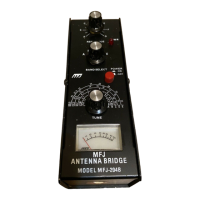
MFJ-209 SWR Analyzer Instruction Manual
2
INTRODUCTION
The MFJ-209 SWR Analyzer is an easy to operate, versatile test instrument for analyzing
nearly any 50 ohm RF system on frequencies between 1.8 and 170 MHz. In addition the MFJ-
209 can be used as signal source.
The MFJ-209 combines three basic circuits; a wide range oscillator, a 50 ohm RF bridge, and a
calibrated bridge unbalance indicator. This combination of circuits allows measurement of the
SWR (referenced to 50 ohms) of any load connected to the ANTENNA connector.
The MFJ-209 covers all ham bands from 2 meters to 160 meters. The dial calibration is
approximate and for reference only. The actual frequency may vary from what is marked on
the front panel. The MFJ-209 FREQUENCY switch selects the following frequency ranges:
1.8 - 4 MHz
4 - 10 MHz
10 - 26.2 MHz
26.2 - 62.5 MHz
62.5 - 113 MHz
113 - 170 MHz
A frequency counter, such as the MFJ-346, can be connected to the "FREQ. OUT" jack (RCA
phono) to get a more accurate reading of the frequency. As an alternative to a frequency
counter, you can zero beat the output with an HF receiver. See the section on zero beating the
MFJ-209 with a receiver.
The MFJ-209 can be used to adjust or measure the following:
Antennas: SWR, resonant frequency, bandwidth, efficiency
Antenna tuners: SWR, frequency
Amplifiers: Input and output networks
Coaxial transmission lines: SWR, velocity factor, losses, resonance
Balanced transmission lines: Impedance, velocity factor, resonance
Matching or tuning stubs: SWR, resonant frequency, bandwidth
Traps: Resonant frequency
Tuned Circuits: Resonant frequency
Small capacitors: Value
RF chokes and inductors: Self resonance, series resonance, value
Transmitters and oscillators: Frequency
Warning: Please read this manual thoroughly before using this instrument. Failure to follow
the operating instructions may cause false readings or even damage this unit.



 To Next Page