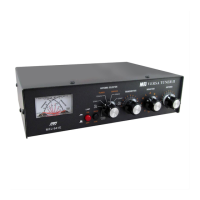
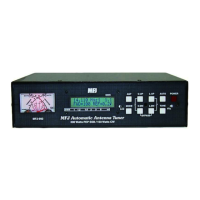
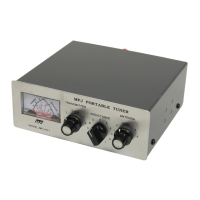
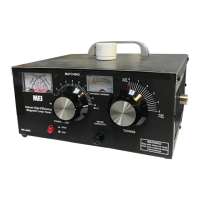
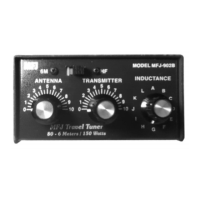
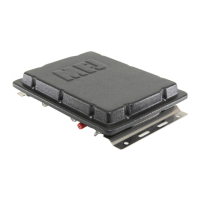
MFJ-941EK Tuner Kit Instruction Manual
- 2 -
INTRODUCTION
General Information:
This manual contains all the information you'll need to build, calibrate, and use
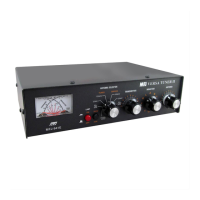
your new MFJ-941EK Versa-Tuner II kit. The Versa-Tuner II is actually four very
useful station accessories combined into one package. The first is MFJ's wide-
range 300-Watt T-network that can match virtually any HF antenna you're likely to
encounter. The second is our highly accurate dual-range SWR/Wattmeter that
features cross-needle metering. The third is an eight-position RF-routing switch
for selecting a variety of antennas, either through the tuner or around the tuner in
bypass mode. And, finally, there's a built-in 300-Watt 4:1 balun to accommodate
antennas using balanced feedline. Despite its versatility, the circuitry and
mechanical layout for the MFJ-941EK are straight forward, and these instructions
will guide you through assembly from start to finish.
Before You Start:
Prepare a clean work surface and use muffin tins, egg cartons, or small paper
cups to organize your parts. To reduce eyestrain, choose an area with strong
overhead lighting and add a high-intensity desk lamp for close-up work.
Construction requires the tools listed below:
[ ] Soldering iron with a narrow chisel tip.
[ ] Soldering-iron holder with a moistened cleaning sponge.
[ ] Your choice of leaded or lead-free solder with rosin or no-clean flux.
[ ] Small needle-nose pliers or surgical hemostat.
[ ] Side-cutter type wire nippers.
[ ] Solder sucker or de-soldering braid
[ ] Magnifying glass or loupe for reading component markings
[ ] Phillips-head screwdriver
[ ] 5/64" Allen wrench (for knobs)
[ ] 3/32" Allen wrench (for shaft coupler)
[ ] 1/4" nut driver (for 4-40 hardware)
[ ] 5/16" nut driver (for 6-32 hardware)
[ ] 3/8" nut driver (for 10-32 hardware)
[ ] 7/16" nut driver (for insulated terminal posts)
[ ] 1/2" nut driver (for 3/8" ID control-nuts)
As you work, watch for the four most common kit-building errors:
1. Wrong Part: Identify, sort, and organize all parts ahead of time.
2. Reversed Polarity: Double check diode and meter polarity.
3. Defective Soldering: Routinely check for cold solder joints or bridged tracks.
4. Omitted part: Check off each construction step as you go.


 To Next Page