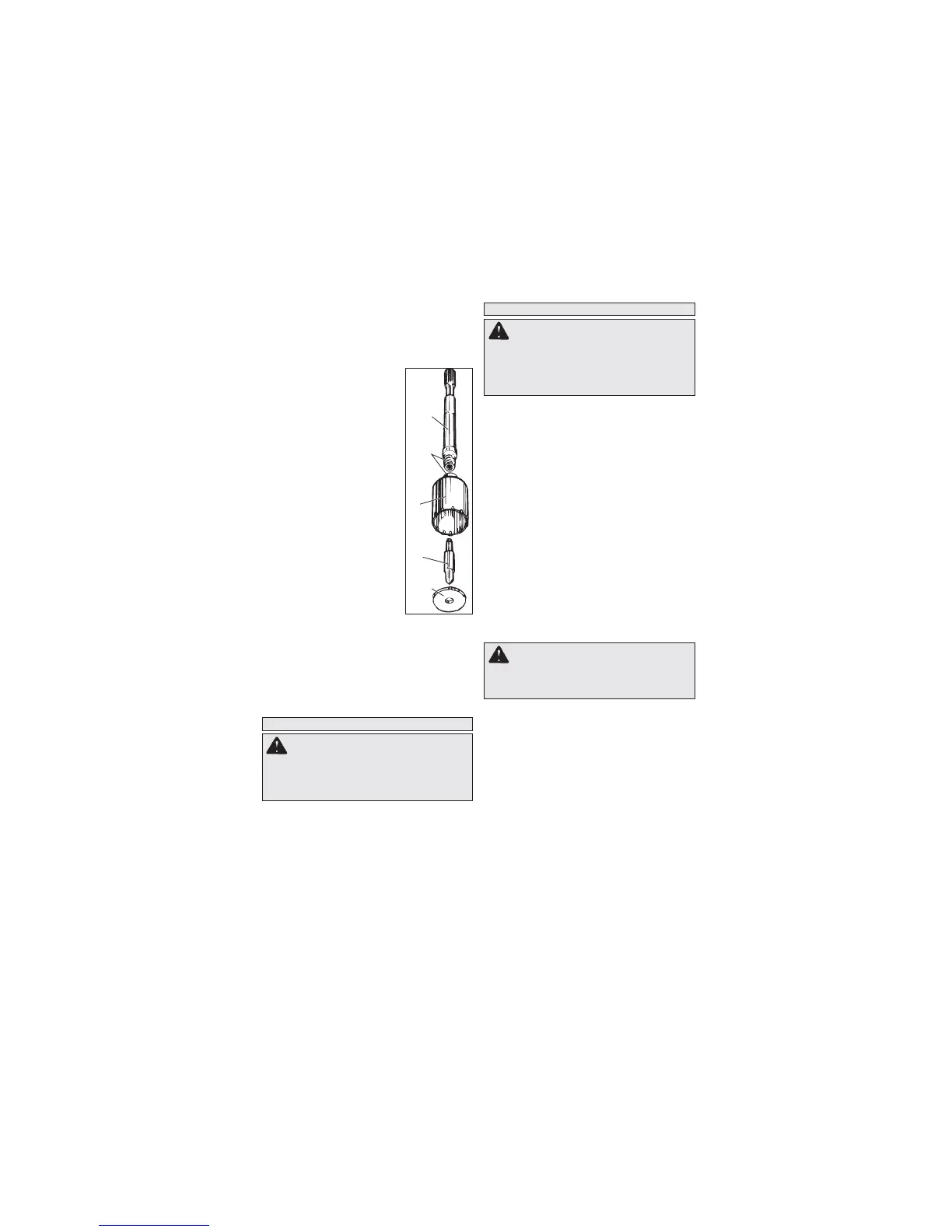
Adapter
Core
Bit
Center
Pin
Guide
Plate
Clean
and
lubricate
threads
Using Core Bits
Core bits are useful for drilling large holes for
conduit and pipe. MILWAUKEE Heavy-Duty Thin
Wall Core Bits have heat treated steel bodies with
durable carbide tips. They are specially designed
for fast, accurate drilling with combined hammering
and rotary action.
1. Clean and lubricate the threads
on the adapter and core bit as
indicated to make later removal
easier. Screw the threaded end
of the adapter into the rear of
the core bit.
2. Push the guide plate onto the
pointed end of the center pin.
Insert the center pin with guide
plate a ssembly into to the core
bit. Be sure the small end of the
center pin is securely placed
into the hole in the center of the
adapter.
3. Insert the adapter into the bit
holder of the tool as described
in “Inserting Drill Bit or Chisel”.
Set the rotary hammer/drill
lever to rotary hammer.
4. Press the center pin firmly
against your center mark, hold
the tool fi rmly and pull the trigger.
5. After drilling to about the depth
of the core bit teeth, remove the
center pin and guide plate from
the core bit. Resume drilling.
6. After you have fi nished drilling the hole, hold the
tool upwards, pointing it away from your body,
and run it briefl y in forward to loosen the core
bit from the adapter.
MILWAUKEE Heavy-Duty Thin Wall Core Bits drill
holes up to 3" deep. To make deeper holes, remove
the bit, break and remove the core. Resume drilling.
Maintaining Tools
Keep your tool in good repair by adopting a regular
maintenance program. Before use, examine the
general condition of your tool. Inspect guards,
switches, tool cord set and extension cord for
damage. Check for loose screws, misalignment,
binding of moving parts, improper mounting, bro-
ken parts and any other condition that may affect
its safe operation. If abnormal noise or vibration
occurs, turn the tool off immediately and have the
problem corrected before further use. Do not use a
damaged tool. Tag damaged tools “DO NOT USE”
until repaired (see “Repairs”).
Under normal conditions, relubrication is not neces-
sary until the motor brushes need to be replaced.
After six months to one year, depending on use,
return your tool to the nearest MILWAUKEE service
facility for the following:
• Lubrication
• Brush inspection and replacement
• Mechanical inspection and cleaning (gears,
spindles, bearings, housing, etc.)
• Electrical inspection (switch, cord, armature, etc.)
• Testing to assure proper mechanical and electrical
operation
Cleaning
Clean dust and debris from vents. Keep the tool
handles clean, dry and free of oil or grease. Use
only mild soap and a damp cloth to clean your tool
since certain cleaning agents and solvents are
harmful to plastics and other insulated parts. Some
of these include: gasoline, turpentine, lacquer thin-
ner, paint thinner, chlorinated cleaning solvents,
ammonia and household detergents containing
ammonia. Never use fl ammable or combustible
solvents around tools.
ACCESSORIES
WARNING To reduce the risk of injury,
always unplug the tool before attaching or
removing accessories. Use only specifi cally
recommended accessories. Others may be
hazardous.
WARNING To reduce the risk of injury,
electric shock and damage to the tool, never
immerse your tool in liquid or allow a liquid
to fl ow inside the tool.
MAINTENANCE
WARNING To reduce the risk of injury,
always unplug your tool before performing
any maintenance. Never disassemble the tool
or try to do any rewiring on the tool’s electrical
system. Contact a MILWAUKEE service facility
for ALL repairs.
Rely only on high-grade power tools on our virtual shelves.



 To Previous Page
 Loading...