17
4. Calibration
To be able to display the electrical signal from the measuring section (load cell) as an accurate
weight, the operation to match the display of the instrument with the weight loaded on the
measuring section is called a calibration.
For example to adjust the display of this instrument to 100.00 accurately when the weight of 100
kg is loaded on the measuring section is said.
4-1. Set items required in the calibration
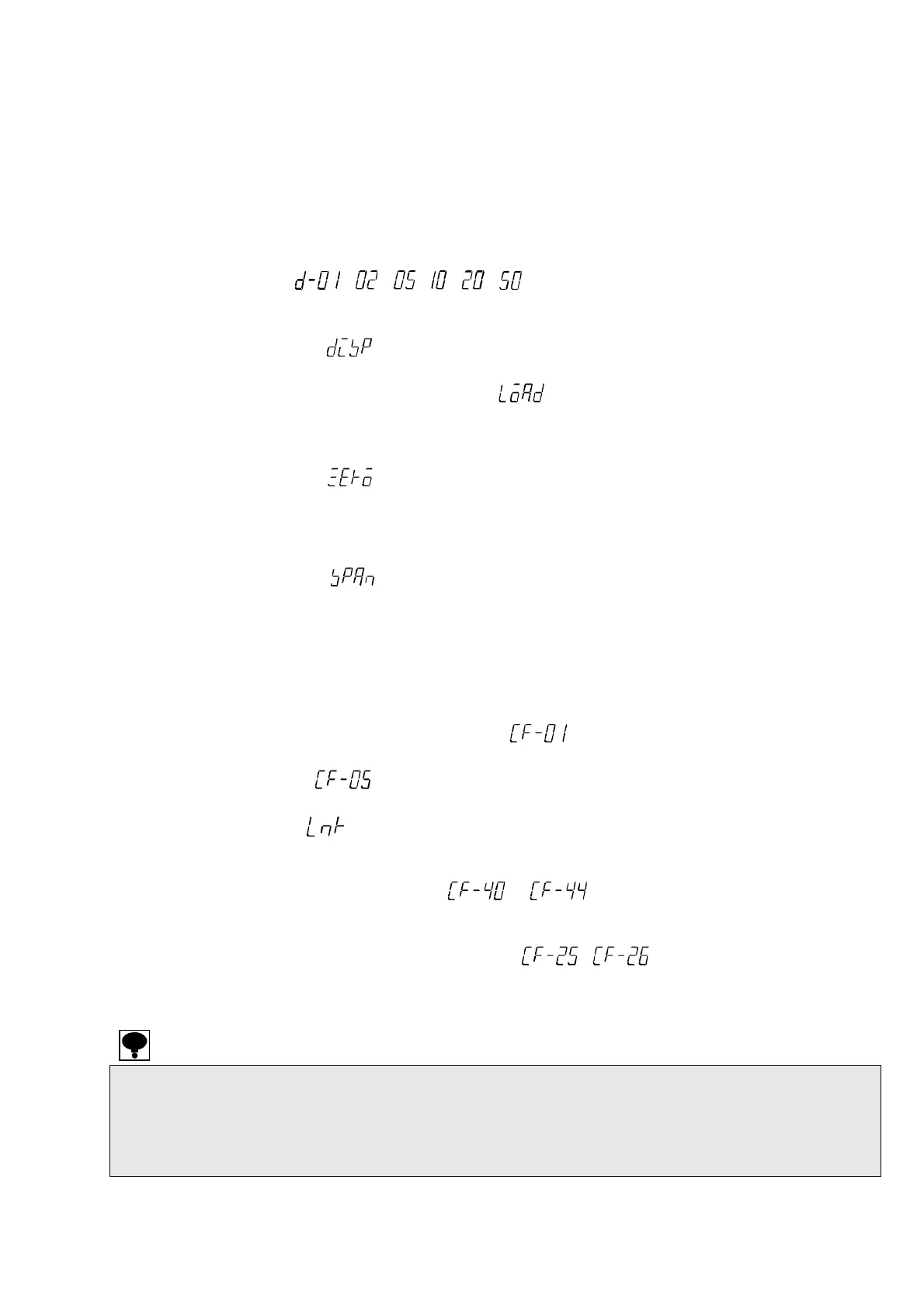
(1) Scale interval ( , , , , , )
It is the minimum unit of the measuring value the value to be set is [1], [2], [5], [10], [20] or [50].
The value of {Weighing capacity/Scale interval} is the display resolution.
(2) Weighing capacity ( )
It is the maximum weight to be able to measure by the measuring section (load cell).
(3) Mass of weight used at the span calibration ( )
The span calibration can be executed with the arbitrary weight. The same setting as the weighing
capacity is executed when there is a weight for weighing capacity.
Please give setting here as 2/3 or more of weighing capacity to reduce the calibration error.
(4) Calibration at zero ( )
It is a procedure of the calibration to become the zero point of the measurement when nothing is put
on the measuring section (status of an initial load). There are [Method by the weighing data (status of
an initial load)] and [Method by a numeric input of the load cell output voltage] as a calibration
method.
(5) Calibration at span ( )
It is a procedure by which execute the calibration of the change in the electric signal of the load cell
when the weight is put on the measuring section to become the display of a correct weighing value.
There are [Method with weight] and [Method by a numeric input of the load cell output voltage] as a
calibration method.
4-2. Procedure set if necessary after calibration
(1) Display position of decimal point (C function : )
The decimal point is put on the load display of this unit.
(2) Unit (C function : )
The unit is put on the load display of this unit.
(3) Digital linearize ( )
It is a function the compensation of three points or less except the zero and span, and to reduce the
measurement error. Refer to the paragraph 4-5. Digital linearization.
(4) Automatic range switch (C function : ~ )
It is the setting of the second range or the third range for [Multi scale interval scale]. The boundary
value and the scale interval within the each range are set. Refer to the [6-13.Automatic range switch].
(5) Gravity acceleration compensation (C function: , )
It is a function for the compensation of the span error by setting the gravity acceleration of the two
different districts with a calibration place and a place to be used. Refer to [6-11.Gravity acceleration
compensation].
・ Please execute the calibration if necessary when the environment to be used changes.
・ The display resolution that the performance becomes effective is 10 000 or less.
The display resolution is a value into which weighing capacity is divided by the scale interval of the
first range.
・ The mass of the weight used in the span calibration must use the one of 2/3 or more of weighing
capacity to reduce the calibration error.


 To Next Page
 Loading...