Chapter Two: Installation Setu
25
Setup
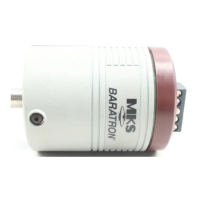
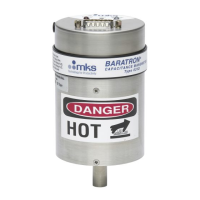
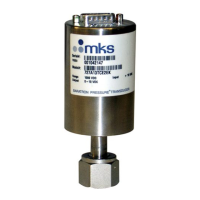
Mount the transducer with the inlet port pointing (vertically) downward. Although the unit can
be mounted in any orientation, mounting it as suggested allows any foreign matter entering the
pressure port to fall away from the diaphragm.
Isolate the unit from vibration as much as possible. When not subject to gas damping at low
pressure, the diaphragm may become susceptible to resonance. The 0.05, 0.1 and 1 Torr F.S.
units are most sensitive and you should isolate these units from any vibration that exists.
Remember to isolate the vibration through the cable as well as through the port.
Checking the Transducer Zero
Check the transducer zero prior to the initial operation and then periodically as required. The
zero can be set (or reset) by adjusting the zero potentiometer located on the top cover of the
transducer or at the front panel of any MKS Power Supply/Readout which is being used. The
unit must be
fully stabilized
before you change the zero adjustment. Stabilization is
accomplished by allowing the unit to warm up for approximately:
•
15 minutes for Types 622 and 626 instruments
•
2 to 4 hours for the Types 627, 628, and 629 instruments (
≥
1 Torr)
•
8 hours for the 0.05 Torr (627 and 629) and 0.1 Torr (627, 628, 629)
Pump the unit, with the power on, down to a pressure less than the transducer’s resolution
(0.01% of Full Scale).
Note
Once the unit is properly warmed up and stabilized, the zero adjustment
must be made at a
ressure less than the transducer’s resolution (0.01% o
F.S.). Low range transducers (0.1 and 0.05 Torr) should be pumped for
at least one hour after exposure to air to remove any moisture and to
allow the pressure to stabilize.
Zeroing a transducer above its stated minimum resolution creates a
zero offset
relative (or
unique) to the system in which the transducer is located. All subsequent readings are then linear
and accurate
relative to the offset value
.
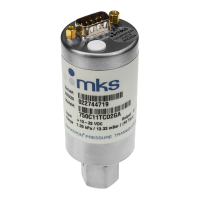
Refer to Figure 4, page 26, for the location of the zero potentiometer on the Types 622, 626, 627,
628, and 629 transducers.
Note
If available pressures are not sufficiently low to set the transducer zero,
you may use a vacuum leak detector with sufficient vacuum pumping (to
achieve proper zeroing pressures). In this case, mount the transducer on
the leak detector
in the same plane of orientation as it will be during
actual use
.



 To Next Page