1110
2.0 Operation
2.1 Before you start firing
For Use with Solid Wood Fuel Only. Do Not Overfire, If Heater or Chimney Connector
Glows You Are Overfiring. Inspect and Clean Chimney Frequently. Under Certain
Conditions of use creosote buildup may occur rapidly. Because of risk of smoke and flame
spillage, operate only with door fully closed.
Caution:
Hot while in operation. Keep children, clothing and furniture away. Contact may cause
skin burns.
Do not use chemicals or fluids to start the fire.
Do not burn garbage or flammable fluids.
Do not use gasoline, gasoline-type lantern fuel, kerosene, charcoal lighter or fluid or similar
liquids to start or freshen up a fire in this heater. Keep all such liquids away from the heater
while it is in use.
Distance to furniture
The recommended minimum distance from stove to furniture is 30 inches. Note that some
furniture is more easily affected by heat and may need to be moved to a greater distance. This
is your responsibility.
In addition other combustible materials, away from the stove. In general, a distance of 30 inches
must be maintained between the stove and moveable combustible item such as drying clothes,
newspapers, firewood etc.
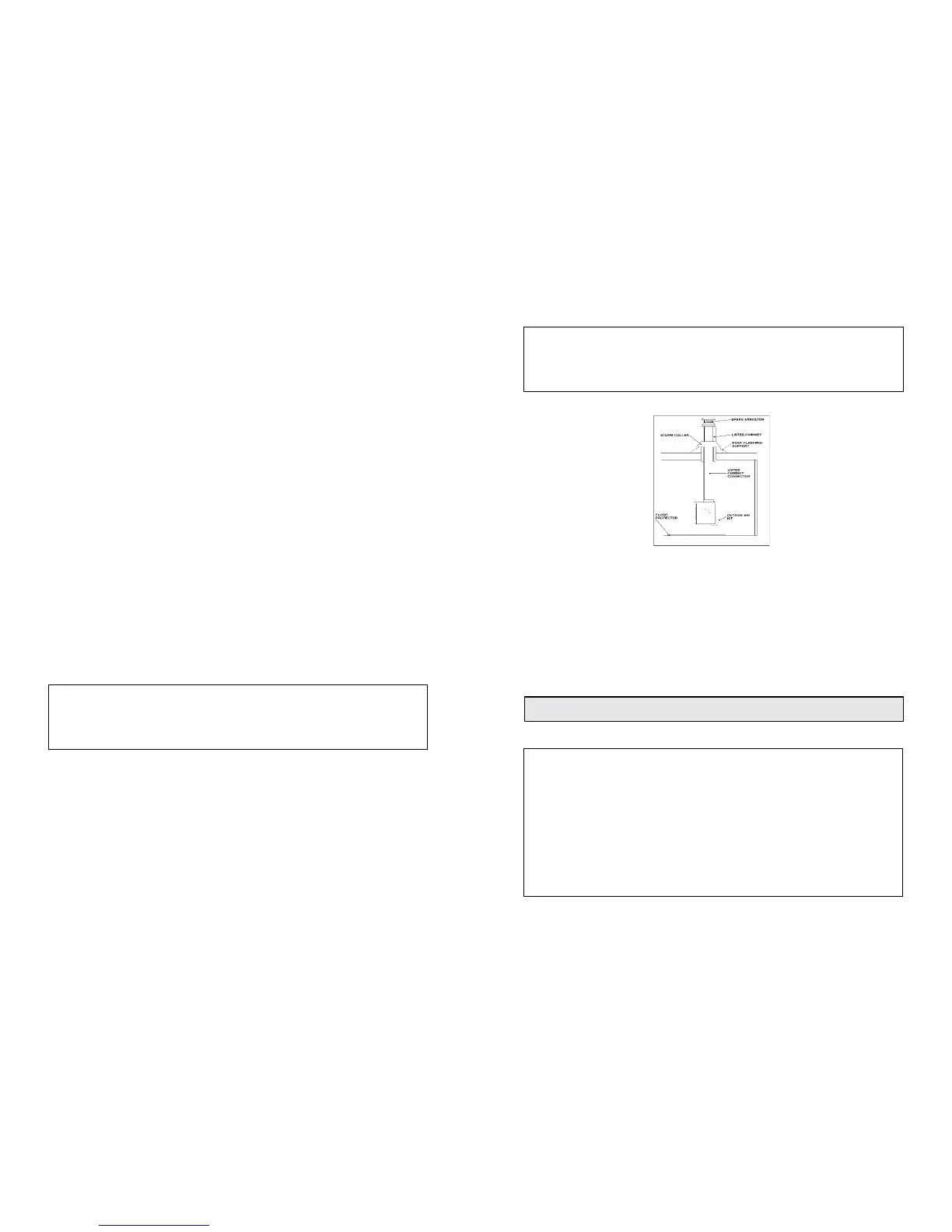
1.6 Mobile Home Installation
The Morsø 8100 can be installed in a mobile home if equipped with an outside combustion air
kit, a terminal cap with a spark arrestor, and if it meets the following installation requirements:
• Thestovemustbesecuredtothemobilehomestructurebyboltingthroughthe
hearth pad and into flooring.
• ThestovemustbeinstalledwithalistedTypeHTchimneyconnector,HTChimney,
and terminal cap with spark arrestor. Never use a single wall connector (stovepipe)
in a mobile home installation.
• Floorprotectionrequirementsinsection1.5mustbefollowedprecisely.
• InCanada,thisappliancemustbeconnectedtoa6”(152mm)factory-builtchimney
conforming to CAN/ULC-629M, STANDARD FOR FACTORY BUILT CHIMNEYS. Floor
protection as referenced in section 1.5 must be followed, as well as use of Canadian
Floor Protector.
• Followthechimneyandchimneyconnectormanufacturer’sinstructionswhenin-
stalling the flue system for use in a mobile home.
• Outsideairkitshouldbeinstalledaccordingtoinstallationguideinthekit.
• Intakeairpipingcanbeinstalledthroughtheoorintoaventedcrawlspaceor
through the wall of the residence to obtain outside air.
• Installinaccordancewith24CFR,Part3280(HUD).
• NOTE:Topsectionsofchimneymustberemovabletoallowmaximumclearanceof
13.5’ from ground level for transportation purposes.
WARNING:
NEVER DRAW COMBUSTION AIR FROM A WALL, FLOOR OR CEILING CAVITY OR FROM ANY
ENCLOSED SPACE SUCH AS AN ATTIC OR GARAGE.
DO NOT INSTALL IN SLEEPING ROOM.
Rotatable smoke outlet
The rotatable smoke outlet is locked during transportation. The screw that locks the smoke
outlet is located next to the little yellow label on the edge of the cast smoke outlet, and can be
loosened with a 2 mm Allen key.
N.B.: The smoke outlet must not be lifted when the screw that locks the rotatable smoke outlet
has been loosened. If you lift the smoke outlet, the steel balls on which it turns may fall out.
CAUTION:
THE STRUCTURAL INTEGRITY OF THE MOBILE HOME FLOOR, WALL, AND CEILING/ROOF MUST
BE MAINTAINED (I.E., DO NOT CUT THROUGH FLOOR JOIST, WALL STUD, CEILING TRUSS, ETC.)
DO NOT USE A GRATE TO ELEVATE FIRE - BUILD FIRE DIRECTLY ON HEARTH.
Note:
Acid Protection
If acid-washing the masonry around the stove, protect the stove surface with an acid-proof
cover
Fresh Air Inlet
Unless there is deemed to be sufficient ambient leakage of air into the room via doorways,
windows and the like, a dedicated fresh air inlet will be needed. This inlet should have 2
square inches (1250 square mm) of free air space. This is particularly important where the
room is well sealed, or where an extractor hood or ventilation system disturbs the natural
air pressure. Such an inlet should not be on a wall that is usually subject to negative pressure
from normal wind pattern. Avoid placing the inlet directly across the room from the stove,
thus causing a cold air draft.


 To Next Page