Need help?
Do you have a question about the Motic D-Moticam 1080 and is the answer not in the manual?
Guide for connecting and using the Moticam 1080 camera with a microscope eyepiece.
Instructions for attaching and using the Moticam 1080 with a trinocular microscope.
Steps to configure and use the Moticam 1080 as a macro camera for close-up imaging.
Explanation of controls for live image viewing, zooming, freezing, and capturing images/videos.
Description of the AE/AWB menu for adjusting exposure, gain, and white balance.
Overview of the Settings menu for saturation, contrast, language, and system configurations.
Guide to installing and accessing the Motic Images software for PC users.
Accessing the comprehensive help documentation for the Motic Live Imaging Module.
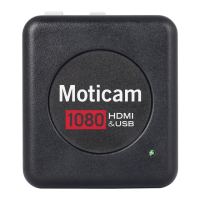
The Moticam 1080 is a versatile digital camera designed for microscopy and macro photography, offering both HDMI and USB connectivity for flexible integration into various setups. It serves as an essential tool for capturing, analyzing, and sharing high-quality images and videos in educational, research, and industrial environments.
The primary function of the Moticam 1080 is to convert optical images from a microscope or macro setup into digital data. This digital data can then be displayed on an HDMI-compatible monitor, recorded onto an SD card, or streamed to a computer for further processing and analysis using Motic Images Plus software. The camera is capable of capturing still images (JPEG) and recording 1080p video (AVI), making it suitable for documentation, presentation, and detailed study of microscopic or macroscopic specimens.
Its dual connectivity options (HDMI and USB) allow for standalone operation with an HDMI display and a USB mouse, or integrated use with a computer. In standalone mode, users can control various camera settings directly through an on-screen display (OSD) using a USB mouse, enabling real-time adjustments and immediate capture without the need for a computer. When connected to a computer, the Motic Images Plus software provides advanced functionalities for image acquisition, measurement, annotation, and report generation.
The camera's design emphasizes ease of use and adaptability. It can be mounted on trinocular microscopes using a C-Mount adapter, or on monocular/binocular microscopes via an eyepiece adapter and focusable lens. For macro photography, a dedicated macro tube allows the camera to capture images of larger objects. This flexibility ensures that the Moticam 1080 can be integrated into a wide range of existing optical systems.
The Moticam 1080 offers several usage features that enhance its functionality and user experience:
Multiple Mounting Options:
Dual Connectivity (HDMI & USB):
On-Screen Display (OSD) Controls (HDMI Mode): When connected to an HDMI display and controlled with a USB mouse, the Moticam 1080 provides an intuitive OSD for real-time image adjustments and capture. Key OSD functions include:
Image Adjustment Controls (OSD): The OSD also provides comprehensive image adjustment menus:
SD Card Recording: The integrated SD card slot supports up to 32GB SDHC cards for direct storage of captured images and videos, eliminating the need for a computer during field work or presentations.
Motic Images Plus Software (PC/Mac): The included software significantly expands the camera's capabilities when connected to a computer.
While the manual does not explicitly detail maintenance features, general best practices for digital imaging devices apply to the Moticam 1080:
By adhering to these usage and maintenance guidelines, users can ensure the longevity and optimal performance of their Moticam 1080, making it a reliable tool for their imaging needs.
 General
| Sensor Type | CMOS |
|---|---|
| Interface | USB 2.0 |
| Resolution | 1920x1080 |
| Frame Rate | 30 fps |
| Compatibility | Windows, Mac |
| Output Format | AVI, BMP |

 To Next Page