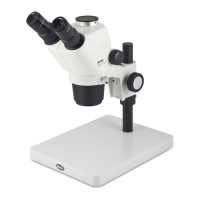
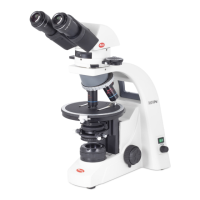
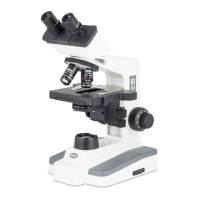
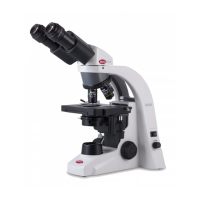
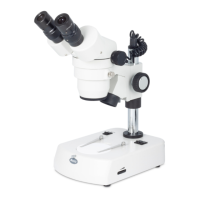
The Motic SMZ Series stereomicroscope is a precision instrument designed for observing three-dimensional objects, examining small parts, dissecting biological specimens, and observing slide specimens. Its design emphasizes ease of management, optimum functioning, and minimal maintenance.
Function Description
The stereomicroscope operates by providing a magnified, three-dimensional view of a sample. It features a binocular or trinocular head, allowing for comfortable viewing with both eyes or the attachment of a camera. Illumination is provided by both incident (from above) and transmitted (from below) light sources, which can be used independently or simultaneously, depending on the sample type and observation needs. The zoom knob allows for continuous magnification changes, while focus knobs adjust the image sharpness. The head holder can be moved vertically along a column to accommodate objects of varying sizes.
Usage Features
- Illumination Control: The microscope offers both incident and transmitted illumination. The transmitted illumination is specifically designed for transparent or thin samples like leaves or insect wings, utilizing a frosted glass stage. The incident illumination is suitable for opaque objects or dissection. Light intensity can be adjusted to suit the objective used and the sample type. An adjustment screw allows for varying the angle of incident illumination.
- Stage Options: The SMZ series includes two types of stages: a frosted glass stage for transparent samples and a black and white opaque stage for non-transparent objects or dissection. The black and white stage offers contrast enhancement, allowing the user to choose the side that provides the best contrast for their specimen. A blue filter can be inserted with the glass stage to enhance viewing.
- Focusing Mechanism: The microscope features a robust focusing system. The head holder, which carries the optical components, can be moved up and down the column to bring objects of different heights into focus. Fine-tuning of the focus is achieved using the focus knobs. The tension of the focus knobs can be adjusted to prevent the head from sliding down under its own weight, ensuring stable observation.
- Magnification Adjustment: A zoom knob allows for continuous adjustment of magnification. The microscope is parfocal, meaning that once focused at a higher magnification, minimal refocusing is needed when switching to lower magnifications. This is due to the greater depth of field offered by lower magnification objectives.
- Interpupillary Distance Adjustment: To ensure comfortable viewing and a unified image, the interpupillary distance can be adjusted by moving the eyepiece tubes. This feature is crucial for accommodating different users' eye spacing.
- Diopter Adjustment: Diopter adjustment collars on the eyepiece tubes allow users to compensate for differences in eyesight between their left and right eyes. This ensures a sharp image for both eyes without needing to use the main focus knobs.
- Camera Adaptability (Trinocular Models): Trinocular models (SMZ-143-N2GG) are equipped with a vertical image port for attaching photographic or video cameras. An adapter tube, which includes 2X lenses for parfocality balance, is used to connect the camera. A selection lever on the head directs the image to the vertical port, though this may temporarily disable viewing through the right eyepiece. The adapter tube features a T-type thread, compatible with various camera brands via specific T-mount adapters.
Maintenance Features
- Optical Cleaning: Regular cleaning of optical components is essential for maintaining image quality. Dust should be removed using a brush designed for lenses or low-pressure compressed air. Eyepieces can be cleaned by dampening the lens with breath and then drying with special lens paper in circular movements from the center outwards. Objectives should only have their surface cleaned with a soft cotton cloth slightly dampened with Xylene, followed by drying with the same cloth. Disassembly of optical components is not recommended for general maintenance.
- Bulb Replacement: Both transmitted and incident illumination bulbs are user-replaceable. For the transmitted illumination bulb, the stereomicroscope must be carefully rested on its side, and the base cap, secured by four screws, needs to be opened. The bulb can then be carefully pulled out with a cloth. For the incident illumination bulb, the illuminator protector tube needs to be unscrewed. In both cases, new bulbs should be handled with a clean cloth to avoid touching them with bare hands, as skin oils can affect light transmission and bulb lifespan.
- Fuse Replacement: The microscope's fuse can be replaced by the user. A flat screwdriver is used to lightly press and turn the fuse holder cover, allowing access to the fuse. It's important to replace the fuse with one of the correct amperage (0.5 Amps).
- Focus Tension Adjustment: The tension of the focus knobs can be adjusted to the user's preference. This involves loosening a screw in the collar hole with a hexagonal key and turning the collar clockwise to decrease tension or anti-clockwise to increase it. This ensures the head moves smoothly without unintended sliding.
- Transport and Storage: When moving the microscope, it is recommended to carry it with both hands, supporting the column and the base, and to maintain it in a vertical position. For long-term storage or transport for repair, retaining the original polystyrene packing is advised.
The Motic SMZ Series is designed for durability and ease of use, with clear instructions for operation and basic maintenance to ensure a long service life.


 To Next Page
 General