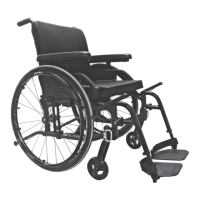
TECHNICAL SPECIFICATIONS – FOLDING WHEELCHAIRS | USER MANUAL
NOTE: If you ignore these warnings or fail to inspect or maintain your wheelchair as directed in the manual, you may fall, tip over or lose control of the wheelchair and seriously injure yourself or others and damage the
wheelchair.
14
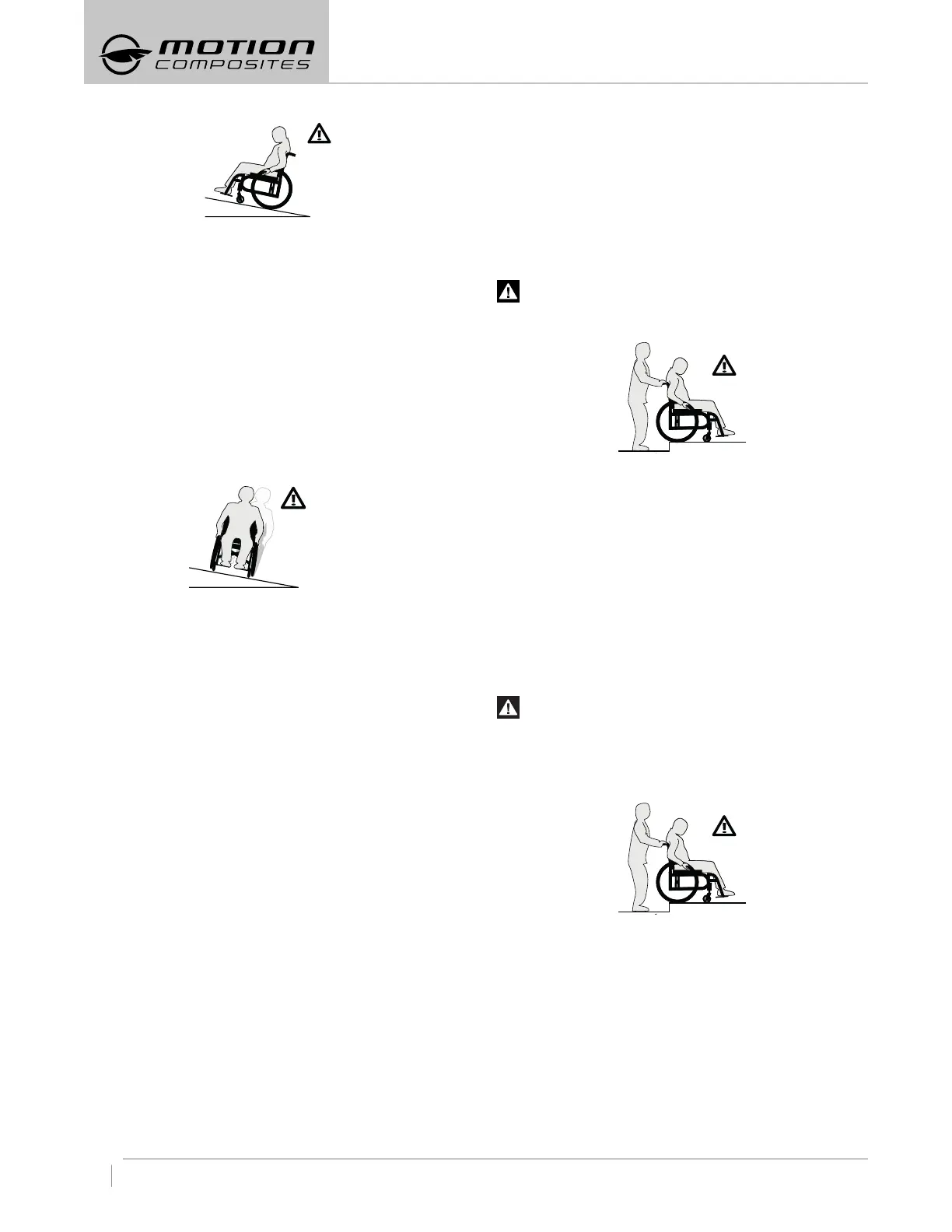
– Make sure to be assisted by a caregiver who is physically able
to retain the wheelchair and its occupant.
– The wheelchair must always point facing up the slope.
– The caregiver should always remain behind the wheelchair to
retain it.
– Always lock the anti-tippers in the safe position.
– Follow the same words of caution for hills or slide hills of 10%
or less.
– Do not use your wheelchair on a ramp below 3 meters in length
if the slope angle is greater than 10 degrees (17.63%).
SLOPES AND SLIDE HILLS OF 10 FEET (3 METERS) OR MORE IN
LENGTH
– If you must go through a slope or a vertical rise of 10 feet (3
meters) or more, the angle of the slope should not exceed 5.7
degrees, which corresponds to a 10% slope, that is a rise of 3.28
feet (1.00 meter) for a distance of 30 feet (10 meters).
– Make sure to be assisted by a caregiver if you have trouble on
the slope or if the slope is between 5.7 and 10 degrees.
– Move your weight in the slope direction to adjust your center of
gravity.
– Stay in the center of sidewalks and ensure that there is enough
space for the wheels.
– Try to move straight up or down the slope.
– Avoid turning on a downhill slope.
– Avoid stopping on slopes and never use the wheel locks to slow
yourself on a downhill slope.
– Keep pressure on the handrims to control your speed.
– Do not ride on wet or slippery surfaces. Be cautious for changes
in terrain height or stairs at the end of a slope (casters may lock
from simply hitting a small bump upon descending a slope).
– Do not use your wheelchair alone on a slope or slide hills above
3 meters in length if the slope angle is greater than 5.7 degrees
(10 %).
6.4.9 OBSTACLES
– Always look for obstacles or road hazards (potholes, broken
surfaces, etc.)
– Clear your own home/working environment of any obstacles.
Never use objects (furniture, ramps, and doorknobs) to push
yourself out of the wheelchair.
– Bend your upper body slightly forward as you move up an
obstacle and bend slightly backward as you move down it.
– Keep both hands on the handrims while passing over the obsta-
cle.
6.4.10 CURBS AND STEPS
– Curbs and steps are extremely dangerous obstacles.
– NEVER attempt to go up or down a single curb or step without
an assistant unless you are a very skilled rider of your chair.
You need to have previously learned to safely do a wheelie in
your chair and to be sure you have the strength and balance to
control your chair during any such maneuver.
– ALWAYS unlock and rotate anti-tippers up and out of the way so
they do not prevent you from executing this maneuver.
– NEVER attempt to climb or descend a curb or step more than 4”
(10 cm) high.
– ALWAYS go straight up or down a curb or step. NEVER climb or
descend at an angle.
– ALWAYS be aware that the impact of descending a curb or step
can damage your chair or cause components to become loose.
– If you perform such maneuvers, inspect your chair more fre-
quently.
– ALWAYS rotate and lock the anti-tippers back to ride safely.
6.5 MOVING WITH ASSISTANCE
Caregivers should read the 6.3 Caregivers section of this manual.
6.5.1 CLIMBING A CURB OR SINGLE STEP
WARNINGS
1. NEVER attempt to negotiate a curb or single step without
assistance.
2 Instruct your assistant to stand at the rear of your wheel-
chair, with the front of the wheelchair facing the obstacle.
3. NEVER attempt to negotiate any such obstacle backward.
4. Instruct your assistant to tilt the chair up on the rear
wheels so that the casters clear the curb or step.
5 Instruct your assistant to slowly move the chair forward
and to gently lower the casters to the upper level as soon
as you are sure that they are beyond the edge of the curb
or step.
6. Instruct your assistant to continue rolling the chair for-
ward until the rear wheels are on the curb or step.
7. Instruct your assistant to lift and roll the rear wheels up to
the upper level.
8. Instruct your assistant to never attempt to completely lift
the wheelchair with the push handles
6.5.2 DESCENDING A CURB OR SINGLE STEP
WARNINGS
1. NEVER attempt to negotiate a curb or single step without
assistance.
2. When you are still several feet or a couple of meters from
the edge of the curb or step, instruct your assistant to
stand at the rear of your wheelchair and turn it around to
face away from the curb.
3. NEVER attempt to negotiate any curb or similar obstacle
facing forward.
4. Instruct the assistant to carefully step backwards, pulling
the wheelchair backwards, until he or she is off the curb or
single stair and standing on the lower level. The assistant
should watch his or her step over his or her shoulder
when going backwards this way.
5. Instruct the assistant to carefully pull the wheelchair
backward until the rear wheels reach the edge of the curb
or step, then allow the rear wheels to slowly roll down to
the lower level.
6. Instruct the assistant that, when the rear wheels are
safely on the lower level, he or she may then tilt the chair
backward to the balance point of the rear wheels, thereby
raising casters off the upper level.
7. Instruct the assistant to slowly roll the wheelchair



 To Next Page