Need help?
Do you have a question about the MPPT MPPT-DC Series and is the answer not in the manual?
Guidelines for safe operation and handling of the solar charge controller and batteries.
Details the manufacturer's limitations of responsibility for improper use or installation.
Step-by-step instructions for correctly connecting the solar panel, battery, and load.
Controller enters transport mode if only battery is connected and no solar/load for 5 minutes.
How to activate or confirm transport mode using the remote controller's test key.
Procedure to terminate transport mode by connecting load and solar panel.
Activates the load for 10 seconds using the remote controller's test key.
Accessing and viewing the controller's configured setting parameters via the remote.
Monitoring the controller's operational status and parameters using the remote.
The controller performs a self-test upon connection to the battery.
Specifies compatibility with single Lithium rechargeable batteries.
Settings for charging at or below 0°C ambient temperature.
Enables automatic load operation from sunset to sunrise based on light detection.
Configurable five-stage dimming profiles for nighttime lighting control.
Allows setting specific load-on times before morning, independent of dusk/dawn.
Sets the battery voltage at which the load is disconnected to prevent deep discharge.
Sets the battery voltage required to reconnect the load after LVD.
Defines light levels for day/night detection and adds a delay for load switching.
Automatic adjustment of load output based on battery voltage.
Description of status and functions indicated by Green, Yellow, and Red LEDs.
Lists common faults, their reasons, and recommended remedies for troubleshooting.
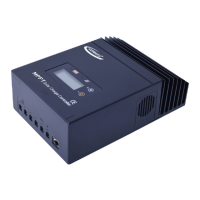
The MPPT-DC series solar charge controller with a built-in LED driver is designed for solar street light systems, offering advanced features for efficient power management and lighting control. This intelligent controller utilizes innovative Maximum Power Point Tracking (MPPT) technology to maximize energy harvest from solar panels, boasting a tracking efficiency greater than 99% and a conversion efficiency of up to 93% with full digital technology.
The primary function of this device is to manage the charging of a single lithium battery from a solar panel and to control an LED load with constant current output. It operates in a boost mode, ensuring that the LED driver can maintain a constant current even when the battery voltage fluctuates. The controller is programmable, allowing users to customize various operational parameters to suit specific lighting requirements.
One of its key features is the integrated LED driver, which provides a constant current output to the LED load. This ensures stable and consistent lighting performance. The device supports a five-stage time and dimming adjustment, enabling precise control over the lighting schedule and intensity throughout the night. This flexibility allows for energy savings and optimized lighting based on environmental conditions or specific needs.
The controller also includes several intelligent functions to enhance system reliability and battery longevity. It can automatically adjust the dimming level if the battery voltage drops below a set threshold, helping to prevent deep discharge and extend battery life. The day/night threshold can be automatically adjusted, ensuring accurate detection of dusk and dawn for reliable lighting activation and deactivation.
For enhanced safety and convenience during transportation, the controller features an auto-sleeping function. In transport mode, the load has no output, and power consumption is significantly reduced (by about 60%), preventing the lithium battery voltage from becoming too low. The system can be activated or deactivated from transport mode through specific button presses on a remote controller or by connecting the solar panel.
The MPPT-DC series controller is designed for ease of use and configuration, primarily through a remote unit with an LCD display. This remote unit allows users to read parameters, monitor running status, and configure settings without direct interaction with the controller itself.
The remote unit allows users to read various parameters and running statuses, including battery voltage, load current, load voltage, PV voltage, PV current, total generating capacity (AH), over-discharge times, and fully charge times. Historical data, such as the highest and lowest voltages for the past three days, is also accessible.
The controller incorporates comprehensive safety features to protect itself, the battery, and the solar panel:
The controller provides clear LED indications for various operational statuses and fault conditions.
The MPPT-DC series controller is designed for durability and minimal maintenance. It features an IP67 rating, indicating strong protection against dust and water ingress, making it suitable for outdoor installations. The robust aluminum case further contributes to its longevity.
While the device itself requires little maintenance, the manual emphasizes the importance of proper installation and adherence to safety guidelines to ensure long-term reliability. Users are advised to:
In case of faults or alarms, the LED indications provide immediate feedback. For more detailed diagnostics and troubleshooting, the S-Unit remote controller can be used to read specific fault information. The manual also provides a table of common faults, their reasons, and recommended remedies, such as checking battery capacity, switching off loads, or inspecting wiring and connections. It is crucial to address and remove any error conditions before continuing to connect the controller to prevent potential damage.
The controller's ability to automatically adjust day/night thresholds and dimming based on battery voltage helps to reduce the need for manual intervention and ensures optimal system performance over time. The low temperature charging protection further enhances battery life by preventing charging under conditions that could cause damage.
 General
| Input Voltage Range | 12V/24V/48V Auto |
|---|---|
| Series | MPPT-DC |
| Battery Type | Gel |
| Protection | Over Temperature |
| Communication | RS485 |
| Cooling | Fan |


 To Next Page