If the circuit breaker is tripped, reset it by
waiting for it to cool down 15 seconds
and then depressing the reset button.
WARNING: with this function, if you are
contacting a protected circuit, a vehicle's
fuse can be blown or tripped if you
apply ground to it.
Probe the suspected ground wire or contact with the probe tip. Observe the
green LED. Depress the power switch forward then release, if the green LED
went off and the red LED came on. This is not a true ground.
If the circuit breaker tripped, this circuit is likely a good ground. Keep in mind
that high current components such as starter motors will also trip the circuit
breaker.
In most cases, a short circuit will appear by a fuse or a fusible link blowing or an
electrical protection device tripping (i.e., a circuit breaker). This is the best
place to begin the search.
Checking for Bad Ground Contacts:
Following & Locating Short Circuits:
Red / Green Polarity LED:
Remove the blown fuse from the fuse box.
Use the probe tip to activate the energize each of the fuse contacts. The
contact which trips the circuit breaker is the shorted circuit. Take note of this
wire's identification code or color.
Follow the wire as far as you can along with the wiring harness.
The Red / Green polarity LED lights up when the probe tip voltage matches the
battery voltage within ±0.8 volts, It is added information that could be valuable
to the technician.
If the circuit you are testing is not within a 0.8 volts (plus or minus) of supply
voltage, you will see the voltage reading on the LCD but you will not hear a tone
or see a red or green LED. This tells you either you have a voltage drop in
excess of 0.8 volt from battery voltage or you are probing a circuit that has an
increase of a 0.8 volt or more over battery voltage.
To determine battery voltage, simply remove the tip from the circuit and press
the power switch forward, battery voltage will then be displayed on the LCD.
The difference between the battery voltage increase allows you to determine
a voltage drop without running back to check the battery. It's just another
time-saving feature the tool has.
If you are following a short in the brake light circuit, you may know that the wire
must pass through the wiring harness at the door sill. Locate the color-coded
wire in the harness and expose it.
Probe through the insulation with the probe tip, and depress the power switch
forward to activate and energize the wire.
If the circuit breaker tripped, you have verified the shorted wire. Cut the wire
and energize each end with the probe tip. The wire end which trips the circuit
breaker again is the shorted circuit and it will lead you to the shorted area.
Follow the wire in the shorted direction and repeat this process until the short
is located.
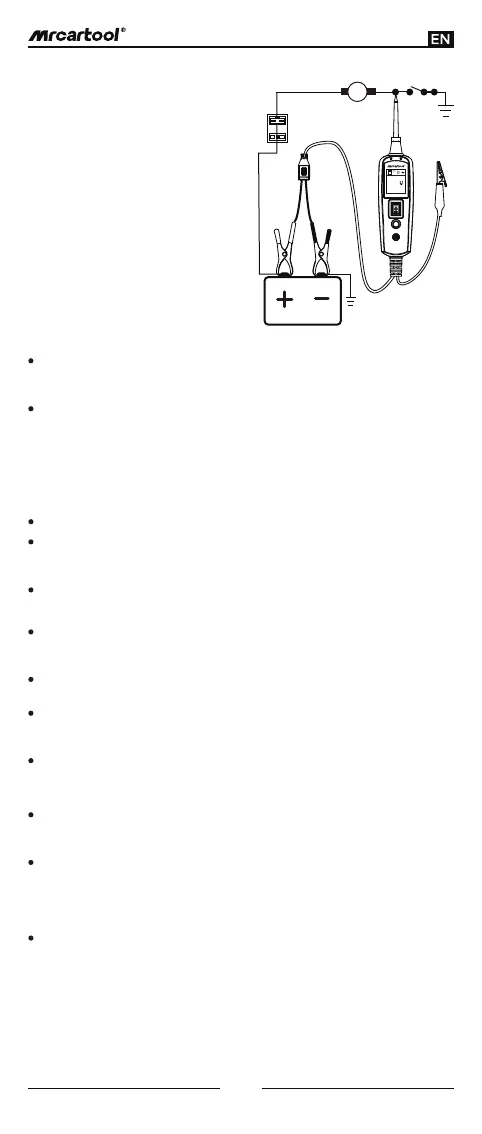
Here is an example for this application:
(Figure 13)
V V
12.0
7



 To Next Page