Positive Pressure Test (exhalation):
1. Cover valve with palm of hand (see Figure 5 ).
2. Slowly exhale.
3. The mask is tight if it slightly lifts off.
Negative Pressure Test (inhalation):
4. Cover both filter openings with palm of hands (see Figure 6 ).
5. Inhale and hold breath for approx. 10 s.
6. The mask is tight if no ambient air enters (facepiece should collapse slightly).
2.2 Filter Replacement
WARNING!
Only use undamaged filters of the same type and class. Always replace both filters at a time.
Failure to follow this warning can result in serious personal injury or death.
Bayonet Filters
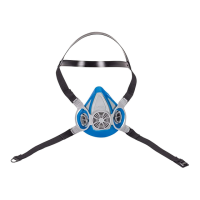
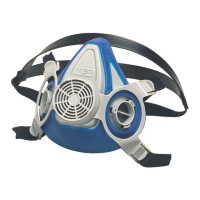
Remove used filters and align new filters with opening on face piece and turn clockwise until the stops are engaged
(see Figure 1 ).
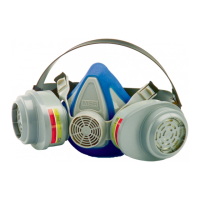
Use of 20 P2-filter: put particle filter in cover, align cover to gas filter and click on. To remove the filters proceed in
reverse order.
The maximum allowed weight of filters on a half mask is 300 g.
3 Filter Selection
Applicable National Regulations must be observed (BGR 190). For guidance the EN529:2005
(Recommendations for selection, use, care and maintenance) is available.
3.1 Gas and Combination Filters
Respiratory protective filters are classified according EN14387:2008 or EN14387:2021, EN 143:2007 or
EN143:2021, GOST 12.4.235-2013, DSTU EN 14387:2017, and marked with the filter type (code letter and code
colour) and filter class (code number) and standard. The filter type, filter class and referenced standard are marked
on each filter.
Filter type
Colour
Application
A brown Vapours from organic compounds with a boiling point higher than 65°C
B grey Inorganic gases and vapours, e.g. chlorine, hydrogen sulphide, hydrogen cyanide
E yellow Sulphur dioxide, hydrogen chloride, acid gases
K green Ammonia and derivatives of ammonia
P white Against particles of hazardous materials with a negligible vapour pressure
For the gas filters A, B, E and K, the filter class to be used depends on the possible maximum concentration of the
hazardous gas and the required service time.
The classification, which is determined by the minimum breakthrough time of gas filters or gas filter part of a
combination filter in laboratory tests under specified conditions, does not give any indication of the possible service
time in practical use. Depending on the conditions of use, possible service times can deviate positively or negatively
in both directions from the breakthrough times determined according to the present document. The classification of
a filter does not reflect actual usage performance in the workplace and does not relate to any established workplace
exposure limits.
3 Filter Selection
8 GB


 To Next Page