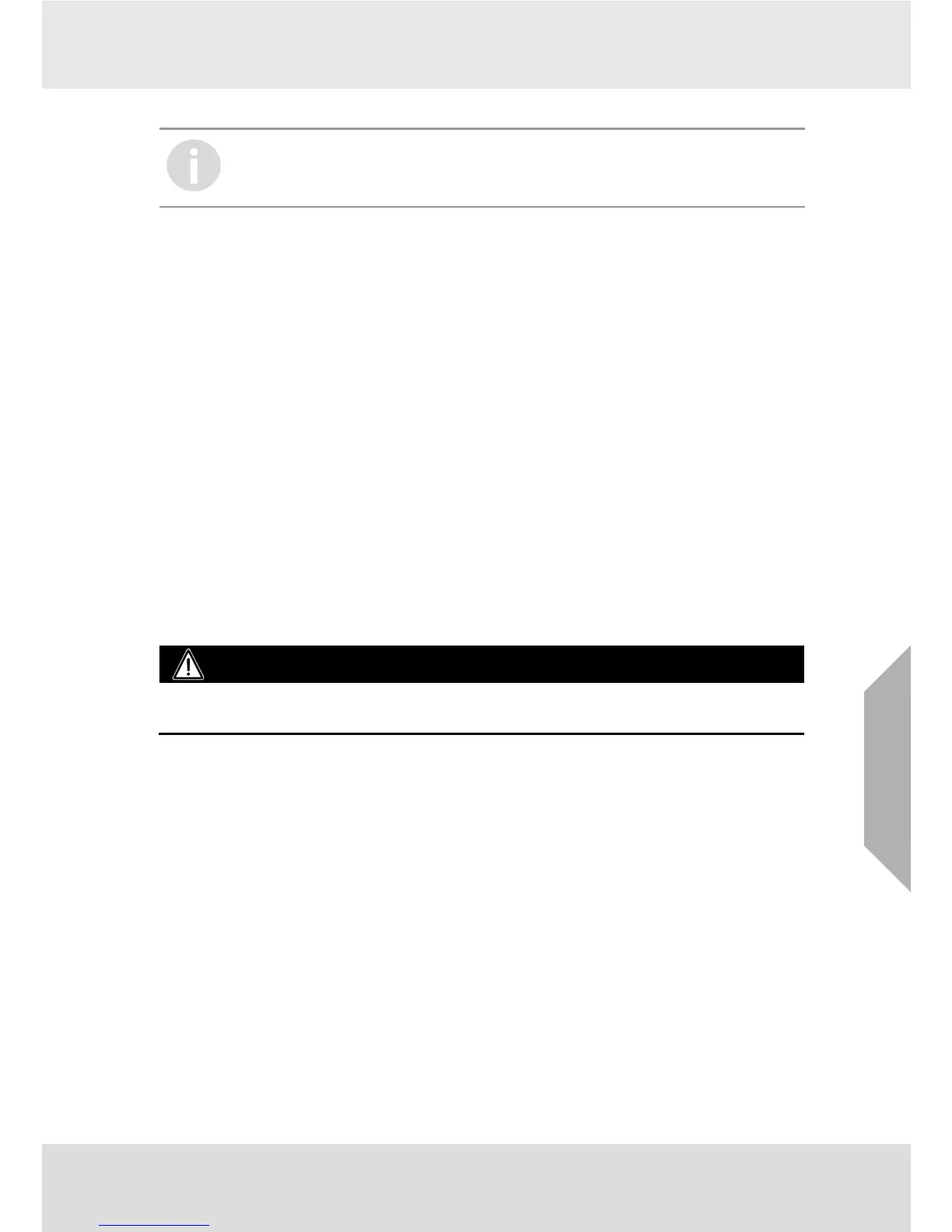
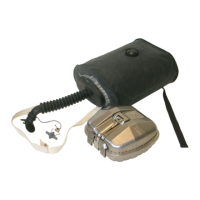
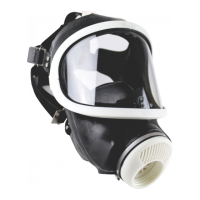
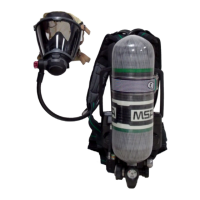
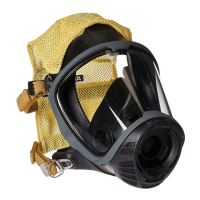
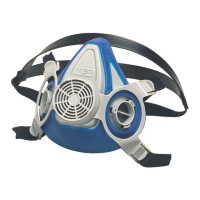
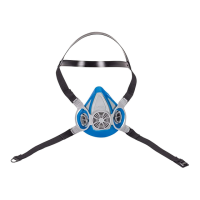
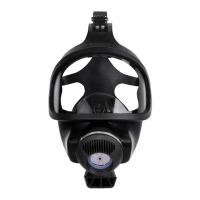
3S Full Face Mask – Positive Pressure
15
Safekeeping and Storage
GB
5.5 Tightness Test of the Mask
(1) Fit mask tight onto the test instrument.
(2) Generate a negative pressure of 10 mbar.
(3) Measure the pressure change after 1 min.
The mask including the exhalation valve meets the requirements if for a moistened exhala-
tion valve and a negative pressure generated inside the mask the pressure change does not
exceed 1 mbar in a minute.
Leaking masks must not be used.
Opening Pressure Test of the exhalation valve
The opening pressure of the exhalation valve has to be at least 4.2 mbar, otherwise the mask must not
be used.
5.6 Visual Test and Function Test
Visual Test
(1) Inspect the mask for possible damages like for example deformations, stickings or cracks. Valve
discs, especially exhalation valve discs, are crucial functional elements of the mask.
(2) Defective or damaged parts have to be replaced immediately.
Functional Test
After assembling the mask the mobile parts, especially the valve discs, have to be tested for unre-
stricted mobility.
6 Safekeeping and Storage
WARNING!
In order to avoid damage to or the deformation of the masks keep no additional loose objects in the
mask container.
For the safekeeping of the mask the mask container should be used. This also applies to masks with
installed filters, except CO and NO filters.
MSA rubber products are protected by an anti-aging agent that can become visible as a light coating.
This coating is harmless and can be removed during cleaning.
To ensure a long life for rubber components, keep them in a cool, dry place that is protected from ultra-
violet radiation, according to ISO 2230:2002, Rubber Products – Guidelines for Storage.
The testing of the masks for tightness is performed using an applicable MSA test device
in accordance with the relevant operating manual.


 To Next Page