82
83
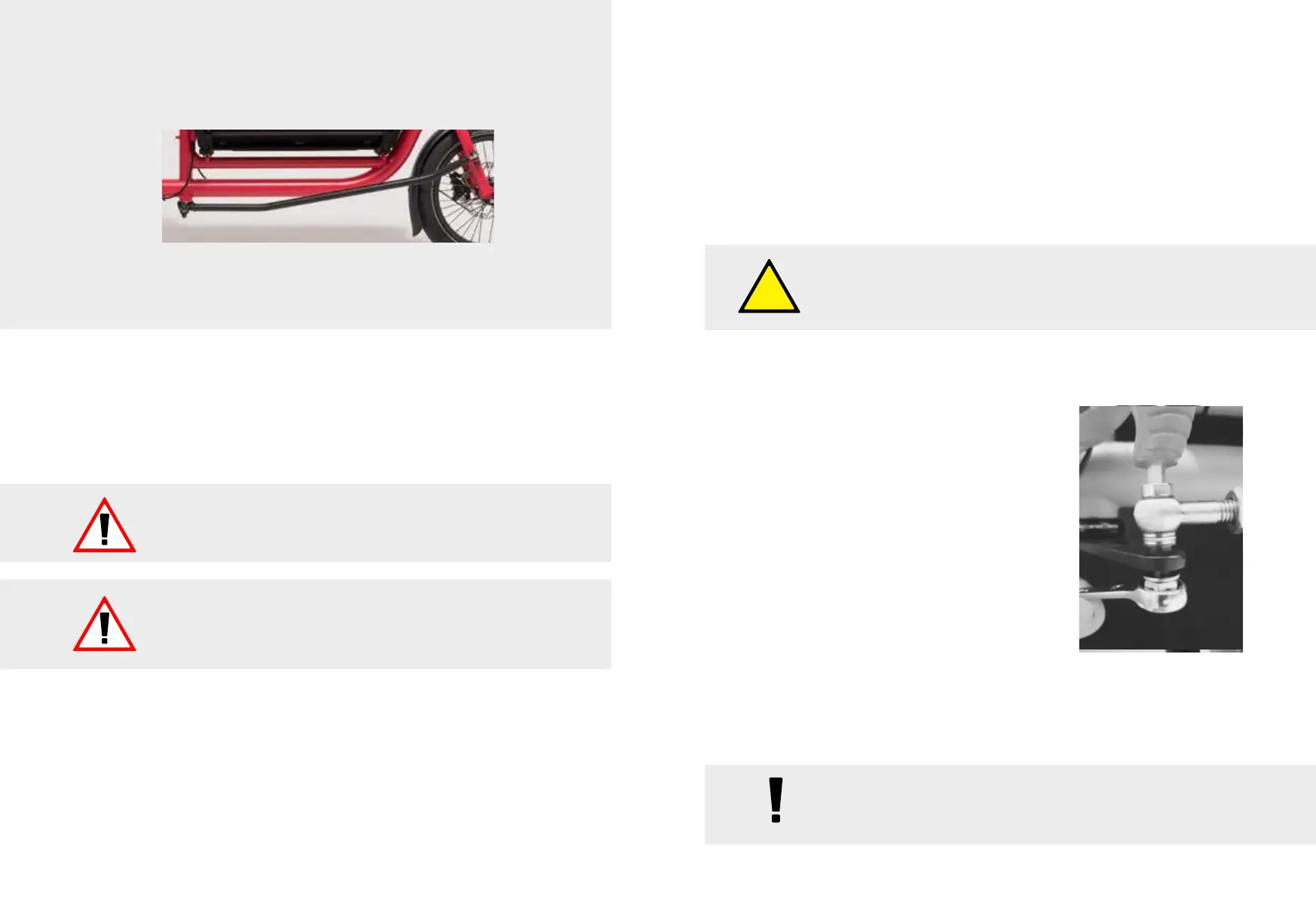
Since the front wheel of the e-muli, like all cargo bikes of the so-called Long
John style, is not directly under the handlebars but in front of the load surface,
the steering movement must be transferred from the handlebars to the front
wheel. The steering linkage translates the steering movement of the handlebar to
the front wheel. It is connected to the boom on the steering tube and the boom
on the fork vi ball joint and swivel joint.
Lane setting
The toe of the front wheel is also set vi the steering linkage. The lane is set
correctly at the factory. If the lane should become misaligned over time, rst try
correcting the lane setting by slightly adjusting the handlebars by loosening the
stem bolts and bringing the handlebars and front wheel back into alignment. The
handlebar bar must be in perpendicular position to the frame and the front
wheel in line with the frame.
However, such correction by adjusting the handlebar is only possible with
small toe adjustment, because the cantilever on the steering tube and the hand-
lebar bracket should be largely in line. In the case of large toe adjustment, it is
necessary to correct the toe directly at the steering linkage. To do this, the lock
nuts of the joints on the steering linkage must be loosened and the joint screws
screwed in or out accordingly. Note that the lock nuts are glued in place with
liquid threadlocker from the factory. So when you open and retighten the nuts,
apply appropriate threadlocker as well.
Note that the lock nuts on the steering linkage are glued in
place with liquid threadlocker from the factory. So when you
open and retighten the nuts, apply appropriate threadlocker
as well.
Steering resistance
The steering resistance can also be adjusted on
the steering linkage. To do this, loosen the screw
that attaches the linkage to the steering tube arm
slightly or tighten it accordingly.
If you prefer more sti steering, tighten the
screw little more. Keep in mind that strong
contact pressure also increases the wear of the
plastic plain bearings. If you prefer smoother
steering, tighten the screw less. Overall, however,
make sure that the screw is neither too tight nor
too loose. Too much contact pressure will jeo-
pardize safe steering in trac. On the one hand,
too loose an adjustment can cause the steering
linkage to rattle, swing open and make safe driving
impossible. On the other hand, too little contact pressure can cause the nut to
loosen completely while driving and the steering linkage to fall o, which can
result in serious falls.
Check the bolts and nuts on the steering linkage before
each ride. Loosening these connections while driving can
lead to serious falls and life-threatening injuries.
Attention! The steering linkage is highly safety-relevant
component. If the steering rod rattles or wobbles, do not
continue your ride.
The plastic plain bearings on the steering rod bolting wear
out and must be replaced when worn.
Steering linkage



 To Next Page