System Faults:
Flow Switch Opening: The flow switch is normally closed during pump operation. Should
liquid solution flow be interrupted for any reason, the flow switch will open shutting down
and locking out the chiller operation. The only exception to this is when power is first applied
to the chiller and the pump bypass timer bypasses the flow switch for 10 seconds.
When the system is first filled with liquid solution and the pump is started,
expect the system to cycle off as the flow is interrupted by air in the piping.
This will continue until all of the air is purged from the piping system.
Before the chiller will restart, the system will have to be reset by opening
and closing the disconnect switch (or circuit breaker) powering the chiller.
Low Pressure Switch Opening: Should the compressor suction pressure fall below 10 PSI, it
will open the low pressure switch and the compressor and condenser fan motors will shut
down. Check for a refrigerant leak, inoperative thermal expansion valve, low liquid solution
control setting, low ambient operation, or low liquid solution flow, etc…
High Pressure Switch Opening: Should the compressor discharge pressure go high enough
to open the high pressure switch, the compressor and condenser fan motors will shut down.
Check for a dirty condenser coil, inoperable fan motor(s), or the recirculation of condenser
air.
Refrigeration System Operation
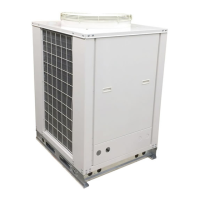
The refrigeration system is a closed loop system consisting of one compressors, single circuit,
brazed plate heat exchanger (evaporator), metering device (TXV's), and a condenser coil. The
refrigerant circulated is R407c. Hot gas is pumped from the compressors to the condenser coil
where condenser fan pulls air across the coil condensing and sub-cooling the hot gas into
liquid refrigerant. The liquid refrigerant flows through the liquid lines to the thermostatic
expansion valve (TXV) where the refrigerant pressure drops causing the refrigerant to boil at
a much lower temperature (34°- 40°F). The refrigerant leaves the expansion valves and swirls
through the plates of the brazed plate heat exchanger absorbing heat from the circulating
liquid solution.
The evaporating heat exchanger is designed to operate with a 10°- 20°F superheat. The
condenser is designed to condense the refrigerant and sub-cool it to 10°F below condensing
temperature.
Page 10 of 28



 To Next Page