If the supply voltage fluctuates significantly and a fixed start time
is
not
required
this feature
is
useful.
Note
that
the
motor
inrush current must
be
approximately
6
times full load when using this' compensation; otherwise set the start timer
as
follows:
Actual
Start
Timer
=
(Norma!
Start)
x
(Actual
start
current
multiples
of
full
!oad)2
Setting
(Time
I I 6 I'
Example-Normal
start
time-20
seconds.
Full
voltage
actual
inrush
current-4.5
times
full
load.
Sel
start
timer
to=
[20)
(4.5)'
_
11
3
c ,
- - .
se
onus.
I 6 I'
Switch
68-
Feeder Protection
The relay can be used
to
protect loads
other
than rotating machinery by turning
this switch on which defeats the start timer. In this case, the run curve selected
is
always active and the relay behaves
as
an inverse/time overload device with the
following features:
(i) 3 phase overcurrent
protection-
The
time/overload
characteristic
of
the
relay is matched to the
device
being protected by suitable adjustment of the
maximum load control and selection
of
the appropriate
runcurve(Section
3.8}.
Iii) Rapid trip at high
currents-Using
the
mechanical jam levels (Section 3.9)
or
short circuit
an
immediate
cutout
at high fault currents can be obtained.
(iii) Phase Unbalance
Protection-the
desired level
of
phase unbalance that
is
acceptable can be selected
by
the
unbalance control.
(iv) Ground Fault
Protection-Ground
faults between the protected
device
and
ground can be detected to obtain first
an
alarm and then a shutdown. Fault
current level and time delay to trip are adjustable.
These features make the relay particularly useful for protection
of
transformers,
feeder cables in portable substations and arc furnace electrodes. Normally the
memory will
be
defeated (Switch
65
on) when operating in this mode
to
prevent
a lockout
or
nuisance trip from repeated short overloads.
3.11
GROUND FAULT (EARTH LEAKAGE)
An insulation breakdown in the
motor
windings can provide a
current
path
between the
motor
casing (ground) and the high voltage supply. When this
occurs, not
only
is
it desirable to shut
the
motor
down
before severe structural
damage occurs but also the
motor
casing may
be
above ground potential, thus
presenting a safety hazard
to
personnel.
A separate current
transformer
which
encircles
all
the
motor
conductors
is
also
required
to
provide
the
sensing
signal. Ground fault
detection
is
only
suitable
for
systems
that
have a path
from
the
supply
neutral
to
ground
either
through
a resistance
or
by
direct
connection.
The current
transformer
ratio,
required
for
ground
fault
detection
on
the
139
is
2000:
1.
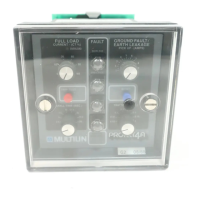
By
means
of
an internally mounted selector switch the relay can
be
set
to
trip for
ground fault currents
of
0.5,
1,
4,
8,
12
amps with instantaneous trip, 100 milli-
second delay
or
two second delay. On sol idly grounded systems the instantaneous
trip should
be
used. The 100 millisecond delay
is
provided for applications
where
the relay has
to
be
co-ordinated with
other
protective devices
or
a short delay is
desired because of transients. The
two
second time delay is provided for use on
high resistance grounded systems
where
nuisance tripping may be a problem.
25
Courtesy of NationalSwitchgear.com



 To Next Page