3.13
THERMAL
CAPACITY
In
processes where the
motor
loads are varied and operated
at
near the
motor
full load such as in grinding
or
in
conveyor systems it is useful
to
know how
close the relay is
to
tripping so the load may
be
adjusted accordingly. When
the thermal capacity option is ordered with the relay a remote meter,
calibrated from 0-100%
of
motor
capacity used, is available
to
be
situated
near the operator and connected to the relay. The meter indicates how much
the memory has charged corresponding
to
heat buildup in the motor. When
the relay is about
to
trip, the meter
will
approach 100% capacity used. After a
trip, the meter will indicate how much charge is left in the memory
to
give a
rough idea
of
the lockout
time
remaining.
3.14 4-20mA FULL LOAD OUTPUT
If
the relay
is
to
be
used
in
conjunction with programmable controllers, automated
equipment, or a chart recorder, this option can be ordered_ A
4-20mA
current
corresponding to
0-100<;to
of the motor full load current
as
set on the maximum
load control
is
output. Thus a computer can be used to automatically shed loads
as
the motor current increases
or
a chart recorder
can
be
used
to
plot the loading
of
a
motor
in
a
particular
process.
Other output ranges of motor full load current can be obtained
on
special fac-
tory order.
3.15 FAULT
DIAGNOSIS
A valuable feature of the relay
1s
its ability to record the fault condition which
caused
the motor
to
be
shut
down
for
later
analysis.
All
the conditions present
at
the moment of tripping except for undercurrent continue
to
be displayed
on
the
front panel indicators until the relay
is
reset.
The
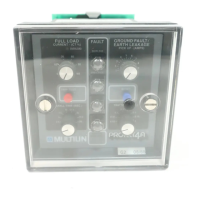
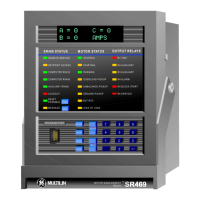
Multilin Fault Finder shown
in
Figure
3-5
allows the user
to
determine the likely cause of trouble by examining
the relay display.
3.16
CONTROL
POWER
Control power should always
be
applied
to
the relay before the
motor
is
started. Even if control
power
is
removed
the
memory will remain active dis-
charging at a rate proportional
to
an
idle motor. If control power is removed
from a relay in the lockout condition, it will remain locked out after power is
reapplied unless sufficient time has elapsed. Whenever control power is
re-
moved and reapplied, the condition causing the trip will not come on. If con-
trol power
is
removed when
in
an untripped state, it
is
not necessary to press
the reset button in order to restart the motor, when control power is reapplied.
Relays are normally supplied with fail safe contacts
so
that the output reverts to a
trip condition when control power
is
lost. It
is
possible to obtain the relay on
special order with a contact configuration which allows motor starting if control
power
is
lost.
28
Courtesy of NationalSwitchgear.com



 To Next Page