© 1999, 2000 MurataCorporation 1 01/11/00
1. INTRODUCTION
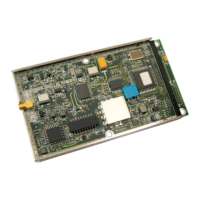
The WIT2420 radio transceiver provides reliable wireless connectivity for either
point-to-point or multipoint applications. Frequency hopping spread spectrum technology
ensures maximum resistance to noise and multipath fading and robustness in the presence of
interfering signals, while operation in the 2.4GHz ISM band allows license-free use and
worldwide compliance. A simple serial interface supports asynchronous data up to 230400
bps. An on-board 3 KB buffer and an error-correcting over-the-air protocol provide smooth
data flow and simplify the task of integration with existing applications.
- Multipath fading impervious
frequency hopping technology
with 75 frequency channels
(2401-2475 MHz).
- Supports point-to-point or
multipoint applications.
- Meets FCC rules 15.247 and ETS
300.328 for worldwide license-
free operation.
- Superior range to 802.11 wireless
LAN devices.
- Transparent ARQ protocol
w/3KB buffer ensures data
integrity.
- Digital addressing supports up to
64 networks, with 62 remotes per
network.
- Low power 3.3v CMOS signals
- Simple serial interface handles both
data and control at up to 230400
bps.
- Fast acquisition typically locks to
hopping pattern in 2 seconds or less.
- Selectable 10 mW or 100 mW
transmit power.
- Support for diversity antenna.
- Built-in data scrambling reduces
possibility of eavesdropping.
- Nonvolatile memory stores
configuration when powered off.
- Smart power management features
for low current consumption.
- Dynamic TDMA slot assignment
that maximizes throughput.
1.1 Why Spread Spectrum?
The radio transmission channel is very hostile, corrupted by noise, path loss and
interfering transmissions from other radios. Even in a pure interference-free
environment, radio performance faces serious degradation through a phenomenon
known as multipath fading. Multipath fading results when two or more reflected rays of
the transmitted signal arrive at the receiving antenna with opposing phase, thereby
partially or completely canceling the desired signal. This is a problem particularly
prevalent in indoor installations. In the frequency domain, a multipath fade can be
described as a frequency-selective notch that shifts in location and intensity over time as
reflections change due to motion of the radio or objects within its range. At any given
time, multipath fades will typically occupy 1% - 2% of the 2.4 GHz band. This means
that from a probabilistic viewpoint, a conventional radio system faces a 1% - 2% chance
of signal impairment at any given time due to multipath.


 To Next Page